Monday, June 24, 2013

Woodland Nymph Teasing Butterfly, circa 1910s


The "Naturist" movement was pervasive during the late 19th and early 20th centuries and, like the common appearance of classical/fantasy romantic imagery on the picture postcard of the time, suggests to us, a turning away of the public imagination from the onslaught of the industrial age, to say nothing of the dark clouds of war, which were gathering over Europe at just about the time we believe this card was published. 

If the term photo-realism is commonly used to describe a particular quality of some paintings, how about we coin the term painterly-fantasticallism for application to this photographic image?

AVAILABLE FOR PURCHASE Woodland Nymph Teasing Butterfly, Circa 1910s

This wonderful German nude was published by die Neue Photographische Gesellschaft, or NPG. Based in Berlin, NPG was one of the largest international producers of the picture postcard during that period. 

Reverse of Card

Clear Example of NBC Logo
Point of interest: In the "stamp box" on the back side of this card is the somewhat faded logo of the "NBC," Neue Bromsilber Convention, or the "New Silver-bromide Convention." Whenever this logo is found on a card, we can date its production to sometime after August of 1909, when the NBC was initially convened.

The NBC was, for lack of a better term, a cartel (one of many, actually), established by a large number of German publishers of silver-bromide print photo postcards, whose intent was to control prices and maintain a competitive edge. This might be called "price fixing" today, and perhaps a blatant violation of today's trade laws, but was quite common during this period. An indication of the strength of this cartel within the industry is the great frequency with which we run into cards bearing this imprint.
 

Also, just for fun, it's worth noting the design of the logo itself, a blazing sun within an equilateral triangle, which was printed in a variety of colors. Like the classic eye in the triangle, this symbol is often closely associated with occult, or "secret" societies. Ah, nothing like a little conspiracy with our morning coffee. :)

In dating this card, our guess is sometime in the early 1910s. The NBC, as we wrote above, dates from 1909, and apparently was still in operation by the early 1930s, so we can only rely on our own personal experience to fix an approximate date of issue. As always, any corrections we receive from readers are not just appreciated, but sincerely requested! We often draw our information from a huge swirling mass of sources called by our sons, "teh interwebs." These sources often offer us contradictory information so any help in the navigation of these storm-tossed depths is always most welcome. 


The absolutely wonderful site from which we drew all of our information on the NBC cartel, The Postcard Album, also lists an NPG logo for the publisher. The NPG logo they display is 
from the 1920s and very similar to the one on this card, but the NPG logo on the front of our card differs in certain respects, and without specific evidence to the contrary we have to trust our eyes. This image looks pre-1920s to us.

Friday, June 21, 2013

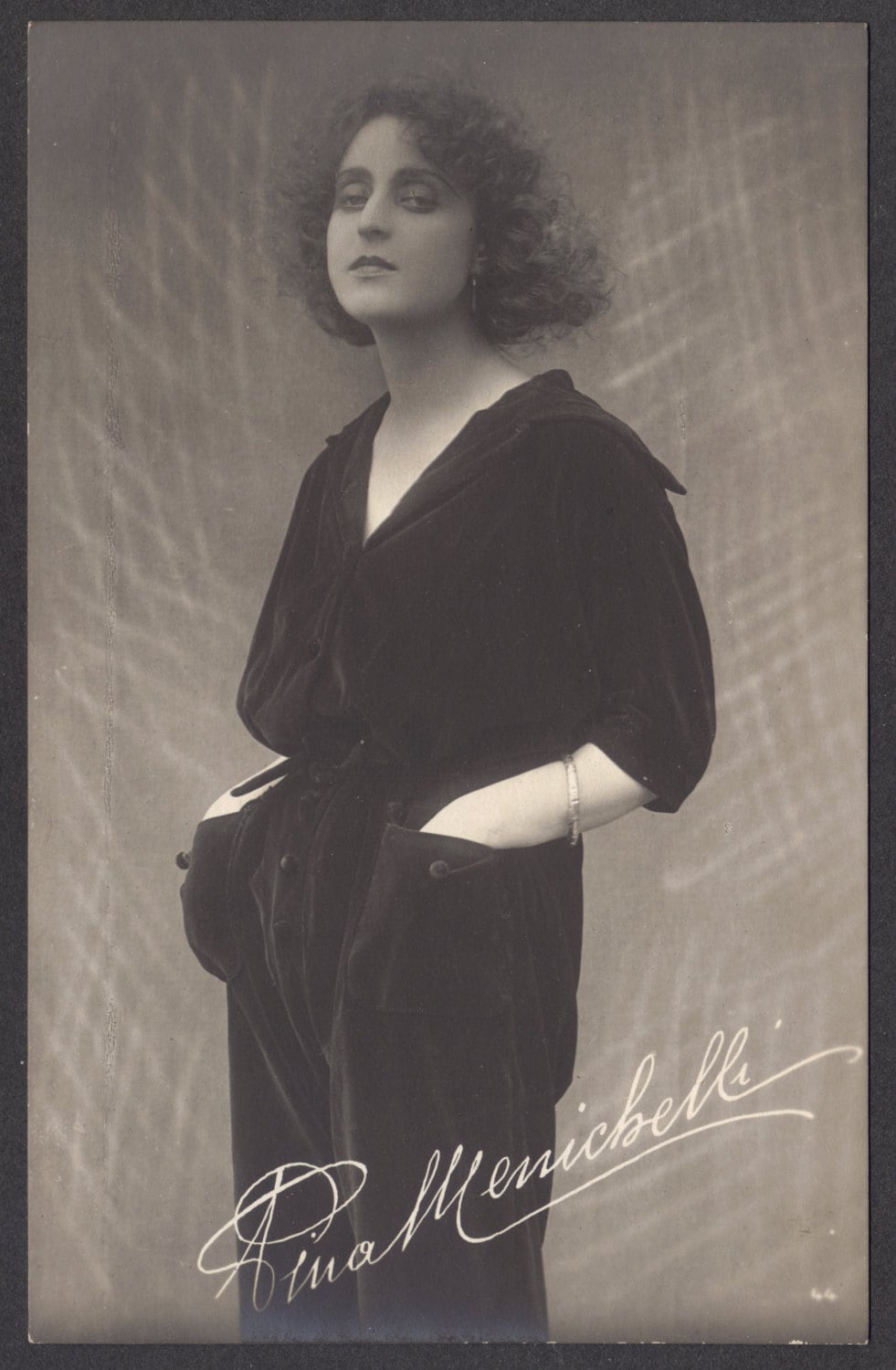
Italian Silent Film Diva, Pina Menichelli, in Velvet Jumpsuit

AVAILABLE FOR PURCHASE Italian Silent Film Diva, Pina Menichelli, in Velvet Jumpsuit


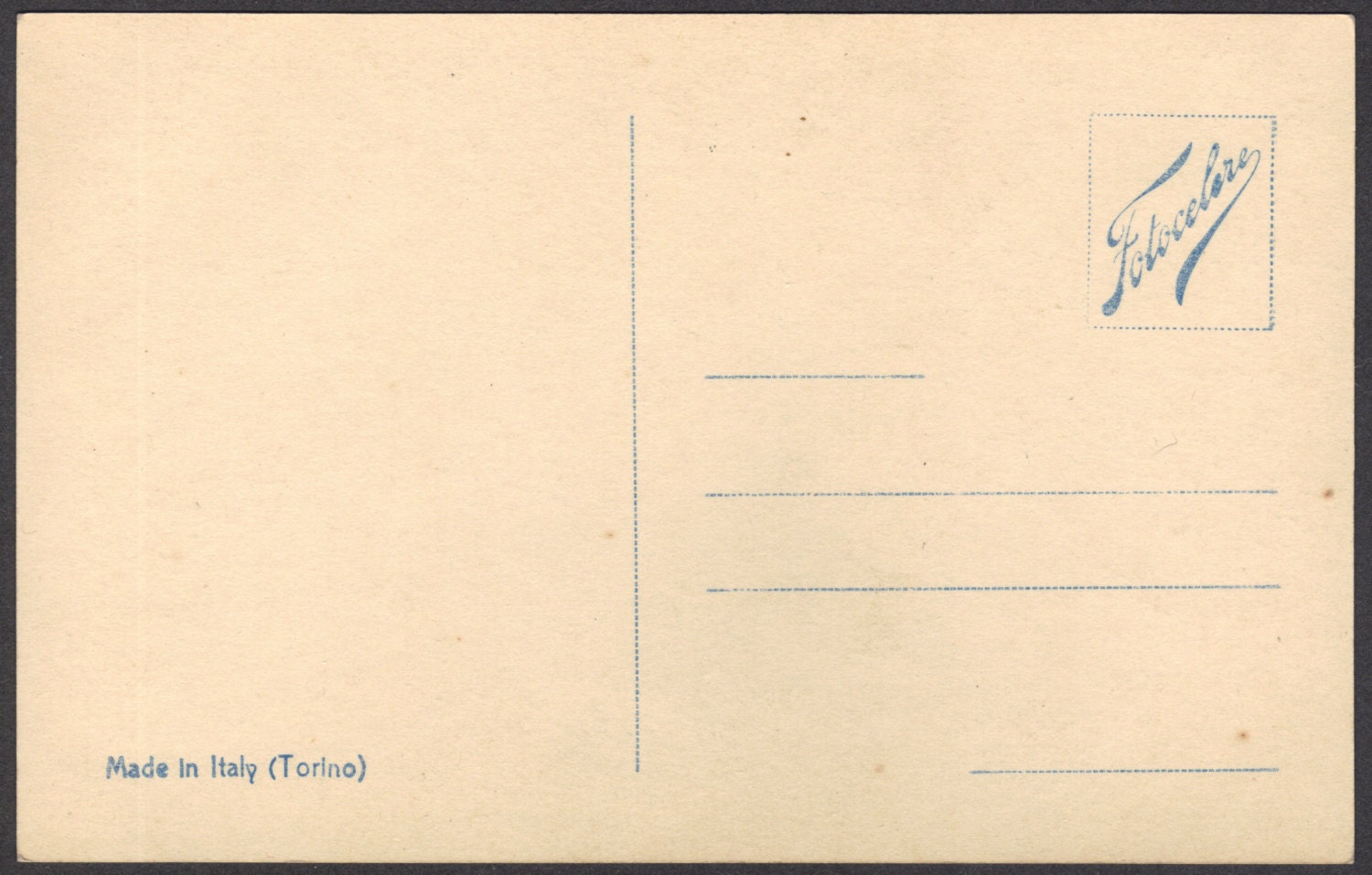
Reverse of postcard


One of the most beautifully expressive faces of the Italian cinema, Pina Menichelli, radiates dramatic presence even in this casual attire. We are particularly fond of one series of images (of which this is one), which used what appears, at first, to be a very casual crosshatching design as a frame, but the sweep of these markings, up and out from the center, creates an instantaneous feeling of depth, and also draws us into the center, where Signorina Menichelli, in highly contrasting dark and light tones, becomes our only focus with no exterior distraction (our eyes having dismissed the crosshatching). 

Do we over-think this stuff? Probably :) But we really do find the artistic construction of these simple portraits exciting and moving. In short, we love what these photographers, working with these amazing models, were able to achieve!

We also love being able to show you cards in this almost pristine condition, as if you had just stepped off a train in Milan, in 1921, and while waiting for your aunt, who was to meet you at the station but is late in arriving, you stop at a kiosk which sells newspapers, magazines and postcards. This particular image catches your eye, because only last month you so enjoyed Pina in one of her films, wearing this oh-so-modern outfit. As you remember sitting in the dark cinema with your sweetheart, the sights and sounds of the busy railway station disappear...

Now, for a real treat, follow the link below to this YouTube video, so that you can better remember that wonderful experience! We recommend a bowl of fresh popcorn and a SanPellegrino Limonata sweetened with two tablespoons of sugar. Ah, Perfetto!


Traveling through time and space is what we we are all about here at Red Poulaine. Please think of us as your own personal Tardis. :)

Mlle. Nostier in Swan-Bill Corset by Leopold Reutlinger, circa 1905

This lovely postcard, with a message in the ubiquitous violet ink of the period, and presumably posted to Moscow in 1907 (stamp missing), offers an image of a Mlle. Nostier (the only image of her we have ever seen), that was taken by Leopold Reutlinger and published by Monsieur G. Piprot of Paris. This image was also reproduced at about the same time on a Melia cigarette card.


AVAILABLE FOR PURCHASE French Actress Mlle. Nostier, in Swan-Bill Corset and Mutton Chop Sleeves, circa 1905


At the turn of 20th century, it was a common practice to use ink of that most romantic of colors, violet, when writing letters or postcard messages, especially when writing to a lover. This postcard has such a message, written in a particularly lovely hand. The message appears to have been inscribed by a Russian, Dimitri, in French, a language used commonly by the Russian aristocracy, but less commonly by Russian postal carriers, to his sweetheart back in Moscow.

Reverse of Mlle. Nostier in Swan-Bill Corset, circa 1905 postcard by Leopole Reutlinger


In the image on the front of the postcard, Mlle. Nostier is presenting a rather fine example of a "Gibson Girl," with her lovely upswept hair, mutton chop sleeves and the narrow waist and S-curve posture created by the "swan-bill" corset which was often worn to achieve the classic "Gibson" look.
 

The Gibson Girl image was so called after the extremely popular, and influential, illustrations produced during the late 19th/early 20th century by American artist Charles Dana Gibson, and used with great effect by other popular illustrators such as Howard Chandler Christy, and Harrison Fisher. The look remained popular into the WWI era, when it was gradually displaced by the new styles popularized by the "flapper." Quite a radical shift, we think, but of course ours is an over simplification of that transition.
 

Following, is a quote from Wikipedia's article History of Corsets, describing the swan bill or straight-front corset. Thanks Wikipedia!
The straight-front corset, also known as the swan-bill corset, the S-bend corset or the health corset, was worn from circa 1900 to the early 1910s. Its name is derived from the very rigid, straight busk inserted in the center front of the corset. This corset forced the torso forward and made the hips jut out in back.
The straight-front corset was popularized by Inez Gaches-Sarraute, a corsetiere with a degree in medicine. It was intended to be less injurious to wearers' health than other corsets in that it exerted less pressure on the stomach area. However, any benefits to the stomach were more than counterbalanced by injury caused to the back due to the unnatural posture that it forced upon its wearer. At this time, the bust lowered and corsets provided much less support for the breasts.

So, given that this card was posted in 1907, and the swan-bill corset went out of fashion only a few years later, we thought that we might "stretch" things just a bit and say that this was its...

Swan Song! :)

Thursday, June 20, 2013

Cléo de Mérode Giveaway to Celebrate Our 1,000th Sale!

Red Poulaine has been in business for so short a time, that it really took us by surprise when we realized that we will soon be selling our 1,000th item! We thank all of you very much for being our wonderful customers, and to celebrate this event, we plan to include a very special card, one that we hope any of our customers would be very happy to add to their collections, in the order that includes our 1,000th sale as a special thank you.

So, with the clock ticking and the calendar pages flying, we conducted a search far and wide for just the right card, one with a very beautiful image and an enticing history, to grace the collection of one very special customer. And we found it!

NOT FOR SALE Exquisite Cleo De Merode Giveaway Card, circa 1900
This beautiful image of Cléo de Mérode will belong to the customer who makes the 1,000th purchase from our shop. 

Cléo de Mérode (September 27th , 1875-October 17th, 1966) is possibly the most well-known dancer of La Belle Époque. Certainly she was the postcard queen of the era, and took great care with the images of her, making careful use of the medium to help promote her public recognition. Her postcard images are some of the most sought after and often the most expensive of all the "artistes."

The daughter of the Austrian-born nobleman and landscape painter Karl von Mérode, and given the exotic name Cléopâtre Diane de Mérode at birth (although her mother called her Lulu), she started taking dance lessons when only 7- or 8-years-old and made her stage debut at the tender age of 11. As Cléo de Mérode, she went on to become an international star, known for her tiny waist, grace, and exquisite beauty. As one of the most glamorous of the stars of that time, she was sought after by many artists and photographers. Henri de Toulouse-Lautrec, Charles Puyo, Alfredo Muller, Giovanni Boldini, and Gustav Klimt painted her, Alexandre Falguière sculpted her, and photographers such as Léopold Émile Reutlinger, who took the image above, Félix Nadar, Henri Manuel, Charles Ogerau, and others vied to immortalize her image. There was even a wax effigy made of her in 1895 by sculptor Leopold Bernstamm, which was displayed in the Grevin Museum. 

Early in her career, in 1896, when Cléo was just 22, King Léopold II of Belgium became entranced by her performance in a ballet. Léopold, then 61 years of age, already had two children by a woman rumored to be a prostitute and his pursuit of Cléo was enough to damage her reputation. Cléo, and her mother, who traveled with her, rejected the allegations. In an October 5th, 1897 interview with the New York Times, her mother, Mme. Mérode, insisted that although Cléo had been required to meet with the king, she did so only with her mother's chaperonage. Cléo herself said, "It Is horrible - horrible - that they should so pursue me with such monstrous lies! The King of the Belgians is no more to me than any other great man who has admired me on the stage, whom I have seen for a few moments off the stage very rarely, and always in the presence of many other persons."

Cléo may have been chaste, but she knew the worth of her beauty and charm as she rose to international stardom. A month prior to the Times interview, she was interviewed for a September 24th piece in the Delphos, Ohio Daily Herald. The interviewer enthused about her charms before sharing her comments:
For some months New York has been anticipating the arrival of Cleo de Merode, the Parisian dancer, the fame of whose wonderful beauty is now worldwide. And not only New York, but the whole country has felt more than common interest in the arrival on these shores of this odd young woman who has done nothing but dance and yet has turned the heads of monarchs, and at whose feet have been showered jewels and gifts that in the aggregate are worth an immense fortune.
 Now that she has come to America, the interest in her attractive personality amounts to a continuous furore. Indeed Cleo de Merode is charming. Lithe and elegant, in an ecru gown embroidered in openwork over white silk, beautiful enough to dispense with wit, she replied to a thousand questions asked her by her many admirers as naturally as if she were witty enough to dispense with beauty. Her hazel eyes reflected a world. Her delicate features, animated by the excitement of her arrival, harmonized admirably with her rich, silky hair, dark with tints of red, and dressed in two wavy bands over her ears. Her black eyebrows commanded. Her smile was sweet, and what a spectacle it was when she lowered her eyelids and let one admire in their length her immeasurable brown lashes!
"I dance the ancient dances," she said, "the Louis XIII, the Louis XV, the gavot, the pavan, the minuet, and I led at Royan Louis Ganne's ballet of 'Phryne.' I am gowned by a real dressmaker. I know music very well, and play the piano as little as possible. I know how to arrange a basket of fruit, place flowers in a jardiniere and touch a book without spoiling it. I have read the poets and the historians, and I do not write. I wear stockings that are as fine as a woven mist. What other accomplishments shall I speak of?"

Although she pretended to make little of her famed beauty, saying she had, "a style of face conventional enough to have pleased a great number of people," Cléo de Mérode made effective use of it, comparing herself to the subject of da Vinci's Mona Lisa (Jaconda). Clearly, as a consummate performer, she knew that her audience required a level of audacity that few women of the time expressed.

Figures 14, 15 of La Belle - Jaconda, by Leonardo da Vinci for Hohenstatt  Analysis
Do you see the resemblance? It is most pronounced in figure 14, but we think Cléo's beauty was even greater than that of da Vinci's model.

Although Cléo was an elite ballerina dancing in a time when there was a firm separation between those who danced on the ballet stage and those who danced in the less respectable Parisian dance halls, in 1901, while at the peak of her career, Cléo, in a brilliant career move, performed at the Folies Bergère. This was a bold move for a ballerina with a serious career, yet her performance was such that she gained an even greater following. It was through such brilliant publicity moves, along with her ability as a dancer, that Cléo was able to maintain her position as one of Paris' most successful dancers, stretching her career into her 50s before finally retiring from the stage.

Despite her statement in 1897 that she did not write, Cléo would, in 1955, publish her autobiography, Le Ballet de ma vie (The Dance of My Life). When she died in 1966 at the age of 96, Cléo de Mérode was interred in the Père Lachaise Cemetery in Paris alongside her mother. A statue of her, depicting her in mourning for her mother, now decorates the headstone the two woman share.

Sources:
"Cleo de Merode (1875-1966)," Stage Beauty, http://www.stagebeauty.net/th-frames.html?http&&&www.stagebeauty.net/demerode/demerode-c.html (accessed June 20, 2013).
"Cleo de Merode (1875-1966): In Press and Literature," Stage Beauty, http://www.stagebeauty.net/th-frames.html?http&&&www.stagebeauty.net/demerode/demerode-c3.html (accessed June 20, 2013).
Dash, "Cleo de Merode," French Sampler, http://thefrenchsampler.blogspot.com/2011/04/cleo-de-morode.html (accessed June 20, 2013).
Red List contributors, "Cléo de Mérode," Muses, The Red List, http://theredlist.fr/wiki-2-24-525-770-925-view-1900s-1-profile-cleo-de-merode.html (accessed June 20, 2013).
Wikipedia [France] contributors, "Cleo de Merode," Wikipedia, the free encyclopedia http://fr.wikipedia.org/w/index.php?title=Cl% C3% A9o_de_M% C3% A9rode & oldid = 93532911 (Accessed June 20, 2013).
Wikipedia [France] contributors, "Musee Grevin," Wikipedia, the free encyclopedia http://fr.wikipedia.org/w/index.php?title=Mus% C3% A9e_Gr% C3% A9vin & oldid = 93716003 (accessed June 20, 2013).
Wikipedia [USA] contributors, "Cléo de Mérode," Wikipedia, The Free Encyclopedia, http://en.wikipedia.org/w/index.php?title=Cl%C3%A9o_de_M%C3%A9rode&oldid=540349043 (accessed June 20, 2013).

Saturday, June 15, 2013

Images of the Fantastic in La Belle Époque

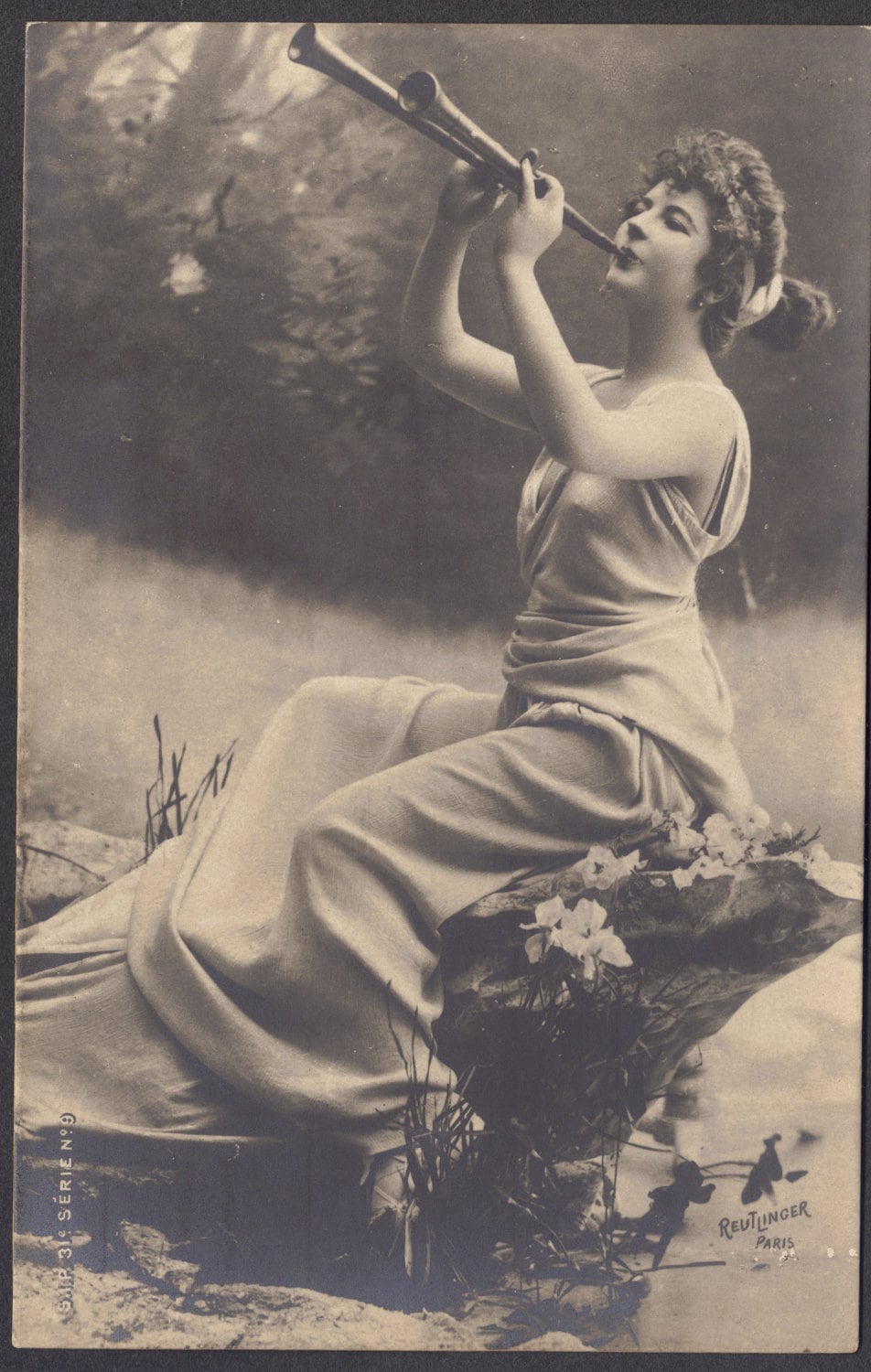
One aspect of La Belle Époque, not just in France either, was a very palpable embrace of antiquity, and though often in a rather naive fashion by today's standards, one gets the sense that people were turning away from the onslaught of the industrial explosion and towards the real, and imagined, simplicity of earlier times. With this came a sense of the possibility of magic, and the ubiquity of images like this one, in which we wouldn't be terribly surprised to see faeries or woodland sprites cavorting about.

SOLD Wood Nymph at the Well
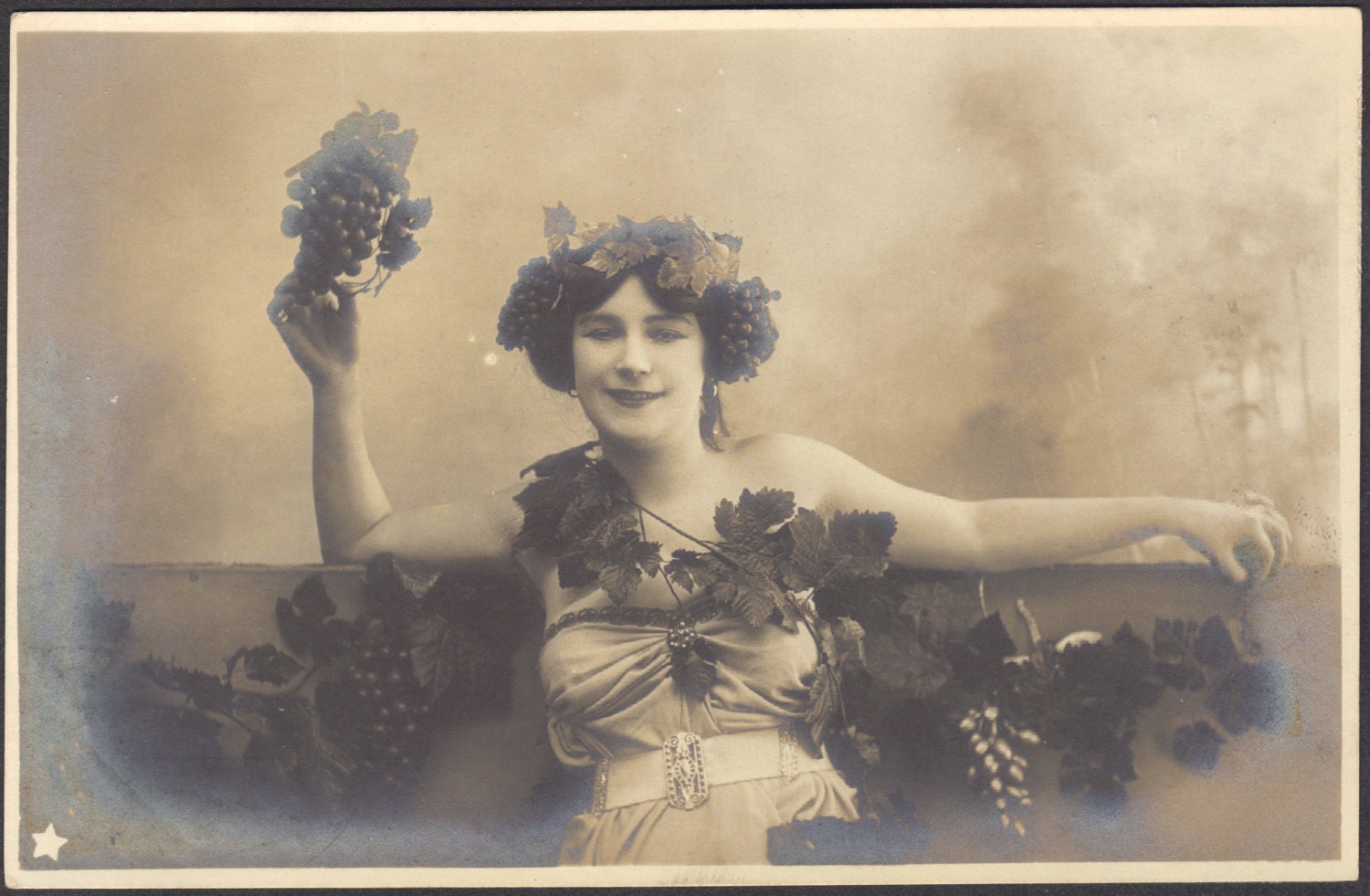
Or, perhaps we expect at any moment to see a faun, satyr, or even Bacchus, himself!

SOLD Nymph Calling Forth the Woodland Sprites circa 1905

We love the way in which the magical is suggested in these images, without the introduction of a single truly fantastic element. These images make us feel much as we might when reading a fairy tale, that at any moment something truly marvelous will happen.

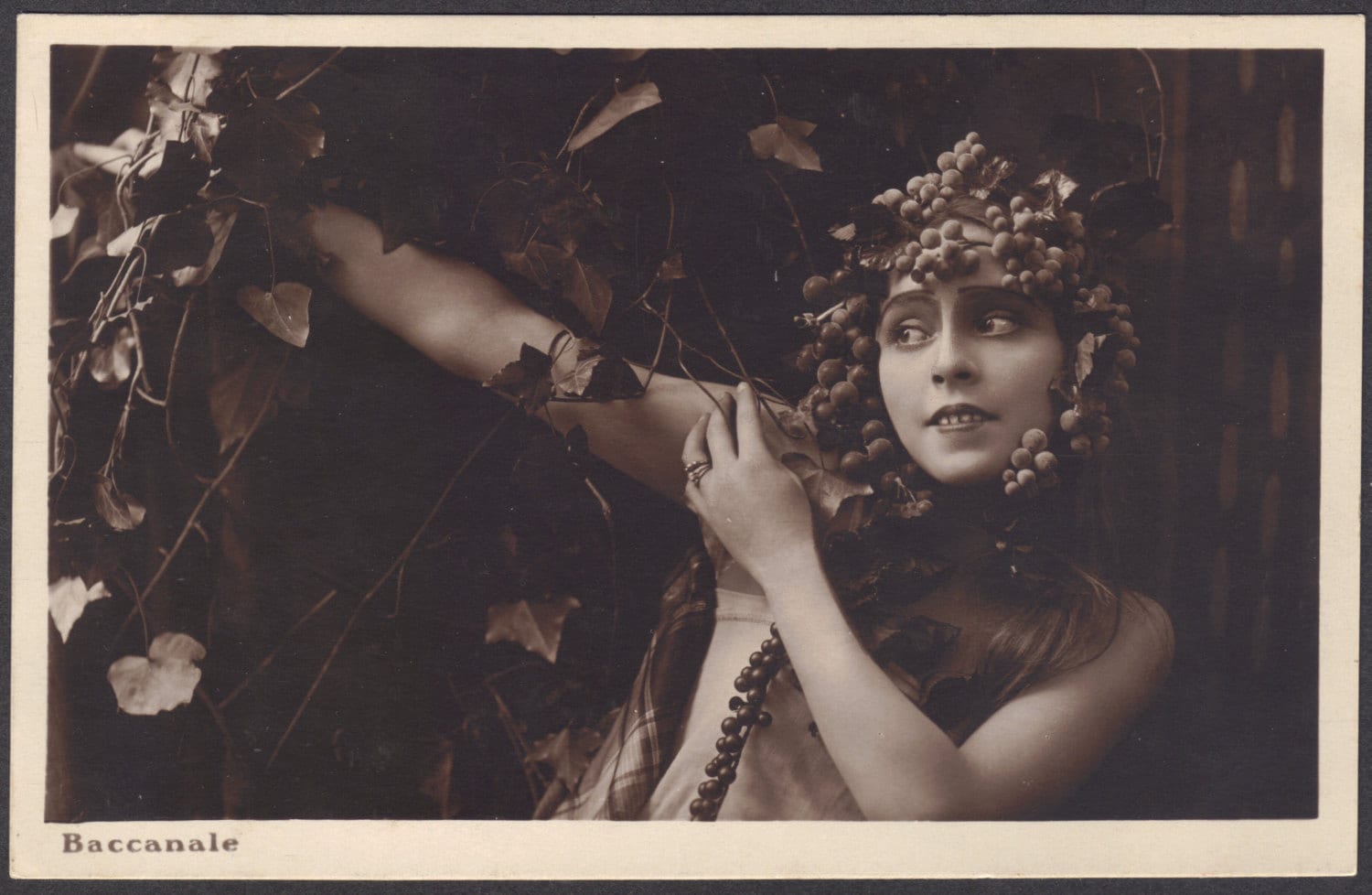
Nymphs, Naiads, Dryads, and Faerie folk so often cropped up in La Belle Époque. Found throughout the period from popular entertainment to commercial advertising, these images reflected a blossoming of Western occult experimentation and a yearning for magic, for myth made manifest. We've written before of our fondness for images depicting the Marvelous Maenad, which is not only a subgenre of the "Lovely Lady" category, but of fantasy postcards, as well.

AVAILABLE FOR PURCHASE Maenad at the Garden Wall, circa 1900
Maenads could be seductive, inviting the viewer to join them in the Bacchanal, as in the previous image, but they could also be depicted as shy and elusive creatures of the wilderness, emerging from a tangle of vines, perhaps looking back with a mixture of amusement and discomfiture at a pursuer.

AVAILABLE FOR PURCHASE Maenad Peering Through the Trees, circa 1910s/20s
Even more interesting, we think, is the fact that this new medium, the picture postcard, made available to anyone with a penny or two the possibility of possessing such an image, one in which an obviously very real human being is pictured in a fairyland setting. We take photographs for granted today, of course, but think about it for just a moment—at the turn of the 20th century, this was all entirely new. Prior to this time, fantastic photo images of human beings were seldom accessible to the common man, woman or child, and we cannot take lightly the effect of "likeness" on the human psyche, and it's worth considering the effect this mass phenomenon had on society. Mass phenomenon, you wonder? Really? Absolutely. Just as an example, in the United States alone, "the official figures from the U.S. Post Office for their fiscal year ending June 30, 1908, cite 677,777,798 postcards mailed. At that time the total population of the United States was only 88,700,000!" (Thanks to emotionscards.com for their fascinating article that provided us with that factoid.)

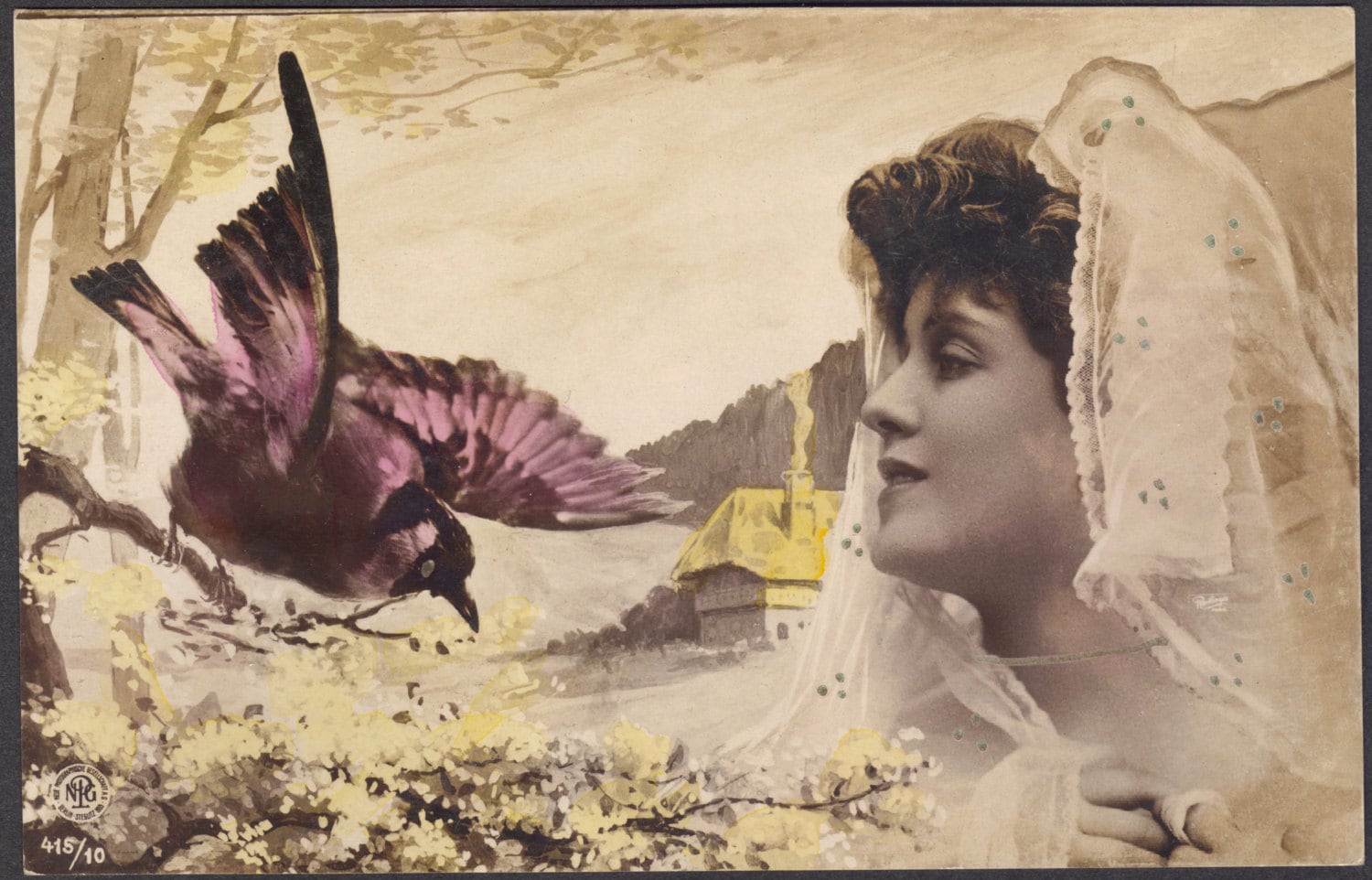
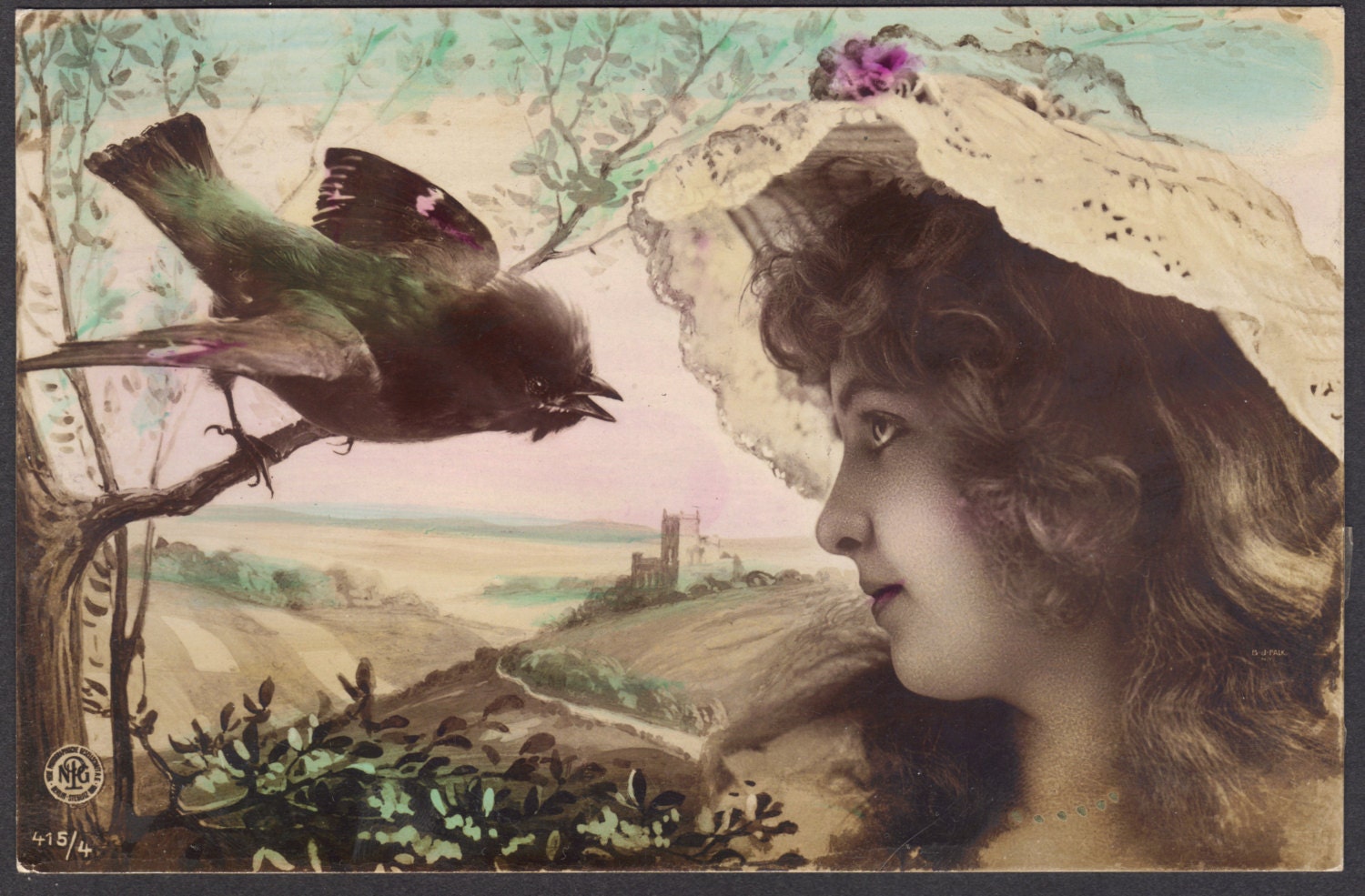
Leopold Reutlinger, the Belle Époque photographer, took thousands of photographs of famous Parisian actresses. These were published in black and white, cropped to close up and republished, hand tinted, glittered, sequined, published again, and when every imaginable possibility had been explored, he superimposed these images onto wonderfully fantastic, often surreal backgrounds. The "Artiste with Bird" series is one of our favorites and quite collectible. As of this writing, we have two such images, both by Reutlinger and in unusually fine condition.

AVAILABLE FOR PURCHASE Marguerite Brezil, Belle Epoque French Actress, Interspecial Romance Image by Reutlinger


AVAILABLE FOR PURCHASE Avian Romance Fantaisie by Leopold Reutlinger of Paris, circa 1905
Can't you just imagine these lovely ladies as heroines in fairy tales, in which for their kindness they have been rewarded the ability to speak the language of the birds? Or, perhaps the bird in the picture is actually an enchanted prince, in need of saving by the brave young woman.

One of the issues with Reutlingers "fantaisies," is that although the artiste's name was usually printed on the face of the card in its early incarnations, by the time they got to these dramatic creations, the name would often be left off. This was fine at the time, since their faces were very well known, but not today. We've been able to identify the first of these two beauties as Marguerite Brezil, but the identity of the second remains a mystery and we would welcome any clues that might shed some light on this.

These wonderful fantasy-inspired photographic images quite clearly reflect the same underlying ideals found in Victorian fairy paintings and Victorian attempts to portray fairies in photographs, a connection which ties them in with the Romanticism of the late 18th and early 19th centuries. In his examination of fairy paintings, Jeremy Mass identifies "the turn to mythological and fantasy elements, and in particular to the fairy's world, [ as allowing] an escape from these demands. 'No other type of painting concentrates so many of the opposing elements of the Victorian psyche: the desire to escape the drear hardships of daily existence; the stirrings of new attitudes toward sex, stifled by religious dogma; a passion for the unseen; the birth of psychoanalysis; the latent revulsion against the exactitude of the new invention of photography.'" That photographs, emblematic in some eyes of the science and technology that was displacing many traditional beliefs and occupations, could be manipulated to portray the longed-for simplicity and magic of a bygone (never-was) era was marvelously ironic and ironically marvelous. Photographs, which Jeremy Mass, and many others!, fuse with conformity to a hard and unforgiving realism have, from almost the very moment they came into existence, been used to portray the world in ways the eyes are rarely able to see, providing us with visual evidence of the magic we all long to see.

Sunday, May 5, 2013

Happy Mother's Day

Second Sunday in May is coming up in just one week! Happy Mother's Day! We thought we'd feature four cards this week with images either directly relating to motherhood, or close enough. :)

We hope it's a wonderful day for all moms and their children, and wish you all the very best. Please feel welcome to take advantage of a 25% discount on any item in the shop by using the coupon code THANKSMOM, at check out. This discount will be good only through May 12th, so make sure you hurry!

Belle Epoque Mother and Daughter by Heinrich Traut, circa 1905
Charming Portrait of Mother and Child, circa 1910
Lovely Early 1900s Mother and Daughter RPPC

Wednesday, April 3, 2013

Guest Blogger Mayra Esquivel: Biography of Jeanne Lanvin, Fashion Designer, 1867 – 1946

Every now and then, we come across someone who is able to share a new perspective on a subject of interest to our readers. Mayra Esquivel is such an individual. A student studying Fashion Design at Pima Community College, Mayra's interest in the fashion designers whose work adorned the fashionable women of the late nineteenth and early twentieth centuries has led to this biography of Jeanne Lanvin. We hope you enjoy Mayra's article as much as we have.

Jeanne Lanvin, Fashion Designer, 1867 – 1946
by Mayra Esquivel, Fashion Student, Pima Community College


Jeanne Lanvin. Photograph by Talbot.
Jeanne-Marie Lanvin was born in Brittany, France. She was the oldest of 11 children, since her family was really poor she didn’t have much education. When she turned 13, she was employed as an apprentice by a hat maker. Although she was spending more time cleaning the workshop and delivering the hats, she learned well how to make hats, so she started to make and sell dolls hats on her own in the toy stores of the neighborhood. In 1885, at the age of 18, with good business experience and enough savings she opened her own hat company. In the beginning it was difficult, but later on her business was successful, and she was able to expand and move to Rue du Faubourg Saint Honoré, where the company remains.

Jeanne Lanvin got married in 1896 and divorced in 1903. Born of this union was her only daughter, Marguerite. For Lanvin, being a single mother had a negative effect on her business. In 1907 she married a journalist, Xavier Melèt, but it was not a happy marriage; it was considered an arrangement of convenience. They remained married until 1953 when Melèt died.

Lanvin was the first to design children’s clothes. She designed for her daughter, using her as a model, and creating scaled-down versions of clothing for adults. Her hat clients loved her designs and the fact that mother and daughter could wear similar clothes. In 1909, Jeanne began making dresses for sale. She made no distinction between women’s and children’s wear; her designs were youthful, sophisticated, and featured exquisite handmade detail. The demand for her designs persuaded Jeanne to open a couture house selling mother-daughter garments and, thus, started her career as “Grand Couturier.” Since Marguerite was the unofficial model, as she was growing, Jeanne’s collections grew to target additional clients matching her daughter’s age.

Marie Blanche Polignac, née Lanvin
Her designs were easy to recognize for her skilful use of embroidery, fine craftsmanship, and a particular shade of blue, “Lanvin Blue”. The inspirations in her embroidery patterns were influenced by other cultures: from the Middle East, the geometric shapes, vertical rows, and horizontal border patterns; from China, the traditional symbol of longevity. Her designs used silk, taffeta, velvet, silk chiffon, organza, lace, tulle, and included a lot of free-flowing ribbons, ruffles, flowers, and linked ornaments like appliqué, couching, quilting, parallel stitching, and her main touch, the embroidery. Her creations were considered ultra-feminine, with fitted bodices and long, full skirts. The “robe de style” was one of the well-known collections. Features often found in her designs included scooped-necks, drop waists, cap sleeves, or sleeveless bodices, and full skirts with volume at the hips. These designs were comfortable and classic, appropriate for all ages of women. In order to keep the “robe de style” interesting from season to season she updated her designs. In the mid-1920’s they were abundant, including double silhouettes, and three-quarter-length skirts. In the mid-1930’s they came full circle, with floor-length skirts. Even though Lanvin’s designs were not always contemporary, she was an advocate of modernity. She was a designer who didn’t drape or sketch her ideas, and her inspirations came from many art movements.

"It's still raining", fashion plate from La Gazette du Bon Ton, 1915, showing (left to right) tailored suits by Paquin, Lanvin, and Doeuillet and a coat by Paquin.
In 1926, Lanvin added a menswear division, becoming the first couturier that dressed whole families. For the men’s collection, Jeanne hired her nephew Yves and they succeed among ambassadors, members of the Academie Francaise, and aristocrats. Later she launched an interior-design branch, run by designer Armand-Albert Reteau. She created dozens of perfumes, but none of them were commercially successful until she designed Arpège. The perfume was introduced on the 30th birthday of her daughter and it became the most successful perfume. It had the house’s logo on the bottle: Jeanne in a flowing evening dress holding Marguerite’s hands.

The key of her successful career was that she knew her clientele. Jeanne Lanvin was one of the first
designers who created a true empire; her legacy has proven timeless and is one of the oldest surviving
couture houses. In 1946, Jeanne Lanvin died and her daughter, now known as Marie-Blanced, took over the company until 1958 when she died. Now Lanvin is headed by Alber Elbaz. Elbaz is not reinventing the House of Lanvin, he is following and developing the same environment Lanvin did. His sophisticated and delicate designs create a sublime silhouette suitable and flattering for various types of bodies. He is keeping the style of youth, femininity, and beauty, the same as Jeanne Lanvin’s.

Lanvin’s client list includes celebrities as Nicole Kidman, Kate Moss, Chloé Sevigny, Sofia Coppola, First Lady Michelle Obama, Queens of Italy, Roumania and English princesses House of Lanvin has numerous international locations, several in the United States. In 2011 three boutiques were opened in Moscow. They are traditional boutiques making clothes for both mothers and daughters, in honor of Jeanne Lanvin.

Copyright 2013, Mayra Esquivel. Published with the permission of the author. All rights remain with the author.