Showing posts with label 1900. Show all posts

Tuesday, December 3, 2013

Eve with Snake, by Henri Manuel

Talk about a time machine.... The feel of the period derived from a card like this one is sensational. There is something about a fine photograph in natural sepia tones that is just so...wonderful. Images of Eve being tempted by the snake abound, being a favorite of artists of all ages, but rarely has Eve managed to look quite so humorously nonchalant about the encounter as she does in this image by Henri Manuel.

AVAILABLE FOR PURCHASE Fabulous French Faux Nude with Snake, circa 1900, by Henri Manuel

This postcard, published about 1900, features a superbly naive image of an unidentified model  “en collant” (in a body stocking) with a really great snake! One has to wonder, when viewing an image of this kind, whether the goal was humor, titillation, gender politics, a biblical reference of any kind, or a mix of oh, so many things, but the quality of the image is undeniable. Her facial expression seems to us to say,  “Et alors! You think I can't handle this?”

This card was published by SIP (the Societe Industrielle de Photographie), one of the most prolific French postcard publishers at that time. The image was photographed by Henri Manuel, and given the age of the card (its production date, by its undivided back, is likely to have been before 1904), the photo would have been taken not long after Monsieur Manuel and his brother, Gaston (about whom we can find no information whatsoever), opened their first portrait studio in Paris, in 1900.

Henri Manuel's name appears on many of the cards we bring into our shop, and though most of the subjects we deal in are very lighthearted, Manuel himself was a serious photographer, and an astute business man. He became well known not only for his portraits of theatrical personalities, risque nudes, and romantic fantaisies, but more, for his portraits of famous politicians, art, architecture, and in 1910, “Manuel’s studio began providing a commercial service to news agencies for photographs known as ‘L’Agence universelle de reportage Henri Manuel.’” His studio grew to be the largest in Paris, a recognized center for the development of the photographic arts (please forgive the pun ☺), and for the three decades between 1914 and 1944, Henri Manuel held the post of official photographer for the French government. Because we know his studio operations were shut down during WWII, we wonder if during the last years he held that government post (when France was under German occupation), he worked for  “Free France,” but we haven't yet found a lot of history on that period. Henri Manuel passed away in 1947.

Just to give you an idea of the broad scope of the man's work, you can examine a few of the approximately 2500 photographs Manuel's studio produced of French prisons and juvenile facilities between the years 1929 and 1931, for the French Department of Justice. Pretty grim stuff, but though Red Poulaine is very much about the frolicsome fun, we feel it's important to give you background on our photographers and artistes when possible, and well...we just love the stories.

Tuesday, July 2, 2013

Cléo de Mérode Giveaway Winner!

We are happy to announce that, as the happy purchaser of our 1,000th item on Etsy, Karen Donaldson (oneundonebird) will be receiving the very special Cléo de Mérode postcard featured in our Giveaway. Congratulations, Karen!

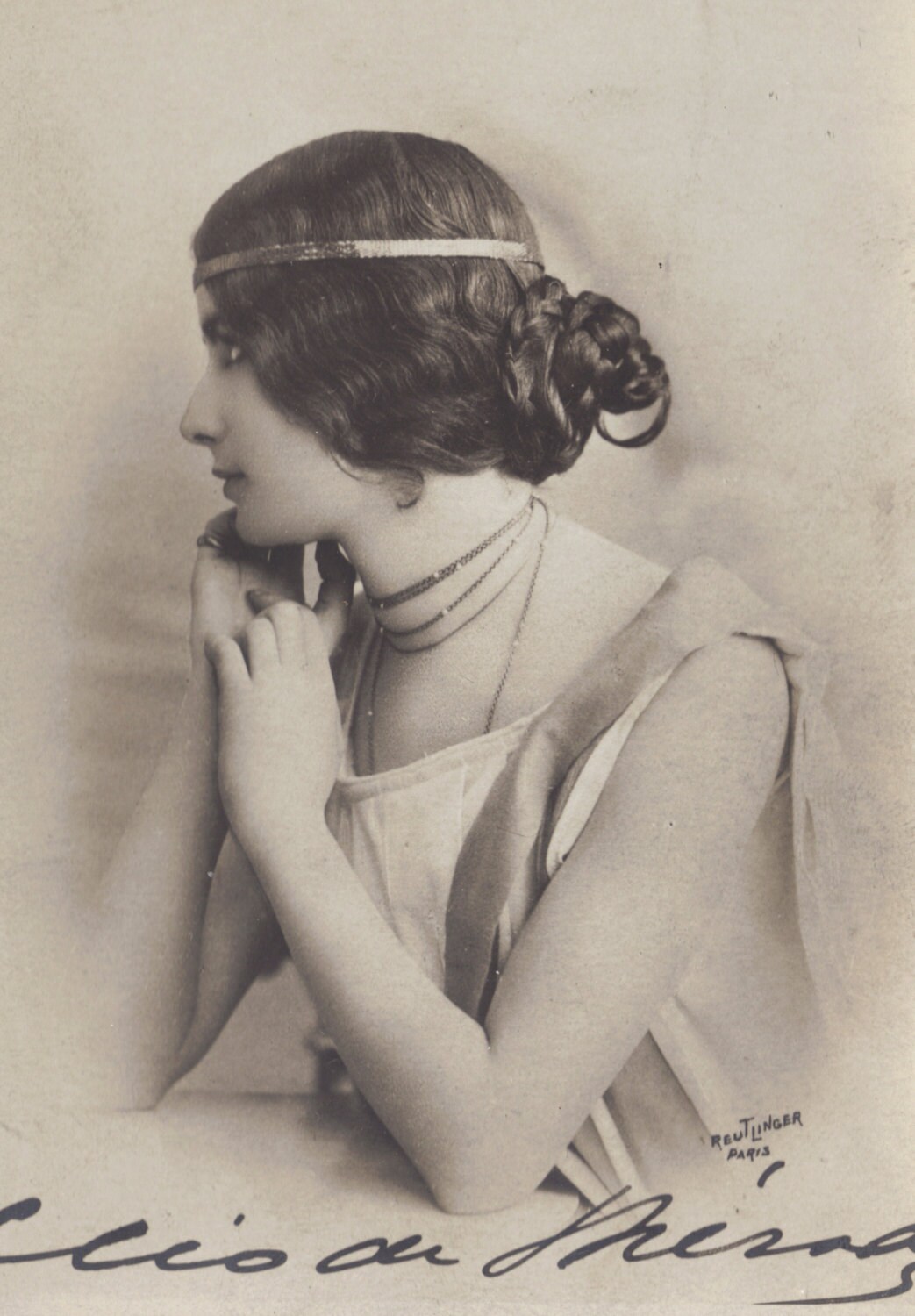
Exquisite Cleo De Merode Giveaway Card, circa 1900
We are currently getting our packages ready to ship, so Karen should be receiving her gift in just a few short days.

Many thanks to all of our wonderful customers who have helped us to reach this milestone! We are grateful to each and every one of you.

Friday, June 28, 2013

Tremendous Tresses

The featured cards in our shop currently include images of women with beautiful, long hair.

Prior to the 1920s, the traditional hairstyles for women almost always seemed to include long hair. That hair might be pinned up to fantastic heights, but take out the pins and the hair fell well past the shoulders, sometimes to the waist, hips, or even farther. And, as anyone who's ever worn long hair knows, taking care of that extra long mane takes lots of time and effort. Which may be one reason that we look with such amazement at these images of women wearing their long and luxurious hair down, so that it accentuates their beauty and grace.

The first of our featured cards is, of course, the card that we will be giving away with our 1,000th purchase. (See details.) In this image, Cléo de Mérode wears her hair down and we can see that, at least in front, her hair descends below her bustline, indicating that the full length is almost certainly well down her back. As always, of course, she is lovely.

Exquisite Cleo De Merode Giveaway Card for 1,000th Purchase, circa 1900

The second of our featured images is a lovely photograph of an unidentified model, holding a bouquet of violet-colored flowers, whose hair falls down her back to arrive in the vicinity of her derriere. This model's hair may be the longest of those featured. The beautifully hand-colored card was published by Misange, most probably in either France or Germany sometime about 1910.

Polka Dots and Peonies. So Lovely. circa 1905/10

Our next featured image depicts an actress with beautiful long curls and a wild feathered hat. The expression on her face is so wonderful, making us think that she offers some words of wisdom for some wanderer. Perhaps, given the deliberately tattered nature of her gown, she is a fairy in disguise, and is about to gift some hero or heroine with some magical ability. Her hair, certainly, is worthy of any fairy queen.

Miry Cassari Belle Epoque Stage Performer in a Lovely Big Hat, dedicated, circa 1912

Of note is the fact that this is a signed card, apparently signed in 1912 following a stage performance in Beaune (pronounced almost as in the English word "bone"), Burgundy, which is between Paris and Geneva. Based on her signature, the actress' name is Miry Cassari, or perhaps Lassari, but we have been unable to find any information about her and she remains a mystery. This is a wonderful image, and in a way there is something wistfully romantic and magical about the autograph of a forgotten actress. So often we have read about the immortality of the old gods having been dependent upon the worship of their followers. Perhaps, merely through the appreciation of this fine, evocative image, we can breathe a little life into the "joie de vivre" expressed by this lovely young woman, so long ago, and share in some of it ourselves.

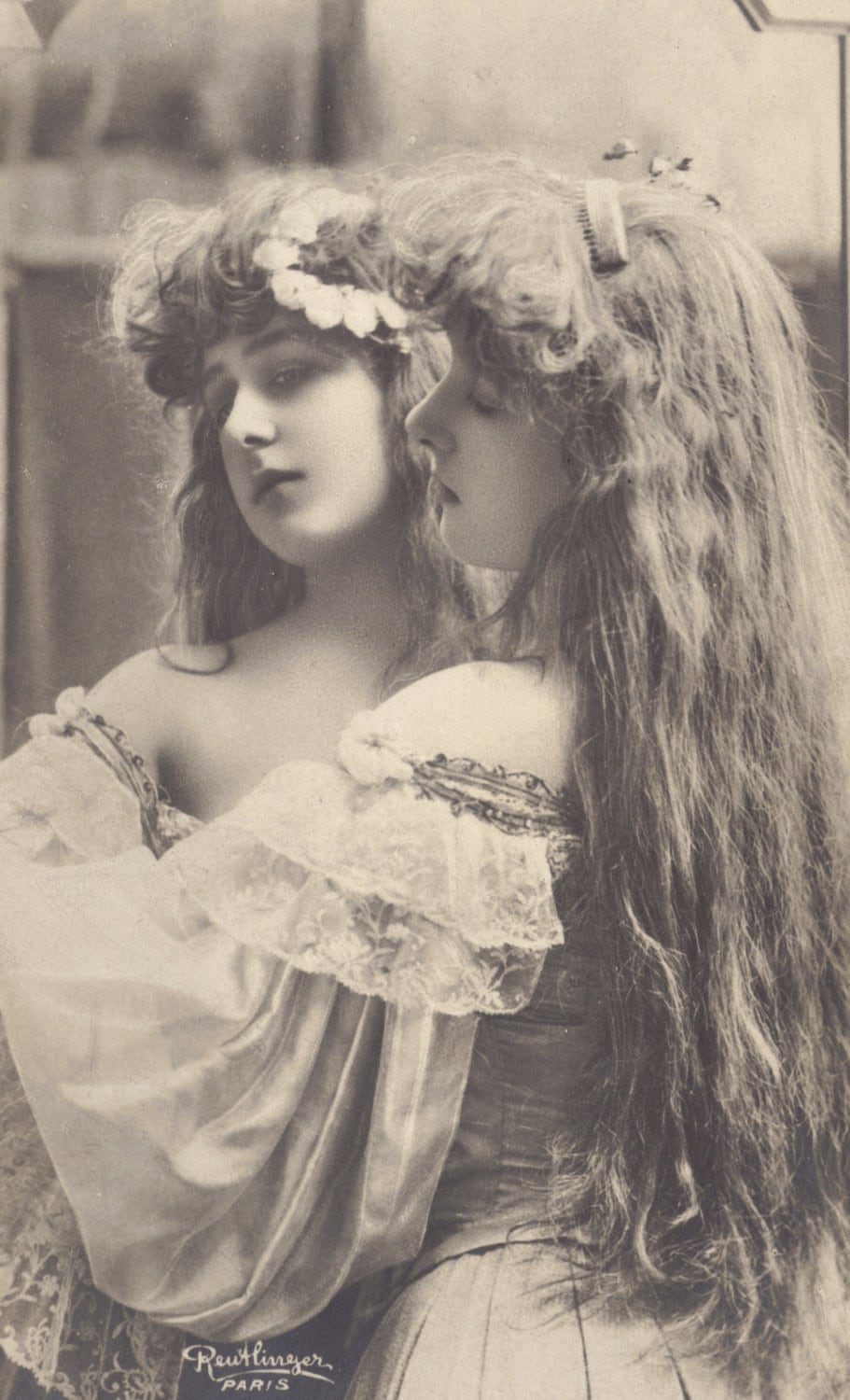
The final featured item is this lovely biogravure by Steglitz, circa 1905. The maiden portrayed in this image is crowned by a wreath of flowers, which, together with her long, unbound hair symbolizes Spring and the purity and innocence of youth. Appropriately, the photographer has captured her with her gaze turned down, deftly maintaining the Arcadian ambiance.

Crown of Flowers, Jugendstil Epoche Maiden, Biogravure by Steglitz, circa 1905


Thursday, June 20, 2013

Cléo de Mérode Giveaway to Celebrate Our 1,000th Sale!

Red Poulaine has been in business for so short a time, that it really took us by surprise when we realized that we will soon be selling our 1,000th item! We thank all of you very much for being our wonderful customers, and to celebrate this event, we plan to include a very special card, one that we hope any of our customers would be very happy to add to their collections, in the order that includes our 1,000th sale as a special thank you.

So, with the clock ticking and the calendar pages flying, we conducted a search far and wide for just the right card, one with a very beautiful image and an enticing history, to grace the collection of one very special customer. And we found it!

NOT FOR SALE Exquisite Cleo De Merode Giveaway Card, circa 1900
This beautiful image of Cléo de Mérode will belong to the customer who makes the 1,000th purchase from our shop. 

Cléo de Mérode (September 27th , 1875-October 17th, 1966) is possibly the most well-known dancer of La Belle Époque. Certainly she was the postcard queen of the era, and took great care with the images of her, making careful use of the medium to help promote her public recognition. Her postcard images are some of the most sought after and often the most expensive of all the "artistes."

The daughter of the Austrian-born nobleman and landscape painter Karl von Mérode, and given the exotic name Cléopâtre Diane de Mérode at birth (although her mother called her Lulu), she started taking dance lessons when only 7- or 8-years-old and made her stage debut at the tender age of 11. As Cléo de Mérode, she went on to become an international star, known for her tiny waist, grace, and exquisite beauty. As one of the most glamorous of the stars of that time, she was sought after by many artists and photographers. Henri de Toulouse-Lautrec, Charles Puyo, Alfredo Muller, Giovanni Boldini, and Gustav Klimt painted her, Alexandre Falguière sculpted her, and photographers such as Léopold Émile Reutlinger, who took the image above, Félix Nadar, Henri Manuel, Charles Ogerau, and others vied to immortalize her image. There was even a wax effigy made of her in 1895 by sculptor Leopold Bernstamm, which was displayed in the Grevin Museum

Early in her career, in 1896, when Cléo was just 22, King Léopold II of Belgium became entranced by her performance in a ballet. Léopold, then 61 years of age, already had two children by a woman rumored to be a prostitute and his pursuit of Cléo was enough to damage her reputation. Cléo, and her mother, who traveled with her, rejected the allegations. In an October 5th, 1897 interview with the New York Times, her mother, Mme. Mérode, insisted that although Cléo had been required to meet with the king, she did so only with her mother's chaperonage. Cléo herself said, "It Is horrible - horrible - that they should so pursue me with such monstrous lies! The King of the Belgians is no more to me than any other great man who has admired me on the stage, whom I have seen for a few moments off the stage very rarely, and always in the presence of many other persons."

Cléo may have been chaste, but she knew the worth of her beauty and charm as she rose to international stardom. A month prior to the Times interview, she was interviewed for a September 24th piece in the Delphos, Ohio Daily Herald. The interviewer enthused about her charms before sharing her comments:
For some months New York has been anticipating the arrival of Cleo de Merode, the Parisian dancer, the fame of whose wonderful beauty is now worldwide. And not only New York, but the whole country has felt more than common interest in the arrival on these shores of this odd young woman who has done nothing but dance and yet has turned the heads of monarchs, and at whose feet have been showered jewels and gifts that in the aggregate are worth an immense fortune.
 Now that she has come to America, the interest in her attractive personality amounts to a continuous furore. Indeed Cleo de Merode is charming. Lithe and elegant, in an ecru gown embroidered in openwork over white silk, beautiful enough to dispense with wit, she replied to a thousand questions asked her by her many admirers as naturally as if she were witty enough to dispense with beauty. Her hazel eyes reflected a world. Her delicate features, animated by the excitement of her arrival, harmonized admirably with her rich, silky hair, dark with tints of red, and dressed in two wavy bands over her ears. Her black eyebrows commanded. Her smile was sweet, and what a spectacle it was when she lowered her eyelids and let one admire in their length her immeasurable brown lashes!
"I dance the ancient dances," she said, "the Louis XIII, the Louis XV, the gavot, the pavan, the minuet, and I led at Royan Louis Ganne's ballet of 'Phryne.' I am gowned by a real dressmaker. I know music very well, and play the piano as little as possible. I know how to arrange a basket of fruit, place flowers in a jardiniere and touch a book without spoiling it. I have read the poets and the historians, and I do not write. I wear stockings that are as fine as a woven mist. What other accomplishments shall I speak of?"

Although she pretended to make little of her famed beauty, saying she had, "a style of face conventional enough to have pleased a great number of people," Cléo de Mérode made effective use of it, comparing herself to the subject of da Vinci's Mona Lisa (Jaconda). Clearly, as a consummate performer, she knew that her audience required a level of audacity that few women of the time expressed.

Figures 14, 15 of La Belle - Jaconda, by Leonardo da Vinci for Hohenstatt  Analysis
Do you see the resemblance? It is most pronounced in figure 14, but we think Cléo's beauty was even greater than that of da Vinci's model.

Although Cléo was an elite ballerina dancing in a time when there was a firm separation between those who danced on the ballet stage and those who danced in the less respectable Parisian dance halls, in 1901, while at the peak of her career, Cléo, in a brilliant career move, performed at the Folies Bergère. This was a bold move for a ballerina with a serious career, yet her performance was such that she gained an even greater following. It was through such brilliant publicity moves, along with her ability as a dancer, that Cléo was able to maintain her position as one of Paris' most successful dancers, stretching her career into her 50s before finally retiring from the stage.

Despite her statement in 1897 that she did not write, Cléo would, in 1955, publish her autobiography, Le Ballet de ma vie (The Dance of My Life). When she died in 1966 at the age of 96, Cléo de Mérode was interred in the Père Lachaise Cemetery in Paris alongside her mother. A statue of her, depicting her in mourning for her mother, now decorates the headstone the two woman share.

Sources:
"Cleo de Merode (1875-1966)," Stage Beauty, http://www.stagebeauty.net/th-frames.html?http&&&www.stagebeauty.net/demerode/demerode-c.html (accessed June 20, 2013).
"Cleo de Merode (1875-1966): In Press and Literature," Stage Beauty, http://www.stagebeauty.net/th-frames.html?http&&&www.stagebeauty.net/demerode/demerode-c3.html (accessed June 20, 2013).
Dash, "Cleo de Merode," French Sampler, http://thefrenchsampler.blogspot.com/2011/04/cleo-de-morode.html (accessed June 20, 2013).
Red List contributors, "Cléo de Mérode," Muses, The Red List, http://theredlist.fr/wiki-2-24-525-770-925-view-1900s-1-profile-cleo-de-merode.html (accessed June 20, 2013).
Wikipedia [France] contributors, "Cleo de Merode," Wikipedia, the free encyclopedia http://fr.wikipedia.org/w/index.php?title=Cl% C3% A9o_de_M% C3% A9rode & oldid = 93532911 (Accessed June 20, 2013).
Wikipedia [France] contributors, "Musee Grevin," Wikipedia, the free encyclopedia http://fr.wikipedia.org/w/index.php?title=Mus% C3% A9e_Gr% C3% A9vin & oldid = 93716003 (accessed June 20, 2013).
Wikipedia [USA] contributors, "Cléo de Mérode," Wikipedia, The Free Encyclopedia, http://en.wikipedia.org/w/index.php?title=Cl%C3%A9o_de_M%C3%A9rode&oldid=540349043 (accessed June 20, 2013).