Showing posts with label 1905. Show all posts

Saturday, February 15, 2014

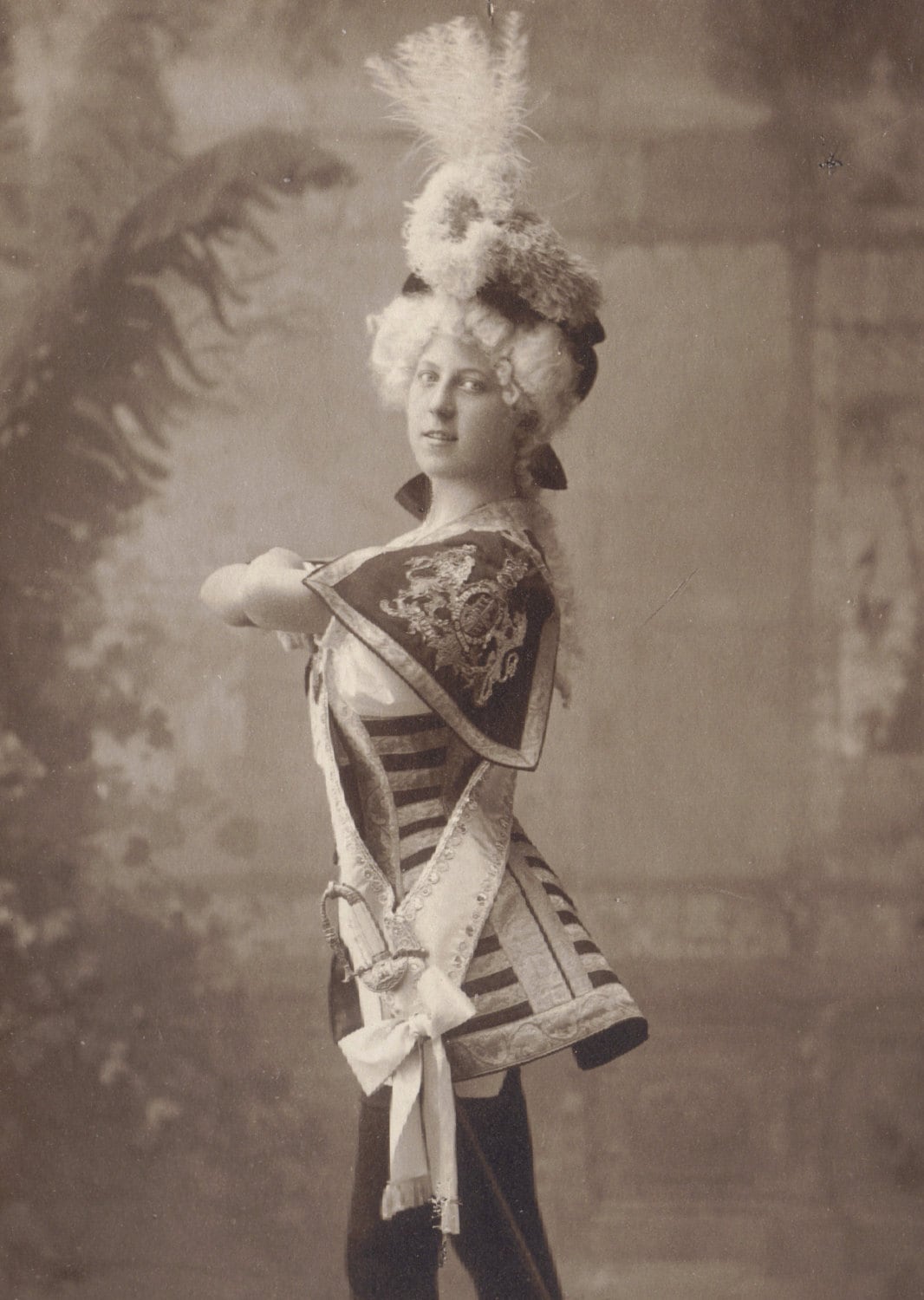
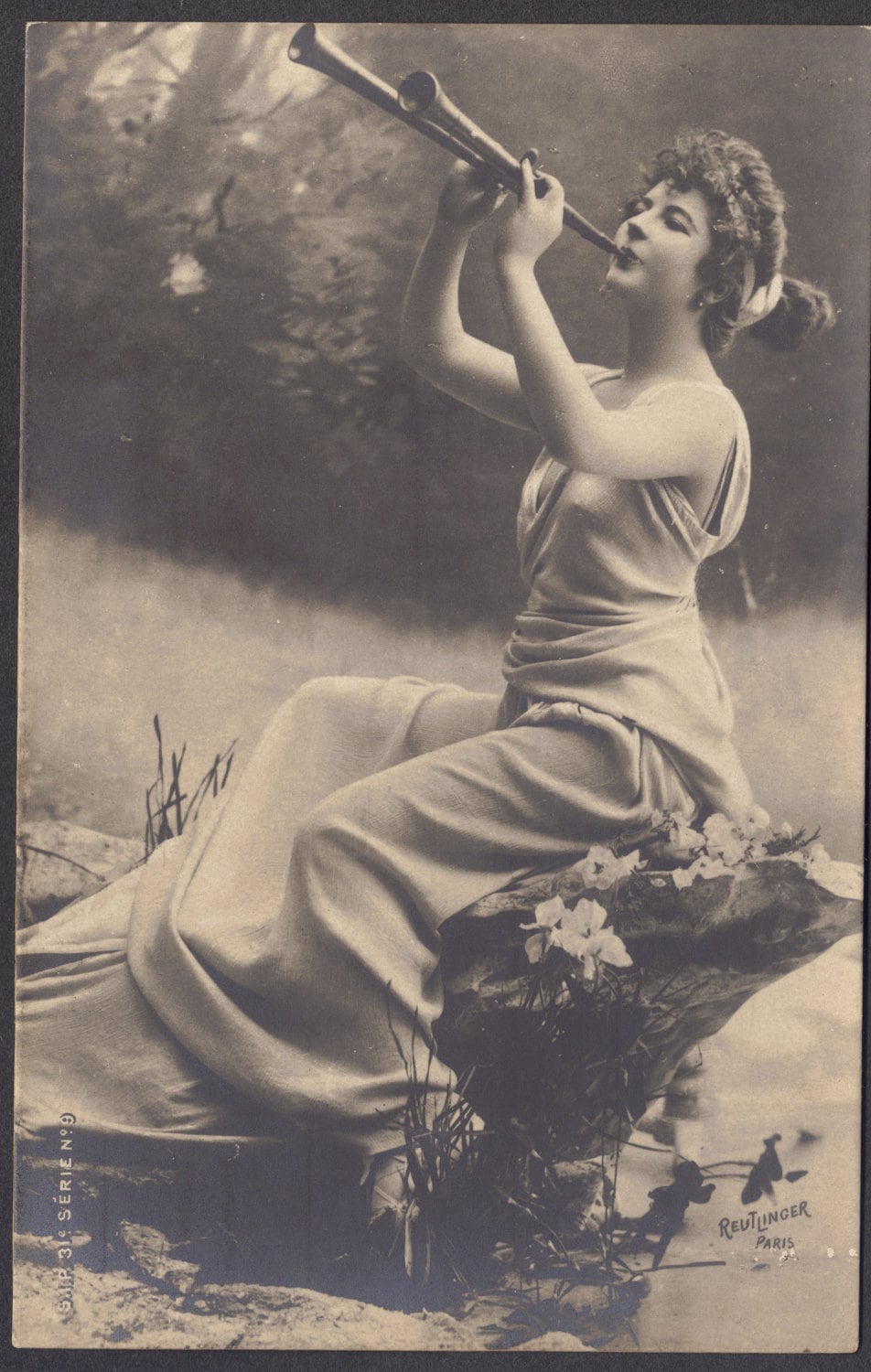
The Four Seasons, Personified by Famous Actresses of La Belle Époque, Circa 1905

Here we have a series of four very special cards, representing the four seasons. Each of the seasons is personified by one of four famous Belle Époque stage performers. Each of these four cards is in particularly fine condition, though posted in 1909.

The Four Seasons, photographed by Reutlinger and posted in 1909

They must have been kept very carefully and lovingly, because, by their appearance, they are practically brand new! They were all sent by the same person, Ninette, to M. Emile Jourdan-Brive, who was clearly someone dear to her. Each includes a brief message, such as,"a thousand kisses from Ninette," written in a nice hand on the back of the card. Our researches suggest that Emile may have been a member of the Jourdan-Brive family of Marseille, who were well-known exporters of truffles, capers, wines, and perfumes to England during the Victorian era.

The images themselves, appear to be photogravures, made from photographs taken by the famous theatrical portraitist Leopold Reutlinger of Paris, probably circa 1905. Deeply impressed in fine, ivory-toned stock, these images are truly precious.

Although we are merchants, and generally sell our wares on a piece by piece basis, we simply cannot bring ourselves to break up so lovingly cared for, and romantic, a set of cards as this one. Consequently, we are selling these four cards as a set.

Note: There will be another post reflecting this listing due to our use of an automatic posting system, which ensures that every time we post an item in our shop a post appears in the blog. We are offering this post to provide you with complete information about the set, including high-res scans of the front and back of each card, since we are limited to only 5 images in our listing on Etsy.

Le Printemps, Spring


Le Printemps (Spring), is represented by the breathtaking Arlette Dorgere. Surrounded by early blossoms, her hair in a woodland sprite's disarray, she tenderly cradles a nest of tiny bird's eggs.

Le Printemps, by Reutlinger

Mlle. Dorgere was a very popular artiste who performed at the Scala, and in many other venues in Paris and elsewhere. We have not been able to find any information about her early life, but we know that her image was captured by the famous poster artist Jules Cheret, and that at about the time the photograph for this card was taken (circa 1904), she was already so successful that she was able to purchase a lovely chateau, the Chateau Vigneus sur Seine, in a quiet neighborhood south of Paris. It was on a large wooded lot, with a pond, and when the pressures of her work grew heavy, she would ride in her chauffeur-driven limousine to this retreat. In 1929, she sold the chateau, which she had renamed Chateau Dorgere, and retired quietly to Morocco, which was then a colonial protectorate of France.
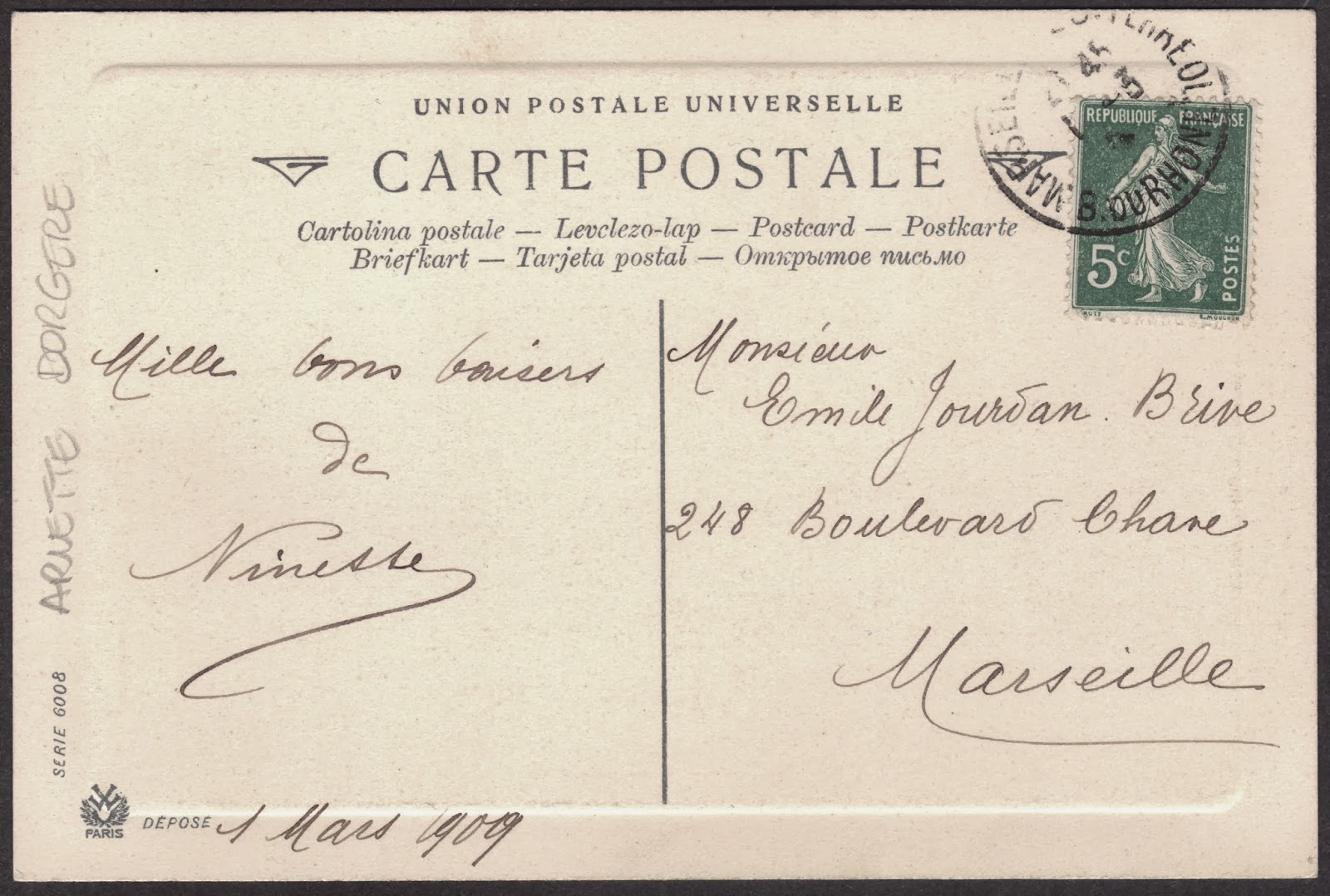
Reverse of Le Printemps
Translation: A thousand beautiful kisses from Ninette

L’ Eté, Summer


L’ Eté (Summer), is represented by Mlle. Marcelle Yrven. In this image, she clutches flowers to her breast, while smiling joyfully, a goddess of the season.

L' Eté, by Reutlinger

Mlle. Yrven (1877-1949) was a fascinating woman who was not only a wonderful stage performer, but also an author, a poet, and outspoken on the subject of women in society. She wrote a short book on feminism, "La Comedienne Et Le Feminisme," as it related to women in the theater, which was not only interesting politically, but historically, as it pertained to La Belle Époque theater, really fascinating. We don't think it is available in English online, but it is short enough that if you have a little French, and the online translator, you can work through it.

Reverse of L' Eté

Translation: Best kisses from Ninette

L' Automne, Autumn


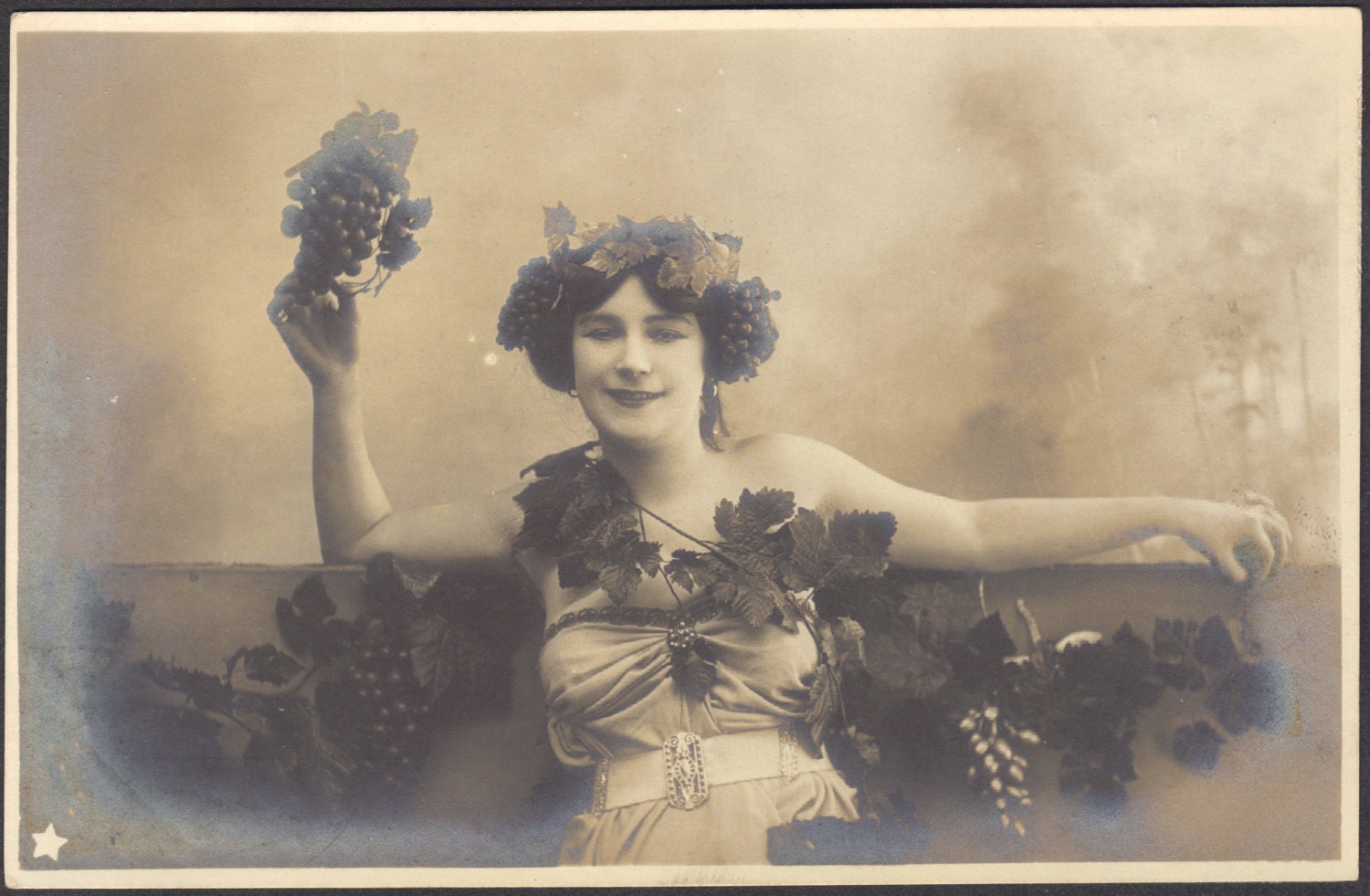
L' Automne (Autumn), is the season during which the wine grapes are harvested, as depicted by the maenad Mlle. Renee Despres, wearing vines and fruit of the vine.

L' Automne, by Reutlinger

This is a wonderful image in which she smiles at us invitingly, offering us the celebration of the season. Unfortunately, we have no biographical information on her, apart from the fact that she did appear on the playbills of a number of theaters in Paris, and that, from other images we've seen, she was a most elegant lady of the Belle Époque theater.

Reverse of L' Automne

Translation: Embraces (or, perhaps, kisses) Fernand for me Ninette [We find this just a bit confusing, since these cards all were addressed to M. Emile Jourdan-Brive, but perhaps Fernand was his middle or nickname.]

L' Hiver, Winter


L' Hiver (Winter), is here pictured not so differently than it might be in England, or elsewhere in Europe or the United States. We have the yule logs, Holly, the evergreen tree, and is that a bit of mistletoe Miss Campton wears in her hair beneath her hood?

L' Hiver, by Reutlinger

Miss Campton, like many performers in the Paris of that time, was English; she was born Emily Straham Cager in Brighton, in April of 1882. Here, photographed by Reutlinger, she was also often found in stunning images produced by Professor Stebbing, another well-known and prolific Belle Époque photographer. She was apparently a very special friend of Paul Derval, who for many years directed the Folies Bergere, and though they did not, as far as we know, marry, when she died at a relatively young age of cancer, in Paris, she was interred in the Derval family tomb.

Reverse of L' Hiver

Translation: Another kiss from Ninette


As a complete set, these cards evoke the magical and celebratory relationship between people and nature that often seems the very essence of so much art during this period.

The listing for this set will be available within the next 24 hours.
Saturday, June 29, 2013

Cléo de Mérode Giveaway Explanation and Update

We're sure that by now all our regular customers are aware of the fact that we're prepared to give away a postcard in excellent posted condition featuring an image taken by Leopold Reutlinger of Paris of the beautiful Cléo de Mérode to the customer who buys the 1,000th item to be purchased from our Red Poulaine Etsy shop.

 NOT FOR SALE Exquisite Cleo De Merode Giveaway Card, circa 1900
We've recently fielded a few questions about how the giveaway works, and we want to make sure all of you have the answers.

First, cards placed on reserve do not count toward the giveaway. Only actual purchases registered by Etsy as completed sales will count. You can see our total number of sales on the menu at the left side of our shop page, as shown in the following image:

Snapshot of Red Poulaine's shop on Etsy, showing the location of our sales figures.
NOTE: The number (984 sales) shown in this image reflects our sales status as of the moment we captured this image. To obtain the current status, you must click through to check our shop on Etsy.

Second, each card purchased is counted toward our total number of sales. Etsy counts each item purchased as a separate sale, even when there are multiple items in an order. If a customer comes in and purchases three cards in a single order, that will count as three sales. We really have nothing to do with counting the sales, as we are using Etsy's counter to determine the final outcome of the giveaway.

We have had customers come in and purchase more than 20 cards at once. That could happen this next minute, and the level would be reached. Or people could buy them one at a time, right up until the 1000th sale, and that could take quite some time.

What this means for you is that it will be possible for someone, maybe you, to swoop in and purchase multiple cards, bringing our total sales to 1,000 in one fell swoop! Or, you could wait, carefully watching until the next purchase will be the 1,000th. It's a bit like one of those radio call-ins, where the 17th caller wins.

Will you be the lucky customer to buy our 1,000th item and receive the lovely Cléo card? We hope so! And we're watching closely so we can announce the final outcome.


Friday, June 28, 2013

Tremendous Tresses

The featured cards in our shop currently include images of women with beautiful, long hair.

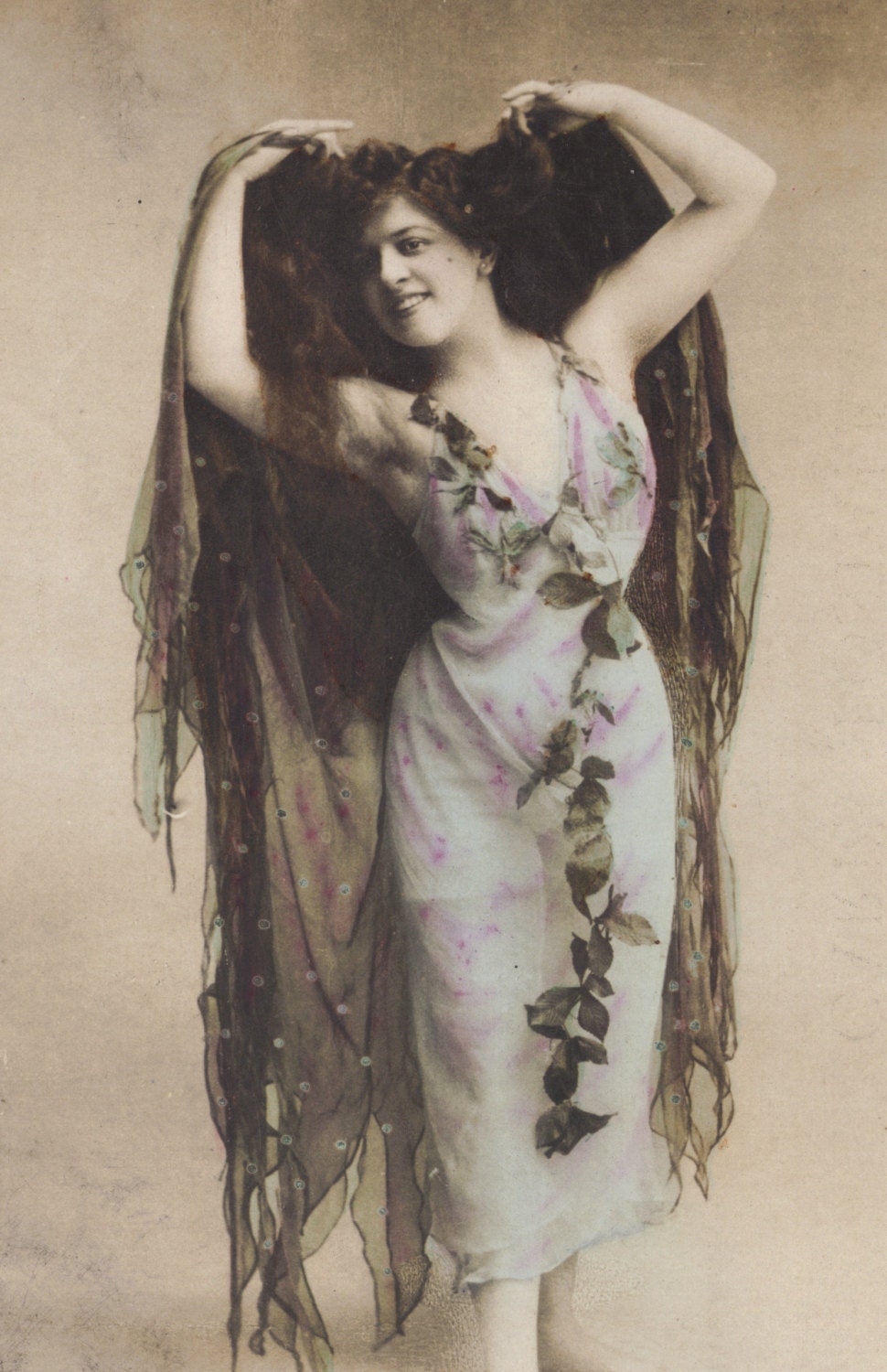
Prior to the 1920s, the traditional hairstyles for women almost always seemed to include long hair. That hair might be pinned up to fantastic heights, but take out the pins and the hair fell well past the shoulders, sometimes to the waist, hips, or even farther. And, as anyone who's ever worn long hair knows, taking care of that extra long mane takes lots of time and effort. Which may be one reason that we look with such amazement at these images of women wearing their long and luxurious hair down, so that it accentuates their beauty and grace.

The first of our featured cards is, of course, the card that we will be giving away with our 1,000th purchase. (See details.) In this image, Cléo de Mérode wears her hair down and we can see that, at least in front, her hair descends below her bustline, indicating that the full length is almost certainly well down her back. As always, of course, she is lovely.

Exquisite Cleo De Merode Giveaway Card for 1,000th Purchase, circa 1900

The second of our featured images is a lovely photograph of an unidentified model, holding a bouquet of violet-colored flowers, whose hair falls down her back to arrive in the vicinity of her derriere. This model's hair may be the longest of those featured. The beautifully hand-colored card was published by Misange, most probably in either France or Germany sometime about 1910.

Polka Dots and Peonies. So Lovely. circa 1905/10

Our next featured image depicts an actress with beautiful long curls and a wild feathered hat. The expression on her face is so wonderful, making us think that she offers some words of wisdom for some wanderer. Perhaps, given the deliberately tattered nature of her gown, she is a fairy in disguise, and is about to gift some hero or heroine with some magical ability. Her hair, certainly, is worthy of any fairy queen.

Miry Cassari Belle Epoque Stage Performer in a Lovely Big Hat, dedicated, circa 1912

Of note is the fact that this is a signed card, apparently signed in 1912 following a stage performance in Beaune (pronounced almost as in the English word "bone"), Burgundy, which is between Paris and Geneva. Based on her signature, the actress' name is Miry Cassari, or perhaps Lassari, but we have been unable to find any information about her and she remains a mystery. This is a wonderful image, and in a way there is something wistfully romantic and magical about the autograph of a forgotten actress. So often we have read about the immortality of the old gods having been dependent upon the worship of their followers. Perhaps, merely through the appreciation of this fine, evocative image, we can breathe a little life into the "joie de vivre" expressed by this lovely young woman, so long ago, and share in some of it ourselves.

The final featured item is this lovely biogravure by Steglitz, circa 1905. The maiden portrayed in this image is crowned by a wreath of flowers, which, together with her long, unbound hair symbolizes Spring and the purity and innocence of youth. Appropriately, the photographer has captured her with her gaze turned down, deftly maintaining the Arcadian ambiance.

Crown of Flowers, Jugendstil Epoche Maiden, Biogravure by Steglitz, circa 1905


Saturday, June 15, 2013

Images of the Fantastic in La Belle Époque

One aspect of La Belle Époque, not just in France either, was a very palpable embrace of antiquity, and though often in a rather naive fashion by today's standards, one gets the sense that people were turning away from the onslaught of the industrial explosion and towards the real, and imagined, simplicity of earlier times. With this came a sense of the possibility of magic, and the ubiquity of images like this one, in which we wouldn't be terribly surprised to see faeries or woodland sprites cavorting about.

SOLD Wood Nymph at the Well
Or, perhaps we expect at any moment to see a faun, satyr, or even Bacchus, himself!

SOLD Nymph Calling Forth the Woodland Sprites circa 1905

We love the way in which the magical is suggested in these images, without the introduction of a single truly fantastic element. These images make us feel much as we might when reading a fairy tale, that at any moment something truly marvelous will happen.

Nymphs, Naiads, Dryads, and Faerie folk so often cropped up in La Belle Époque. Found throughout the period from popular entertainment to commercial advertising, these images reflected a blossoming of Western occult experimentation and a yearning for magic, for myth made manifest. We've written before of our fondness for images depicting the Marvelous Maenad, which is not only a subgenre of the "Lovely Lady" category, but of fantasy postcards, as well.

AVAILABLE FOR PURCHASE Maenad at the Garden Wall, circa 1900
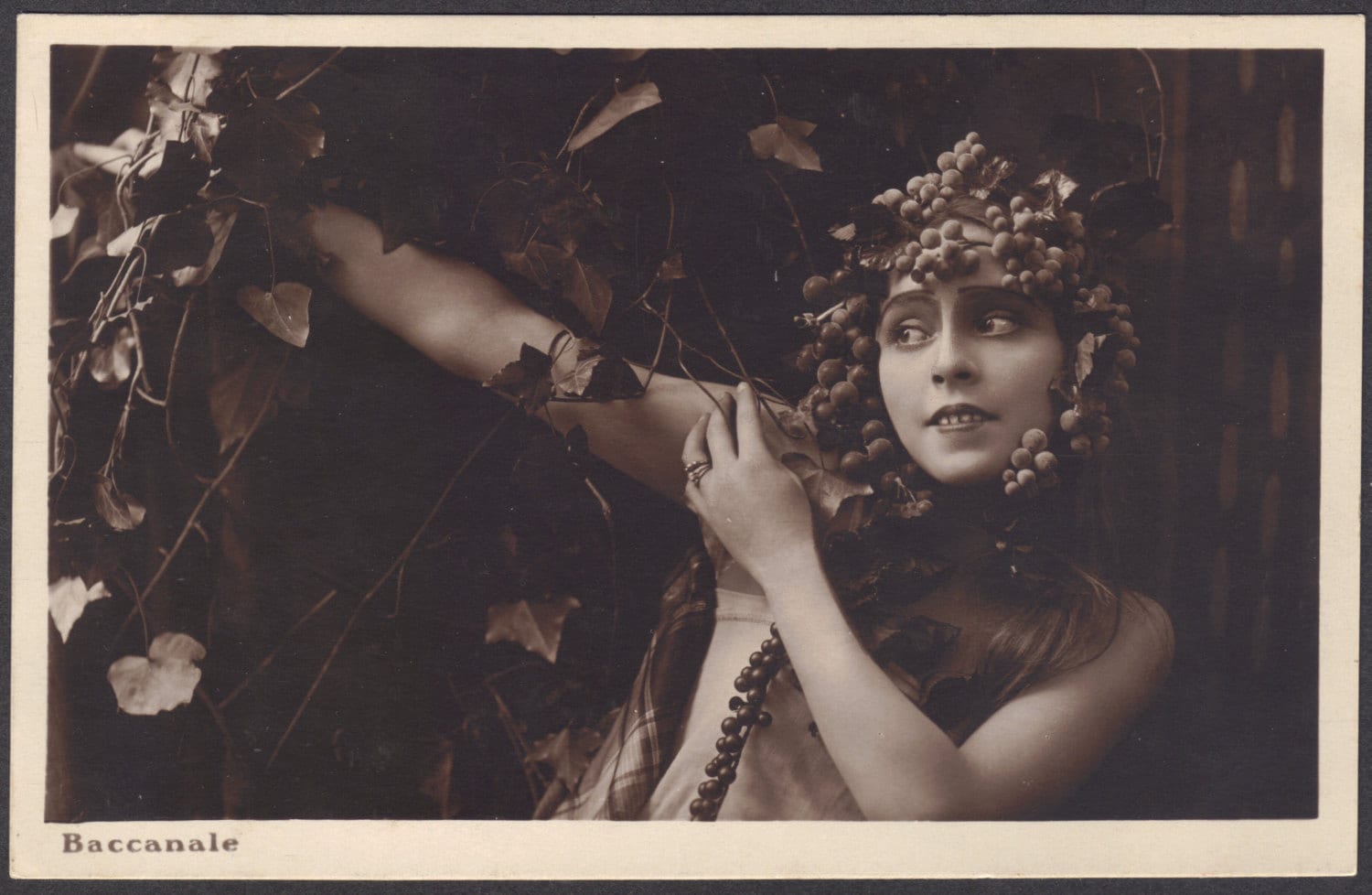
Maenads could be seductive, inviting the viewer to join them in the Bacchanal, as in the previous image, but they could also be depicted as shy and elusive creatures of the wilderness, emerging from a tangle of vines, perhaps looking back with a mixture of amusement and discomfiture at a pursuer.

AVAILABLE FOR PURCHASE Maenad Peering Through the Trees, circa 1910s/20s
Even more interesting, we think, is the fact that this new medium, the picture postcard, made available to anyone with a penny or two the possibility of possessing such an image, one in which an obviously very real human being is pictured in a fairyland setting. We take photographs for granted today, of course, but think about it for just a moment—at the turn of the 20th century, this was all entirely new. Prior to this time, fantastic photo images of human beings were seldom accessible to the common man, woman or child, and we cannot take lightly the effect of "likeness" on the human psyche, and it's worth considering the effect this mass phenomenon had on society. Mass phenomenon, you wonder? Really? Absolutely. Just as an example, in the United States alone, "the official figures from the U.S. Post Office for their fiscal year ending June 30, 1908, cite 677,777,798 postcards mailed. At that time the total population of the United States was only 88,700,000!" (Thanks to emotionscards.com for their fascinating article that provided us with that factoid.)

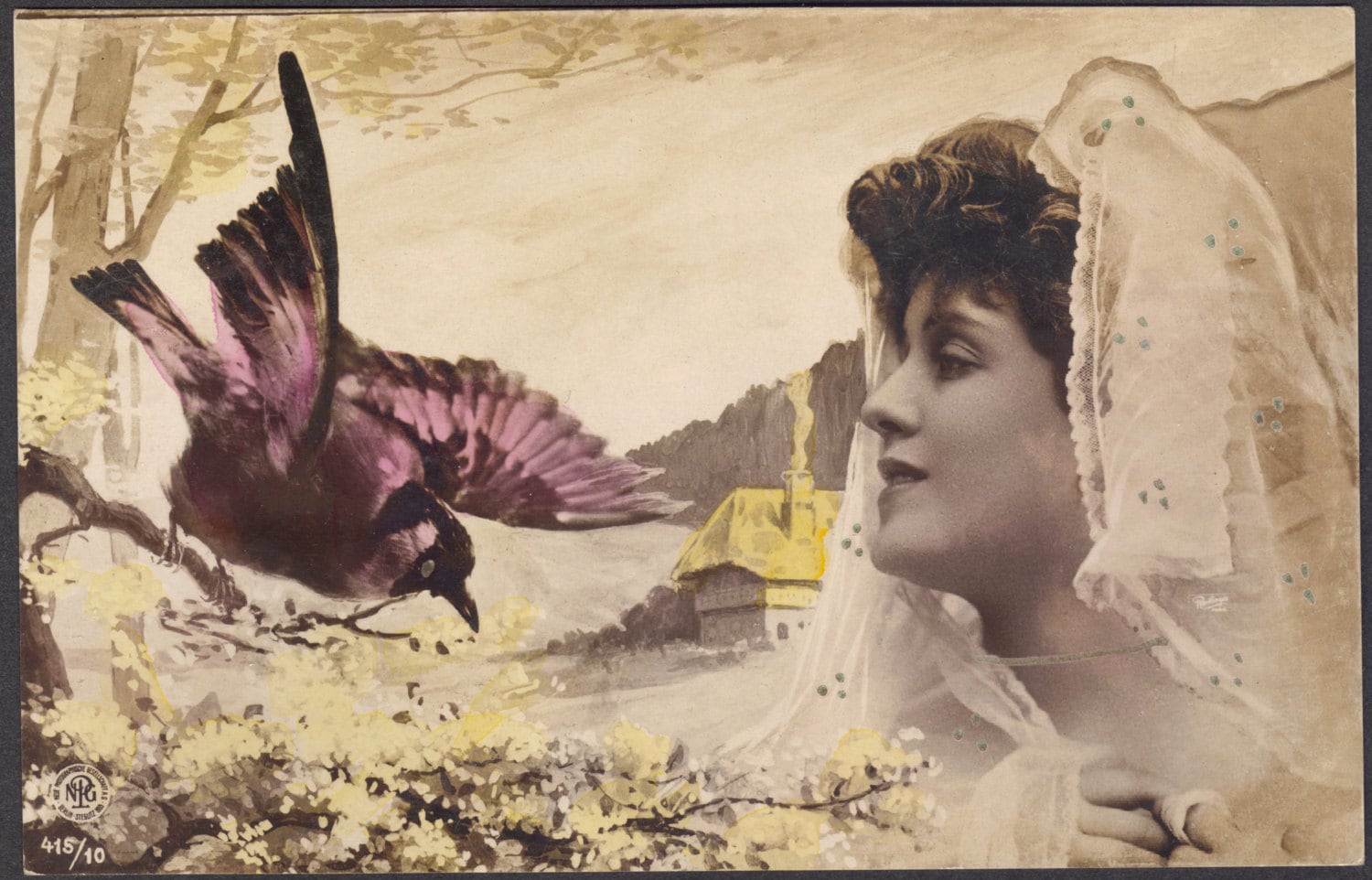
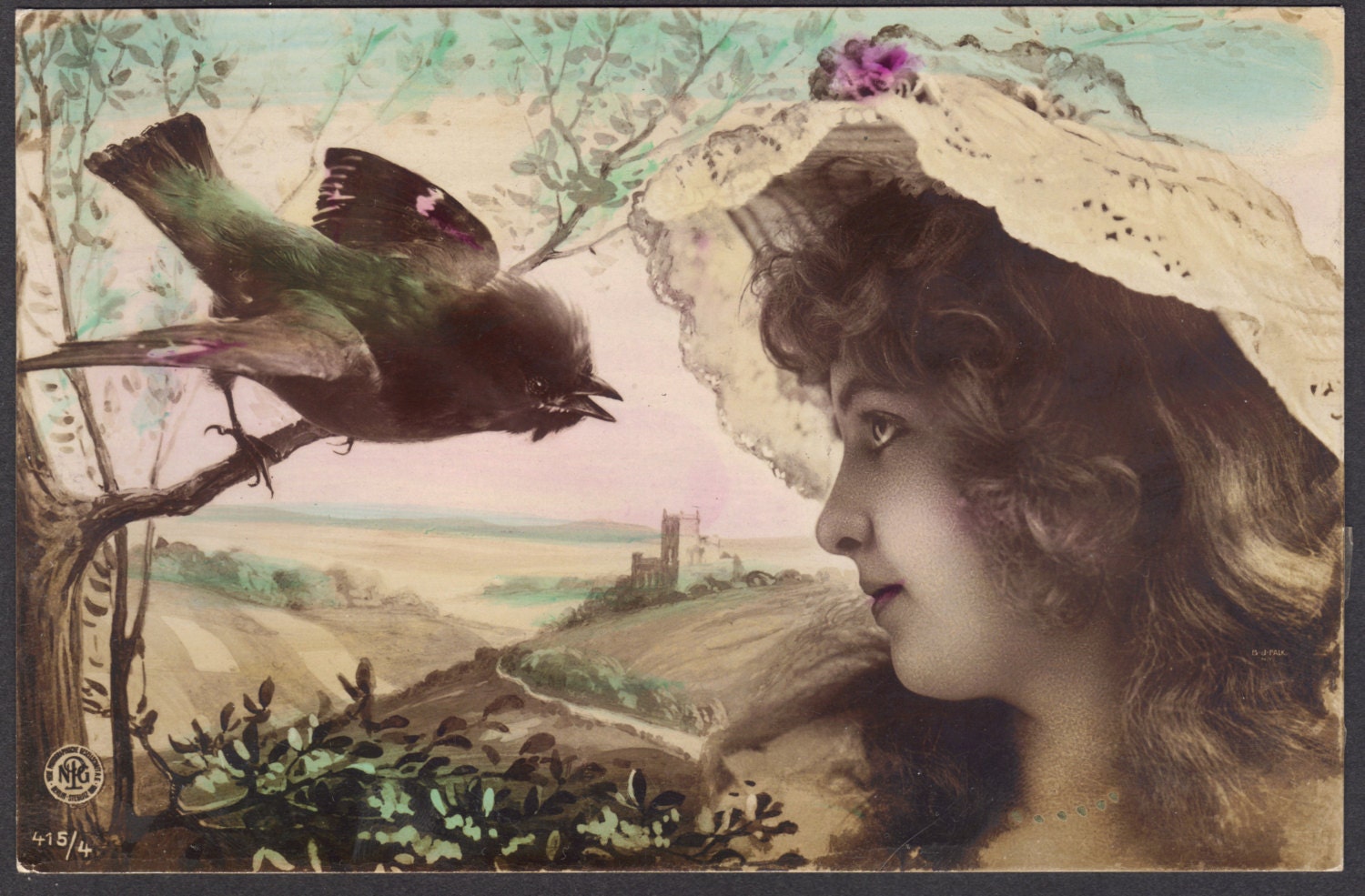
Leopold Reutlinger, the Belle Époque photographer, took thousands of photographs of famous Parisian actresses. These were published in black and white, cropped to close up and republished, hand tinted, glittered, sequined, published again, and when every imaginable possibility had been explored, he superimposed these images onto wonderfully fantastic, often surreal backgrounds. The "Artiste with Bird" series is one of our favorites and quite collectible. As of this writing, we have two such images, both by Reutlinger and in unusually fine condition.

AVAILABLE FOR PURCHASE Marguerite Brezil, Belle Epoque French Actress, Interspecial Romance Image by Reutlinger


AVAILABLE FOR PURCHASE Avian Romance Fantaisie by Leopold Reutlinger of Paris, circa 1905
Can't you just imagine these lovely ladies as heroines in fairy tales, in which for their kindness they have been rewarded the ability to speak the language of the birds? Or, perhaps the bird in the picture is actually an enchanted prince, in need of saving by the brave young woman.

One of the issues with Reutlingers "fantaisies," is that although the artiste's name was usually printed on the face of the card in its early incarnations, by the time they got to these dramatic creations, the name would often be left off. This was fine at the time, since their faces were very well known, but not today. We've been able to identify the first of these two beauties as Marguerite Brezil, but the identity of the second remains a mystery and we would welcome any clues that might shed some light on this.

These wonderful fantasy-inspired photographic images quite clearly reflect the same underlying ideals found in Victorian fairy paintings and Victorian attempts to portray fairies in photographs, a connection which ties them in with the Romanticism of the late 18th and early 19th centuries. In his examination of fairy paintings, Jeremy Mass identifies "the turn to mythological and fantasy elements, and in particular to the fairy's world, [ as allowing] an escape from these demands. 'No other type of painting concentrates so many of the opposing elements of the Victorian psyche: the desire to escape the drear hardships of daily existence; the stirrings of new attitudes toward sex, stifled by religious dogma; a passion for the unseen; the birth of psychoanalysis; the latent revulsion against the exactitude of the new invention of photography.'" That photographs, emblematic in some eyes of the science and technology that was displacing many traditional beliefs and occupations, could be manipulated to portray the longed-for simplicity and magic of a bygone (never-was) era was marvelously ironic and ironically marvelous. Photographs, which Jeremy Mass, and many others!, fuse with conformity to a hard and unforgiving realism have, from almost the very moment they came into existence, been used to portray the world in ways the eyes are rarely able to see, providing us with visual evidence of the magic we all long to see.

Sunday, March 24, 2013

Dramatically Tinted Images from La Belle Époque

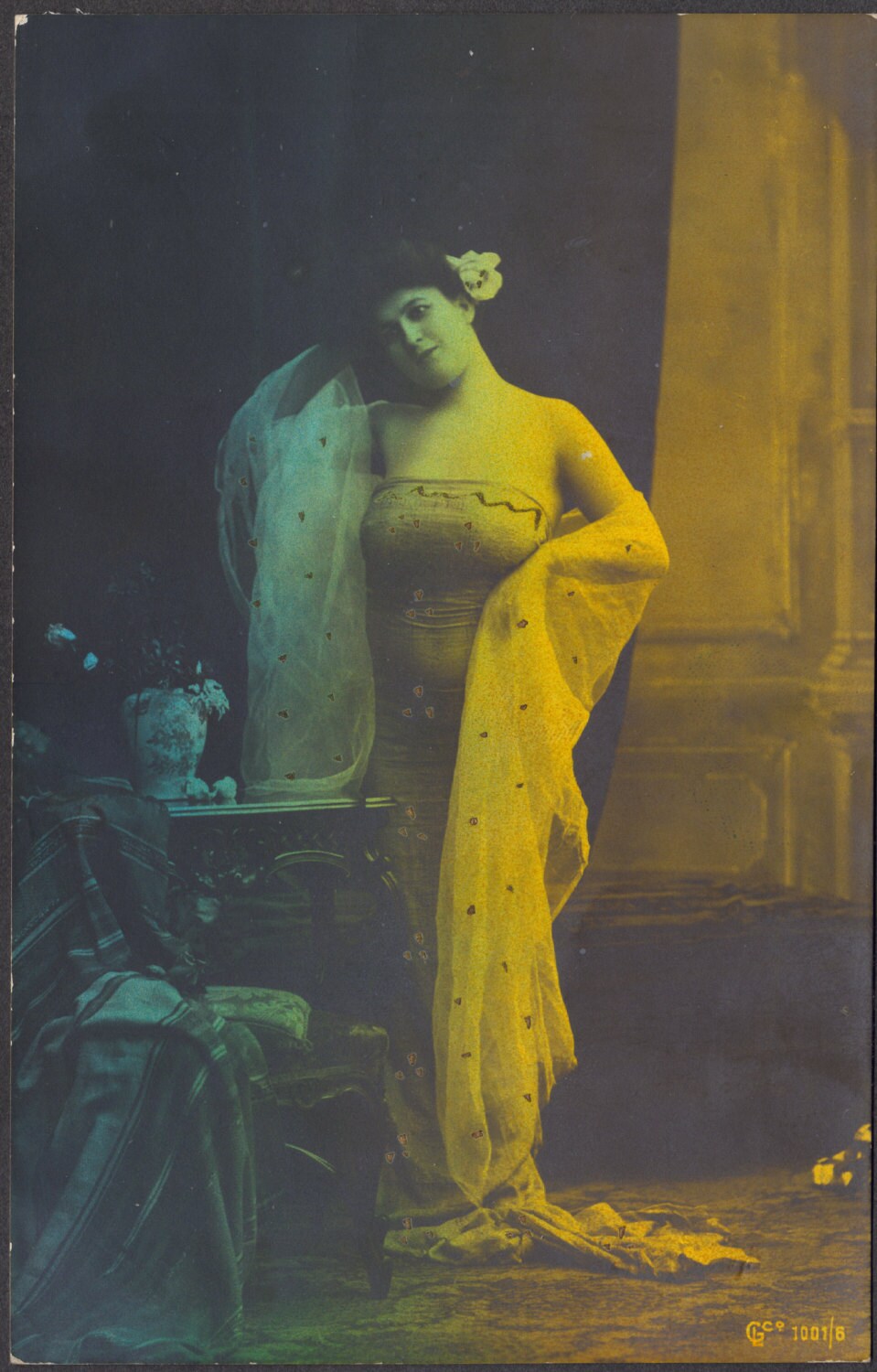
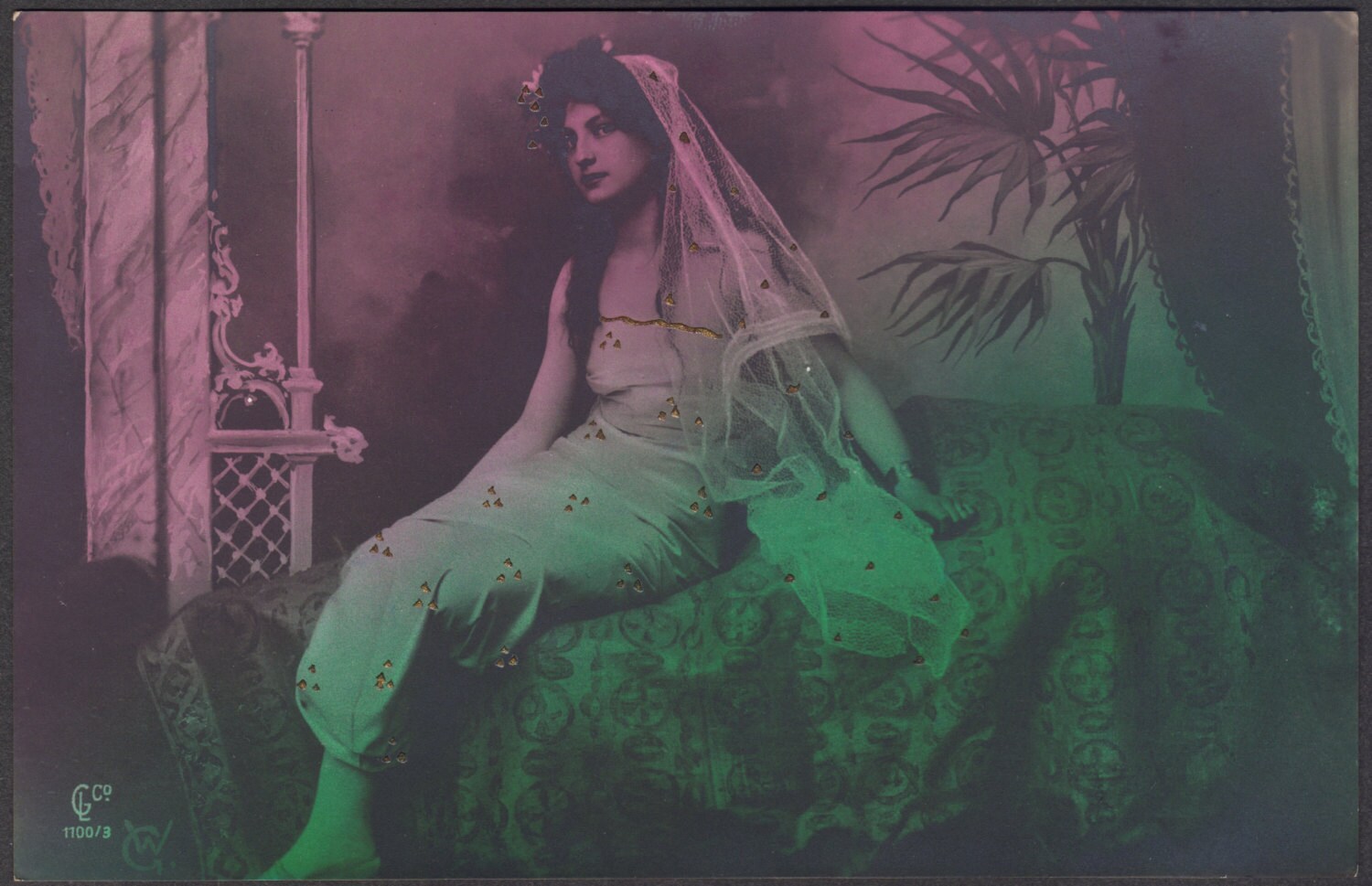
These gorgeous and weirdly ethereal images were accomplished using a type of coloration that was briefly popular during the early part of the twentieth century and which sometimes achieved amazing results. We know their vivid shades resulted from early experimentation with color tinting, but we simply can't find any credible information about the process used to create these fantastically tinted images. Over and over again, while researching hand-tinting of vintage photographs, we stumble across the sentiment that color was added to black and white photographs due to a desire to create images that more accurately mimicked life, but these images show that there were often other, more artistic, aesthetics at work.

The first of these images uses shades of blue fading into yellow. This enhances the impression that the woman in the picture is standing just on the border between shadow and illumination. While there are many possible interpretations of the symbolism in standing on the verge of both darkness and light, our favorite is that of standing with one foot in the mundane world and the other in Faerie, and such perception would be very in keeping with the sentiments of the era.

AVAILABLE FOR PURCHASE Dramatically Tinted Belle Epoque Image of Young Woman, circa 1905
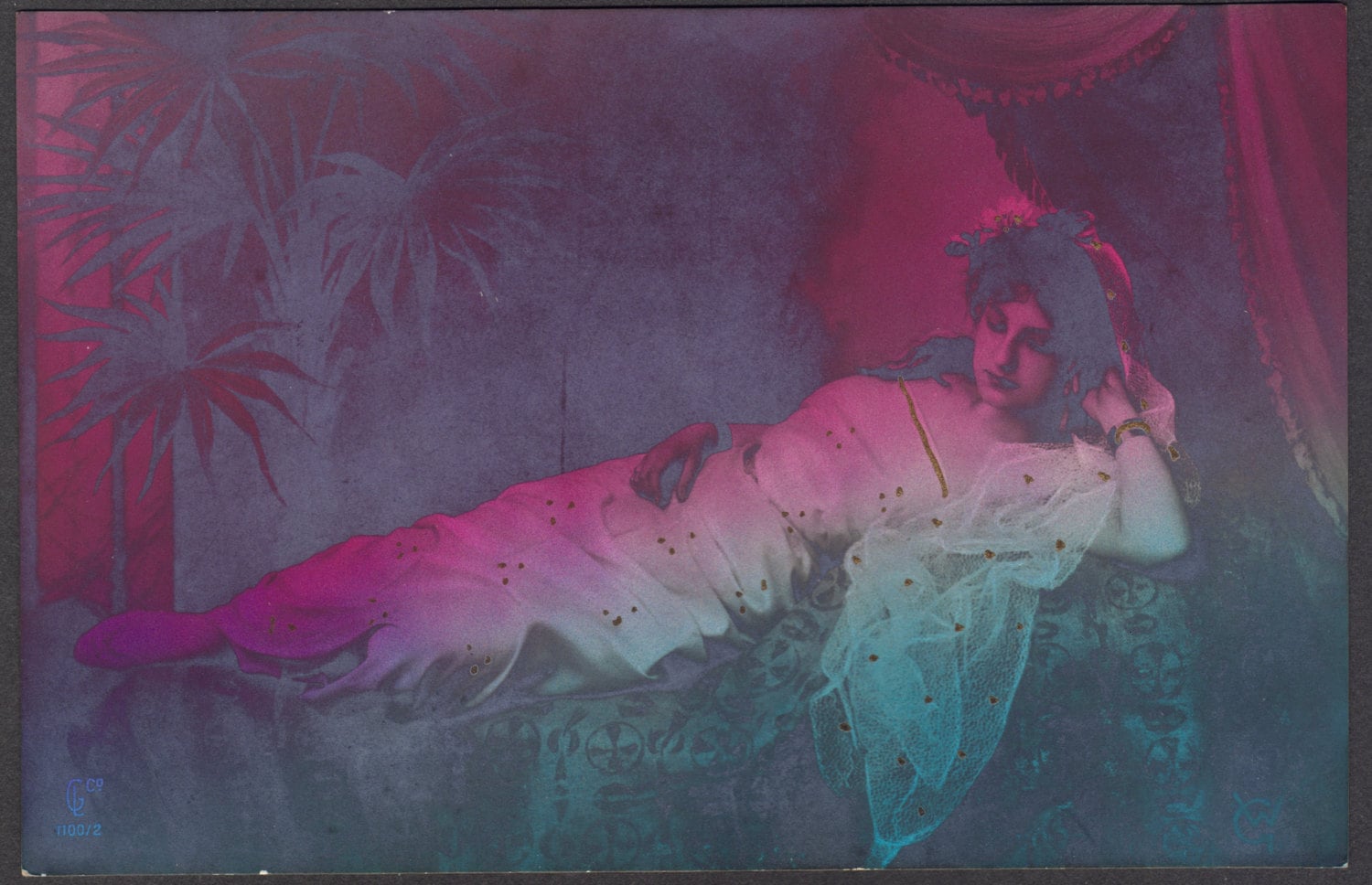
The following two images seem to be from a single photo shoot and were produced by the same studio as the first, although with a different model. Here, the coloration helps to lend an air of mystery and romance to the young woman, while her filmy gown and scarf, the draped couch upon which she reclines, and the decor, complete with potted palm, all contribute the sense that one has been given a rare glimpse into the Sultan's palace. The rich colors in the two images create very different moods: the seated figure could almost be a mermaid under the sea, while the deep fuchsia lends a sultry sensuality to the image of the reclining woman.

SOLD Dramatically Tinted Belle Epoque Boudoir Image, circa 1905
SOLD Dramatically Tinted Belle Epoque Harem Image, circa 1905
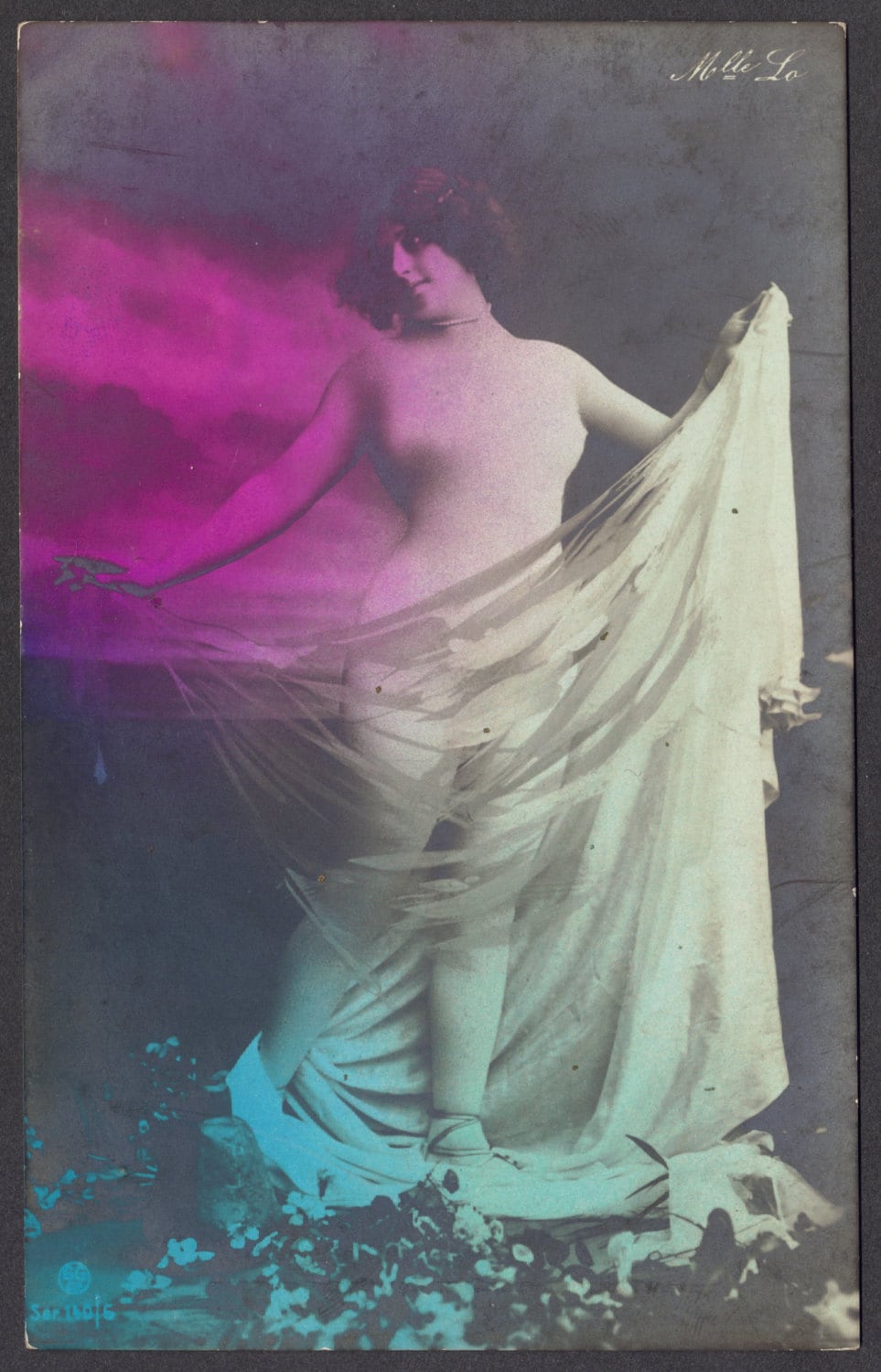
The last of our featured items is a postcard in which Mademoiselle Lo appears in a body stocking and veil. Body stockings were used for a short time at the turn of the century in an attempt to avoid prosecution for violation of decency laws discouraging onstage and photographic nudity, but the intended effect was that the actress appeared to be nude, or very nearly so. In this image, the cloudy sky on the left side of the image, along with Mlle. Lo's arm, face, and a bit of her torso, have been shaded with a deep rose, hinting perhaps of some impending storm or doom. Below the horizon, the shade used is a deep blue, suggestive of water, so that we may imagine that Mlle. Lo has just stepped from the sea onto land. Perchance she portrays some magical being of the sea, come to air herself for a short time before returning to her watery home. Or, maybe she is depicting a character in a play whose reasons for standing on this lonely beach are more tragic, or more playful. We may never know the full story behind this image, but we find its beauty and mystery haunting.

AVAILABLE FOR PURCHASE Mademoiselle Lo, French Artiste Nude en Voile, Fantaisie, circa 1905

Sunday, February 3, 2013

Kamajoeh, Mozambique Beauty En Voile, circa 1905

As well as being a lovely image in and of itself, this is a very interesting postcard for a number of reasons. The subject of the image, almost certainly an actress or performer, is a woman of color whose name (probably Swahili or possibly Malagasy), suggests she may have come from the Portuguese colony of Mozambique in Africa, or the French colony of Madagascar off Africa's coast. Though the postcard bears a German stamp and was probably produced in Germany, the image itself is quite probably French, as her costume, with layers of filmy material wrapped low about her shoulders, and her hair, done up in the classic chignon so popular in that period, are distinctly French European in style. 

AVAILABLE FOR PURCHASE Kamajoeh, Mozambique Beauty En Voile, circa 1905


Why do we find this so fascinating? Primarily because—although dance, music, and costume in the France of the late 19th and early 20th centuries was clearly influenced by the cultures of European colonial holdings—it is uncommon to find on postcards images of performers of color who actually come from these colonies.

Theatrical entertainment in France at that time was full of the romantic idealization of foreign cultures. Margaretha McLeod, a young Dutch woman who apparently learned Indonesian dance while locked in a terribly unhappy marriage in the Dutch East Indies, left her husband, made her way to Paris and, in the proud tradition of P.T. Barnum, changed her name to Mata Hari, billed herself as a Javanese princess, became hugely successful with her sensual dance routines, and the rest is history. There were so many others, many images of whom, from time to time, grace the cards we sell in our shop, but almost always they are white Europeans.

Still, though such images as this one are uncommon, we feel it's important to point out that the egalitarian nature of French society was such that performers of all cultural, religious, and ethnic origins made their way to Paris, where many found success and fame. After all, it was in the Paris of the 1920s that Josephine Baker, the famous African American dancer and stage performer, found a broad acceptance and venue for her talent that had not been available to her in the United States of that time.

Finally, we want to acknowledge that we are mere dabblers in history, and certainly not historians. Our focus is limited and narrow, and our short posts far from even remotely complete. So we offer our observations in the spirit of enthusiastic collectors, and hope they are welcomed by fellow enthusiasts and that our over simplifications of complex historical issues and events are forgiven by those more knowledgeable than ourselves.

Thursday, January 3, 2013

Featured Items: Beautiful Art Nouveau Images by Photographer Arjalew

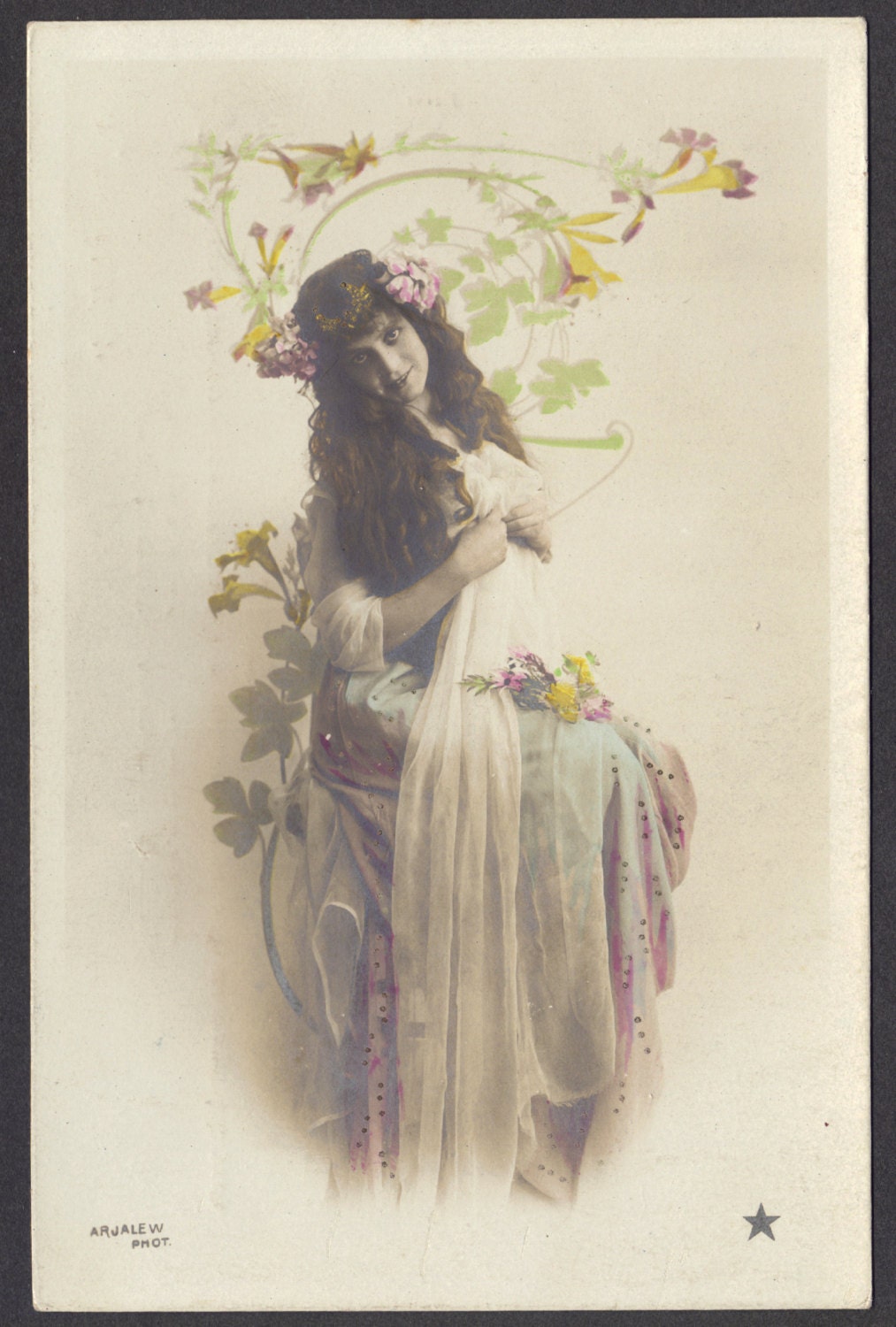
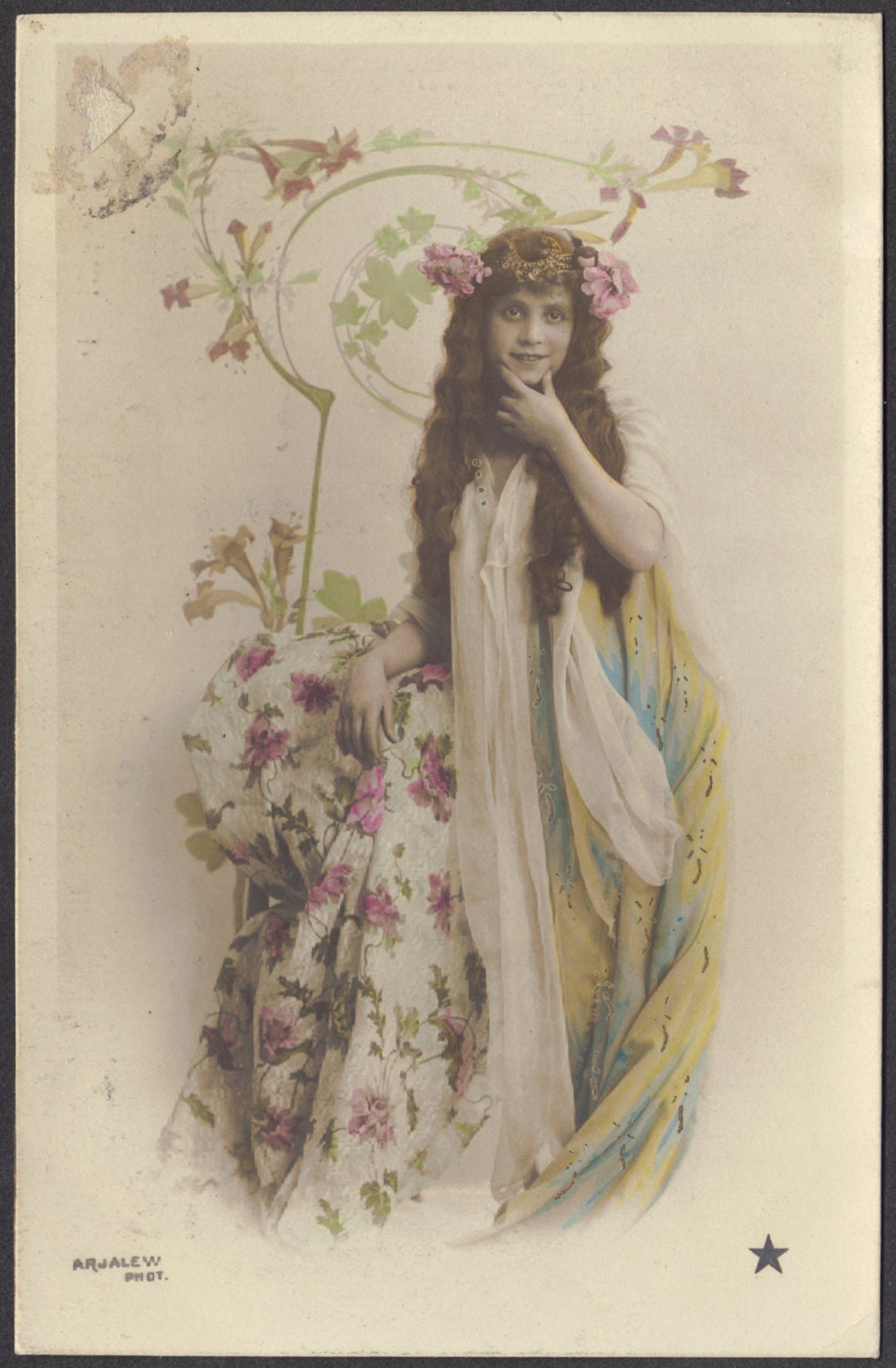
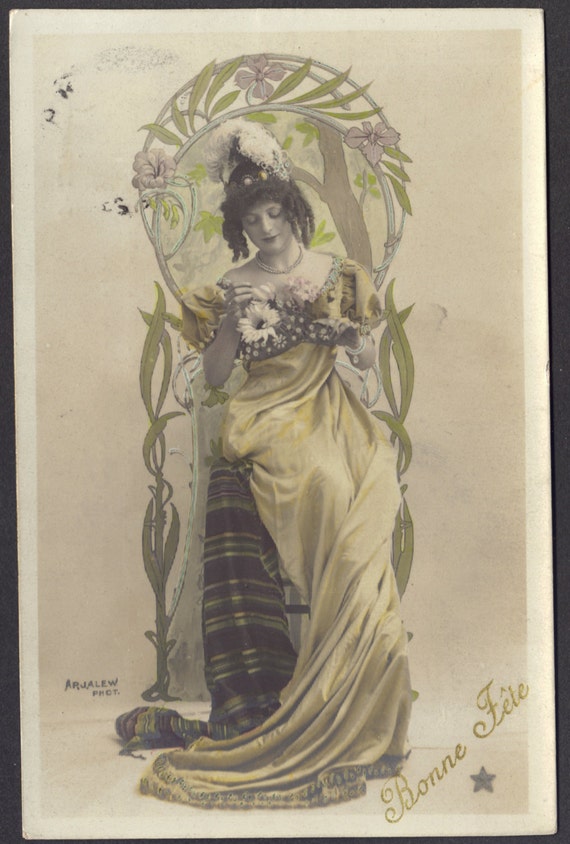
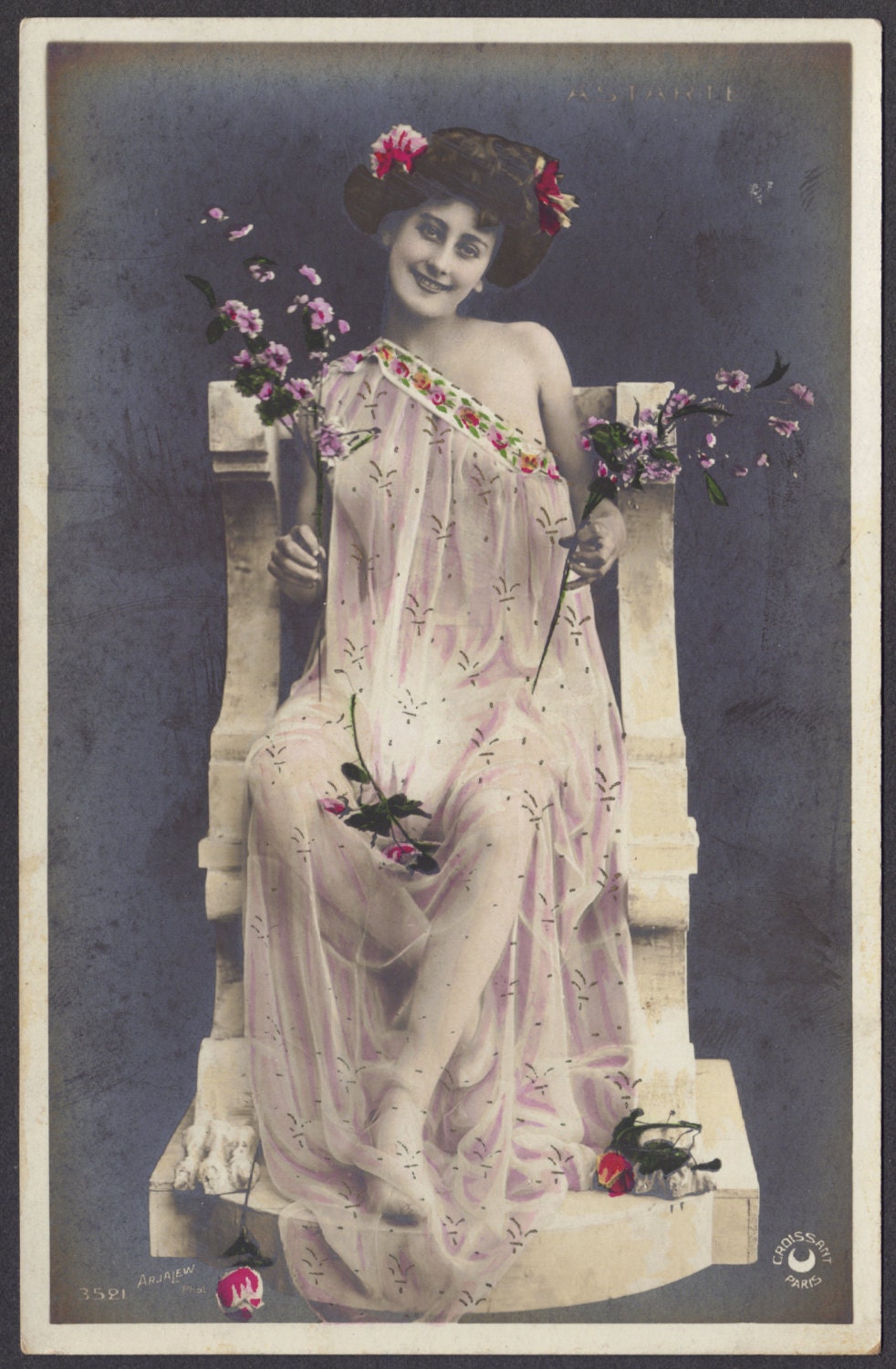
It's pretty amazing when our featured items sell so fast that we can't even get our blog post up, but that's what happened to two out of this beautiful collection of images. Fear not, you will still have the opportunity to view all four of these wonderful Art Nouveau images by the Belle Époque photographer, Arjalew (pronounced ari-ya-lev). Monsieur Arjalew was a Parisian photographer who operated a studio out of 17 Boulevard Poissoniere in Paris. His surname suggests a Polish heritage to us, but we are not experts and have been unable to find confirmation; one source, a French dealer in postcards, has listed Arjalew's work as Judaica, but we cannot confirm this, either. What we do know is that Arjalew created some really stunning Art Nouveau images, often using illustrated backgrounds with that quintessential Art Nouveau floral imagery  So, we now present to you, for your viewing pleasure, four of his lovely images, previously published as postcards.

The first two of these images are companion pieces, depicting as they do the same lovely young woman with her impish smile. She wears flowing draperies and flowers to either side of her face. In one she stands and in the other she sits, but in both the background is a wonderful design of leaves and flowers, very much like the designs found in the artwork of Alphonse Mucha. These images remind us, also, of the artwork of John R. Neill, whose portraits of Ozma and the other young ladies who inhabited Oz so often depicted them in flowing gowns and with flowers framing their faces.

AVAILABLE FOR SALE Beautiful Art Nouveau Portrait of Young Woman by Arjalew, circa 1905
AVAILABLE FOR SALE Beautiful Art Nouveau Portrait by Arjalew, circa 1905

The following image, with its annotation "Bonne Fête," may have been intended as a card to be given on a birthday, or in celebration of the feast day of one's patron saint. Once more, we see that an enchanting Art Nouveau background has been used to frame the model whose attention seems to be coquettishly focused on the flowers she holds in her hands, rather than on the photographer and the camera he points at her.

SOLD Lovely Art Nouveau Image by Arjalew, circa 1905

Our final image is of a young woman who is identified by the annotation in the top right corner as Astarte, the Greek name for a goddess whose roles encompassed fertility and sexuality and who was once "known as the deified evening star." Astarte's robes follow the Classical pattern so favored by Arjalew and other photographers of La Belle Époque, but are daringly sheer, in keeping with her roles involving sex and procreation. Unlike the other cards in this set, the background is plain, designed to disappear, so that only the model and the heavy stone throne upon which she reclines are visible. Yet this image, in keeping with the others, makes liberal use of flowers as a design element crucial to the depiction of youth and beauty, sexuality, and fertility.

SOLD Stunning Art Nouveau Astarte by Arjalew, circa 1905


Sunday, October 21, 2012

Salon de Paris Nude Portrait by M. Fronti

Early in the 20th century, the well-known photographer and publisher Alfred Noyer of Noyer Studios became involved in the Salon de Paris, more commonly called the Salon. Subsequent to his involvement in the Salon, he published the works of artists whose works had previously not been available to the general public.

SOLD Lovely nude image by artist M. Fronti, published by Alfred Noyer, c. 1905
Exhibition in the Salon was of key importance to becoming an established artist in France.

The Académie des Beaux-Arts was an organization devoted to preserving traditional French painting standards. In support of this goal, the academy promoted an annual juried show of art, the Salon de Paris, the first exhibition of which was held in 1725 (although the academy had organized other art shows as early as 1674). Prior to 1881, the Salon de Paris was sponsored by the French government, but in 1881 the government of France officially withdrew its sponsorship. After 1881, the show was sponsored by the Société des Artistes Français, which was an organization of all French painters and sculptors at the time of its foundation and whose principal purpose was to support the Salon. The Société des Artistes Français is still in existence today. 

A lot of the reason for the change of sponsorship of the Salon had to do with the birth of the Impressionist Movement, the rejection of Impressionist art by the more traditional artists who had previously controlled the Salon, and Napoleon's determination that the people should be allowed to decide for themselves the quality of the art. The origins of this shift then, actually occurred some 25 years previously, with the birth of Impressionism, and makes for some very interesting history reading, but for our purposes, what is also very important is what occurred just a few years before this postcard was published. In 1890, the Salon splintered again, this time over the desire of many within its ranks to encourage, through exhibition, young, previously un-awarded artists. This shift is the reason for a tremendous number of postcard images of beautiful artwork, such as the M. Fronti nude, pictured above, by relatively unheard of artists. It is a refreshing source of little known work, accessible to us thanks, in part, to publishers like Alfred Noyer.

Thursday, September 13, 2012

Saharet, the India Rubber Lady

SOLD Saharet
The Australian dancer Saharet was born Clarissa (or Clarise) Rose Campbell in either Melbourne or Ballarat, in 1879.[1, 2] A talented and limber dancer known for her ability to do high kicks, "a reviewer described Saharet as an India rubber lady in her rendition of a dislocation dance."[1]

Beautiful and vivacious, she led a full and interesting life. We hope to share a more complete biographical post with our readers at some time in the future. Today, we are sharing this video of a 1905 silent film clip, showing Saharet dancing the Bolero.[3]


Note A shorter video of the same film clip, but with an added musical sound track, is available at http://www.youtube.com/watch?v=1crlXwGhXcM.

An interesting side note to the silent film clip shown in these videos is that it was directed by the Frenchwoman Alice Guy (married name Blanché), who was, according to IMDB, the first woman to become a film director.[4, 5]

[1] Saharet. (2012, August 2). In Wikipedia, The Free Encyclopedia. Retrieved September 13, 2012, from http://en.wikipedia.org/w/index.php?title=Saharet&oldid=505444955
[2] Saharet. n.d. In HAT-History of Australian Theatre. Retrieved September 13, 2012, from 
http://www.hat-archive.com/Saharet.htm
[3] Change Before Going Productions. (2012, April 28). Saharet performs the bolero (1905) - Alice Guy Blanche - Madame Saharet boléro. In YouTube. Retrieved September 13, 2012, from http://www.youtube.com/watch?v=uD0nJYf4Cg4
[4] Saharet, boléro. n.d. In IMDB. Retrieved September 13, 2012, from http://www.imdb.com/title/tt1649402/
[5] Alice Guy. n.d. In IMDB. Retrieved September 13, 2012, from http://www.imdb.com/name/nm0349785/


Hot Pink Hand-Tinted Vintage Photograph of a Romantic Couple on a Beach


Friday, September 7, 2012

Mlle. Joly Violetta, Famous European Dancer

At the turn of the twentieth century, the beautiful French star Joly Violetta graced the stages of theaters around the world . A dancer and pantomimist, her career began in Europe, but her popularity carried her to South Africa and Brazil, as well as the United States.

AVAILABLE FOR PURCHASE Joly Violetta  plays a gypsy in 1905
Joly Violetta often partnered with the Brazilian dancer Arnaud, who "assisted [her] in parodies and Brazilian dances." Alone, and with M. Arnaud, she trod the Vaudeville stage, headlining with Will Rogers and other famous acts of the time.


SOLD Mlle. Joly Violetta
Joly Violetta introduced a popular pantomime in Berlin, which she brought with her to the United States and performed in her first US appearance at the St. Paul Minnesota Orpheum Theater. Her performance was positively reviewed in the January 23, 1909 issue of the New York Star:


Despite her many successes on the stage, we have been able to learn very little about Joly Violetta's personal life, making her something of a mystery. We do not know where she was born, nor the date of her birth, and her later life is also obscure. Should anyone have any information which could shed some light on her biography, we would be delighted to learn of it.

We are lucky enough to have found another image of Joly Violetta, which will soon be available in the Red Poulaine Etsy shop:

As you can see by the embroidery on her blouse, Joly Violetta is wearing a costume that is either the same, or very similar to, the one she is wearing in the first postcard in this post. We find the details of this costume particularly wonderful, from the embroidery on the blouse and vest, to the simulated tatters, or flower petal designs, of the skirt, and we hope that you will agree that this is a wonderful find.