Showing posts with label photography. Show all posts

Saturday, June 20, 2015

Young Dancers, Pozega, Croatia, by Atelier Wollner, circa 1920s

This RPPC (Real Photo Post Card) was produced at the Atelier Wollner in Prozega, Croatia (what was then Yugoslavia), a small Eastern European city whose history stretches back a thousand, or so, years.


$22.00 USD by Red Poulain via Etsy:

There was a C. Wollner there, making photographic portraits on cartes de visites in the late 19th century, and quite possibly this is the same Wollner, or another member of the family, the name of the studio having changed over time from C. Wollner, to Atelier (workshop, or studio) Wollner, as additional family members, or business partners joined in.

Was the photographer a man or a woman? We don't know, but it might surprise you to find out just how many photographic studios were actually operated by women. According to an article we found on Wikipedia, prior to World War II in Vienna, Austria, most of the photo studios were in fact operated by women, and most of these were Jewish women! This implies that at least 25% of photo studios in Vienna at that time were operated by Jewish women. Why does this matter? Because it gives us a valuable perspective on the images we love.

Way back in the 1850s, in the early days of photography, both women, and Jews, flocked to the profession. Let's remember that in those days, society placed all kinds of roadblocks in the path of those two groups of people (among others, of course), limiting their potential involvement in industry, business, and the arts. But photography was new! It was not broadly accepted in the well established arts community, and so there were no centuries-old guilds that had established rules (often legislated) restricting the professional participation of people who were so often limited in their choices of work and creative expression.

These opportunities carried forward into the 20th century, and into the publication of picture postcards, where all across Europe, and in the USA as well, a very large percentage of the people involved with the cards we sell were Jewish, and a much larger percentage than we might have imagined, women.

The Wollners of Prozega, for example, were probably Jewish. We know of at least one, an Else Wollner, born in 1902, who was a Jew, and who was murdered while in her early forties, by the fascists at Auschwitz in 1944. Many members of the Wollner family (unnamed in the records we accessed) perished in the holocaust, though we were unable to find any records concerning a C. Wollner, or a Wollner who was a photographer.

We apologize for letting some of the dark into this listing. We honestly feel that our images are not merely flat photographic prints, but that they live in a way, and are imbued with their original environment and with the life experiences, not only of their subjects, but of their makers too. So, knowing a little more about these ephemeral elements of their make up helps to round out, and add depth, lending, for example, a poignance to this wonderful image that takes us back to what was still a kinder time, filled with the joy of this group of lovely young ladies, taking pleasure in what was perhaps a recent, and triumphant performance.

Thursday, June 18, 2015

Calling Forth the Spirits of the Old Trees. French RPPC, circa 1910s

Journal Entry, May 6th, 1917 (Alternate Universe A-79/B4)

"The streets are empty now. Any human beings remaining in the towns and cities shelter like me, amidst the corpses, the bones, of human industry.

Its flesh, composed of window-glass and roof shingles, paving stones, all of it returns now to the earth. Those few people who remain, they will be gone soon like the rest, herded, like obedient cattle that follow a scattering of mown hay, into one of the borderlands the Fair have prepared for us.

il_570xN.786319153_e75q.jpg
$24.00 USD by Red Poulaine via Etsy:
www.etsy.com/listing/236908186/calling-forth-the-spirits-of-the-old


There is something in the air that has caused all objects made of iron or steel to oxidize dramatically over these past few months. The machines and weaponry in which we had invested so much confidence and treasure, decompose into powder at the barest touch.

And the ancient forests are returning so quickly. Growing at the pace of a year in a single day, the great trees push through once level floors, weakening foundations, slowly scattering walls, rooftops, entire buildings, into so much rubble.

This broken dross of what was our civilization is so quickly overgrown by ivy and thistles, wildflowers, raspberry canes and the like, that entire city-scapes disappear in a matter of weeks, retained now only in memory. And one begins to question memory, as if the tangled ivy growing everywhere has forced its tendrils into our skulls, strangling thought.

The rats are leaving too, now that we, their benefactors, have gone. Wolves and foxes roam the cities. They pose no danger to us. In fact, they ignore us, as if we represent not even a footnote on a page of this world's history, and are no longer of consequence, not even as food.

They treat us much as the Fair did when they first returned, appearing suddenly from amidst the trees and brambles of tame woods and copses. They did not even meet our eyes as they went about their business. So graceful, like deer at a meadow stream, so terrible and unstoppable, ever in bands of eight, gathering to dance, and to sing the forest back. They filled the air with magic so thick it closed the throat as we looked on, powerless, gasping our sudden, amazed breaths.

It was the war between the great nations, I think, that roused them. That mindless, bitter, conflict seemed certain to rain the blood of our children down upon us all. It was as if the First People, the Fair Folk, knew the world had finally endured enough of us. How certain of ourselves we were, of our place, our primacy, our gods. We are cast out now. I cannot even remember what it felt like then, what it meant to feel that I belonged, that this world was mine."

Now you tell one :)

A really remarkable image, contrasting a stark, empty, perhaps industrial landscape with this lovely, fragile, and yet strong, circle of young dancers.

It is unfortunate that the printer offset the image on the printing paper by a bit. You will notice, by looking at the back of the card, that it was not poorly trimmed, just misprinted by a little. And speaking of the printer, an interesting point! This card was printed in "Angleterre," England. This is interesting because so much photo printing was done in Germany, the European center of that industry during the early years of the photo image postcard, so it seems very likely that this photograph was taken by Monsieur, or Mme., Breuly in France, but sent for printing in England. Why? Because this was probably during the great war, WWI, during which so much of Germany's industry which had depended on trade with countries that were now its enemies, either lay idle, or was diverted to the war effort. And, of course, this clue allows us to date this precious gem with reasonable accuracy, to sometime in the mid, to late, 1910s.

Tuesday, July 23, 2013

Chrysanthèmes and Dragonfly by Henri Manuel, circa 1905

Unlike Leopold Reutlinger and Count Ostorog, aka Walery, who seemed to specialize in "entertainment" photography, Henri Manuel, who with his brother, Gaston, operated the largest photography studio in Paris, covered a very broad array of subjects. That is not to say that Walery and Reutlinger didn't ever step out of the showgirl portrait genre, we know they did, but Manuel was the official photographer for the French government between 1914 and 1944, established one of the earliest "news" photo services, and was well known for his architectural studies.

Henri Manuel's photograph of Auguste Rodin and the Duchesse de Choiseul at the Hôtel Biron. Wikipedia

He did not, however, shy away from "eye candy;" far from it! He was quite adept at risque images, and managed to bring a very artful feel to many of his "artiste" portraits.

AVAILABLE FOR PURCHASE Chrysanthèmes by Henri Manuel
This card offers a fine example of this, we think. Without question, la Belle Epoque, in France, was the era of the chrysanthemum. In images of pretty young dancers, mothers with their little girls in tow, opera divas, etc., the use of the chrysanthemum as a hair decoration was ubiquitous. Most often, they are seen worn at the temples, and here Manuel positions the flowers in their accustomed location, but without removing them from the stem, creating a thoughtful study with a feel of nature, and the placement of the dragonfly is wonderful. Really a gorgeous image.

***Note*** It might be of some interest to collectors that during WWII almost all of the photographic plates housed in the Manuel studio were destroyed, making images by H. Manuel all but irreplaceable.

Thanks to Wikipedia for most of the historical information in this posting.


Saturday, June 15, 2013

Images of the Fantastic in La Belle Époque

One aspect of La Belle Époque, not just in France either, was a very palpable embrace of antiquity, and though often in a rather naive fashion by today's standards, one gets the sense that people were turning away from the onslaught of the industrial explosion and towards the real, and imagined, simplicity of earlier times. With this came a sense of the possibility of magic, and the ubiquity of images like this one, in which we wouldn't be terribly surprised to see faeries or woodland sprites cavorting about.

SOLD Wood Nymph at the Well
Or, perhaps we expect at any moment to see a faun, satyr, or even Bacchus, himself!

SOLD Nymph Calling Forth the Woodland Sprites circa 1905

We love the way in which the magical is suggested in these images, without the introduction of a single truly fantastic element. These images make us feel much as we might when reading a fairy tale, that at any moment something truly marvelous will happen.

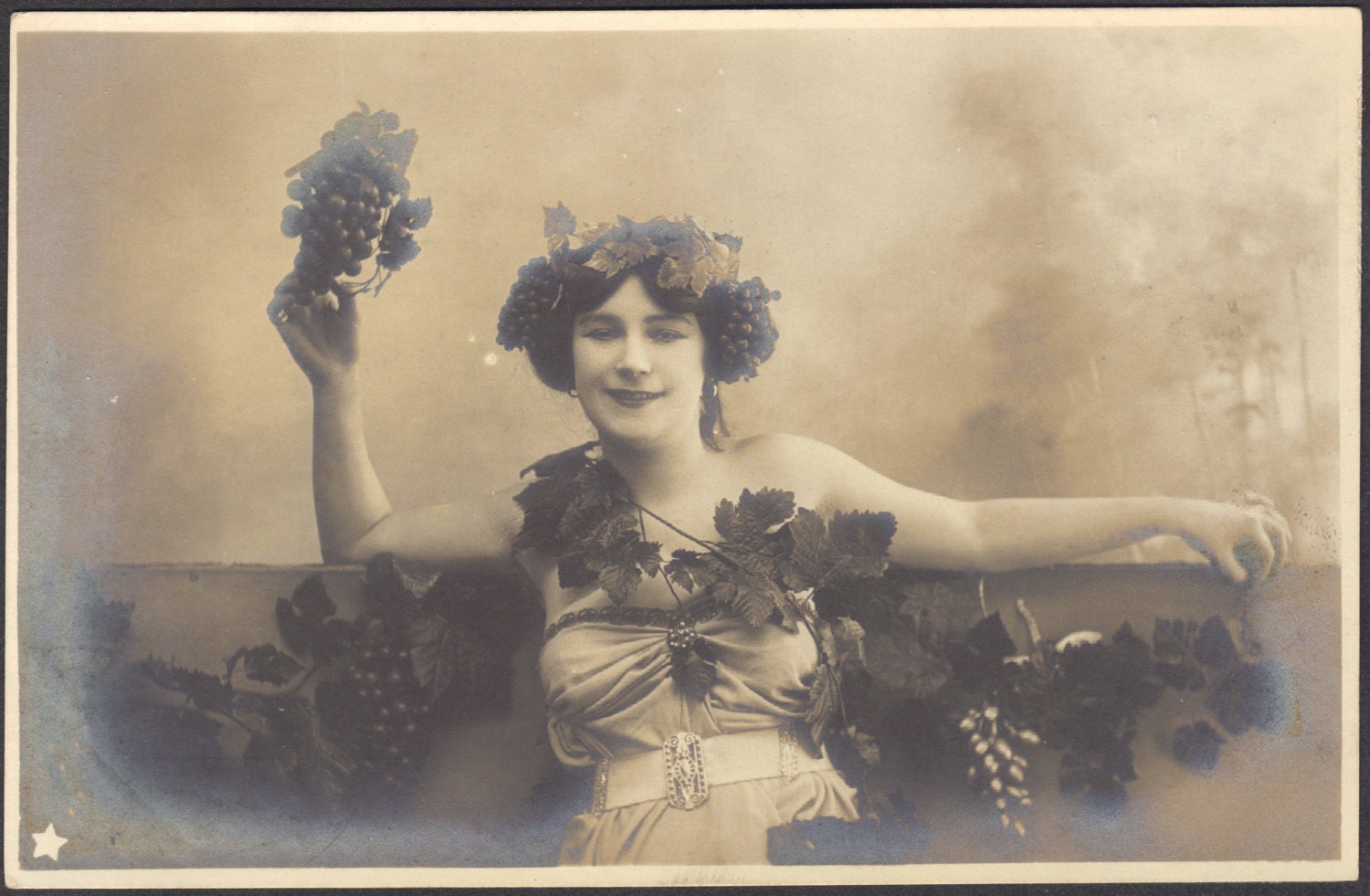
Nymphs, Naiads, Dryads, and Faerie folk so often cropped up in La Belle Époque. Found throughout the period from popular entertainment to commercial advertising, these images reflected a blossoming of Western occult experimentation and a yearning for magic, for myth made manifest. We've written before of our fondness for images depicting the Marvelous Maenad, which is not only a subgenre of the "Lovely Lady" category, but of fantasy postcards, as well.

AVAILABLE FOR PURCHASE Maenad at the Garden Wall, circa 1900
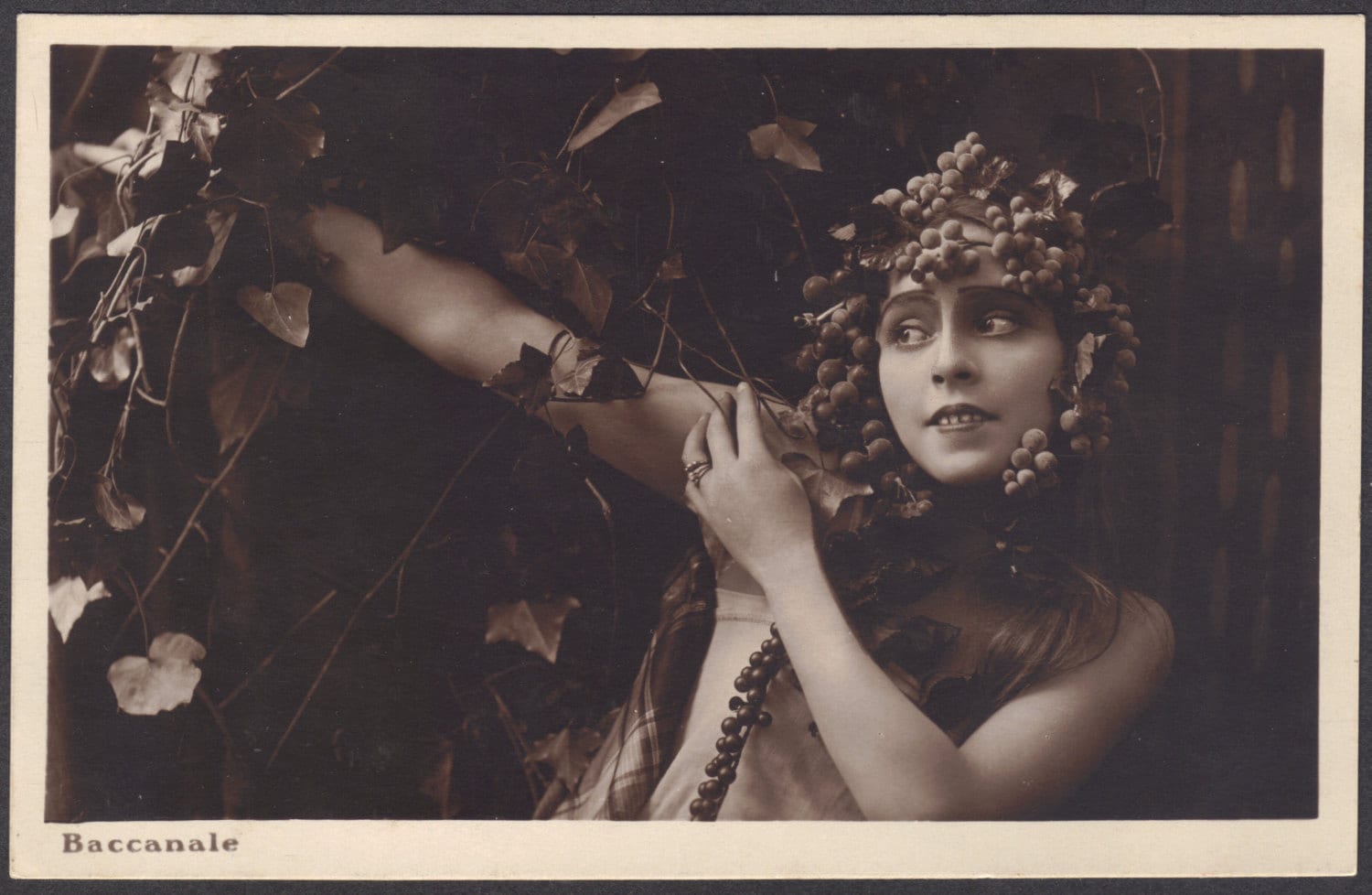
Maenads could be seductive, inviting the viewer to join them in the Bacchanal, as in the previous image, but they could also be depicted as shy and elusive creatures of the wilderness, emerging from a tangle of vines, perhaps looking back with a mixture of amusement and discomfiture at a pursuer.

AVAILABLE FOR PURCHASE Maenad Peering Through the Trees, circa 1910s/20s
Even more interesting, we think, is the fact that this new medium, the picture postcard, made available to anyone with a penny or two the possibility of possessing such an image, one in which an obviously very real human being is pictured in a fairyland setting. We take photographs for granted today, of course, but think about it for just a moment—at the turn of the 20th century, this was all entirely new. Prior to this time, fantastic photo images of human beings were seldom accessible to the common man, woman or child, and we cannot take lightly the effect of "likeness" on the human psyche, and it's worth considering the effect this mass phenomenon had on society. Mass phenomenon, you wonder? Really? Absolutely. Just as an example, in the United States alone, "the official figures from the U.S. Post Office for their fiscal year ending June 30, 1908, cite 677,777,798 postcards mailed. At that time the total population of the United States was only 88,700,000!" (Thanks to emotionscards.com for their fascinating article that provided us with that factoid.)

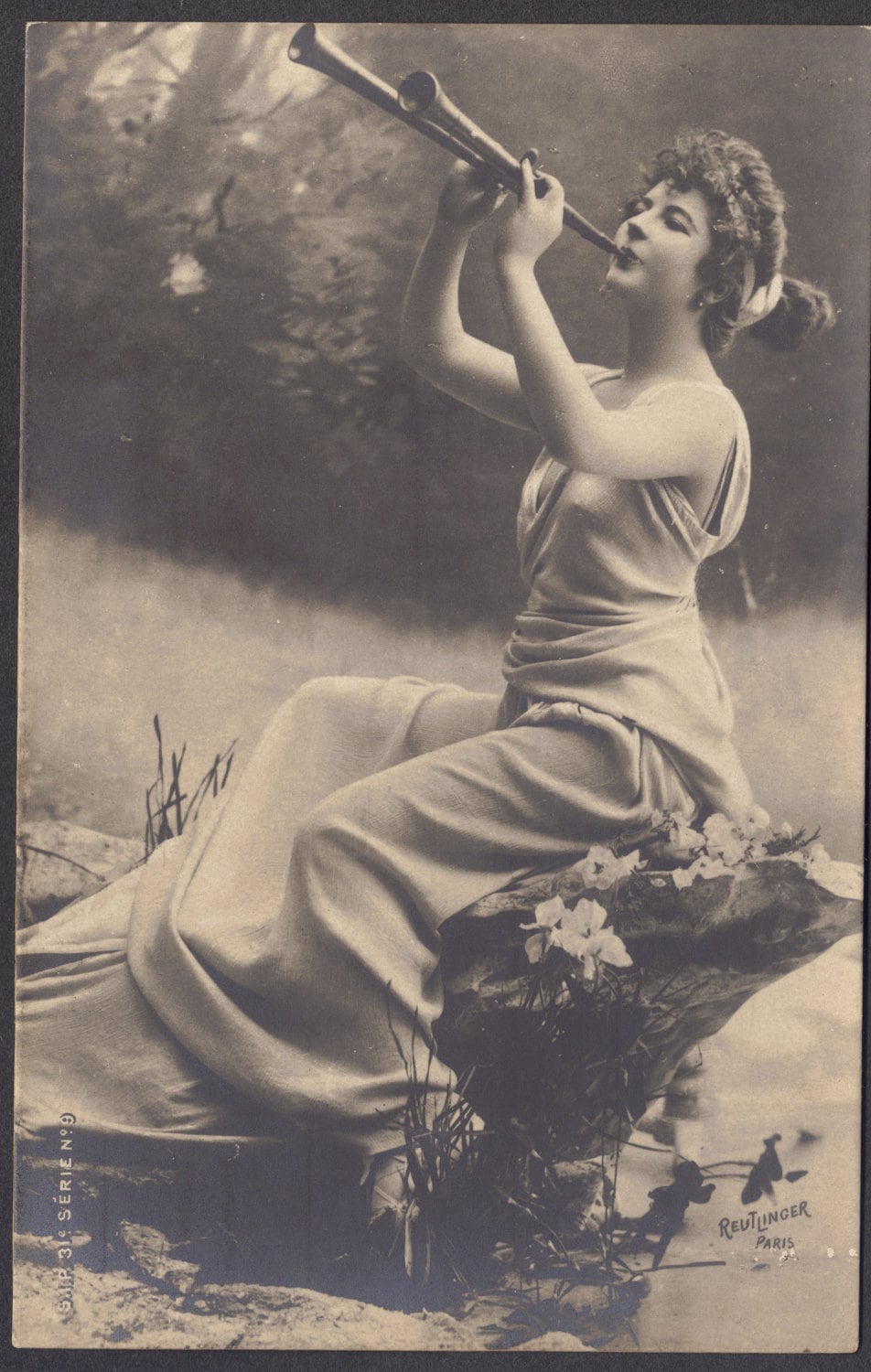
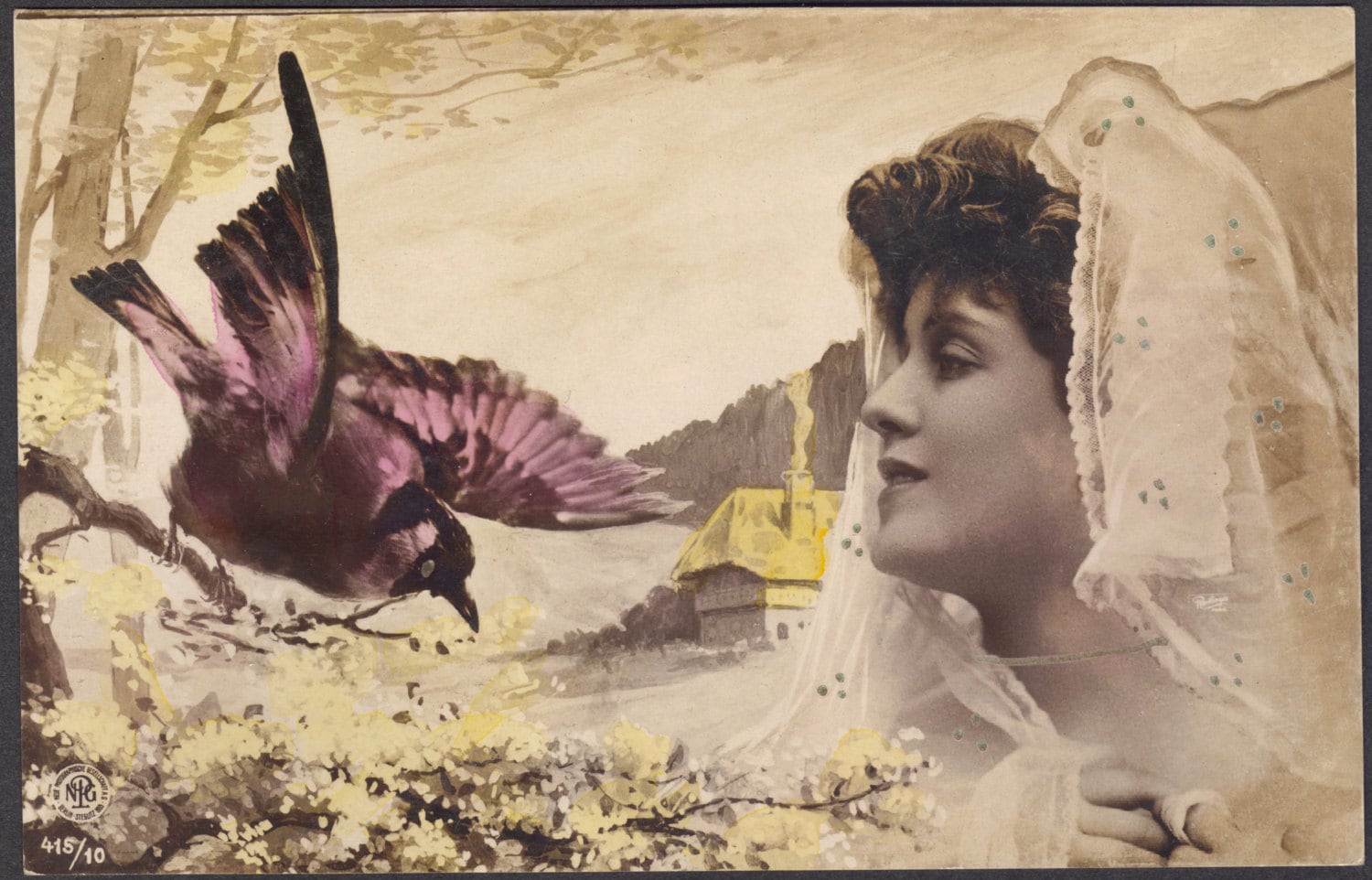
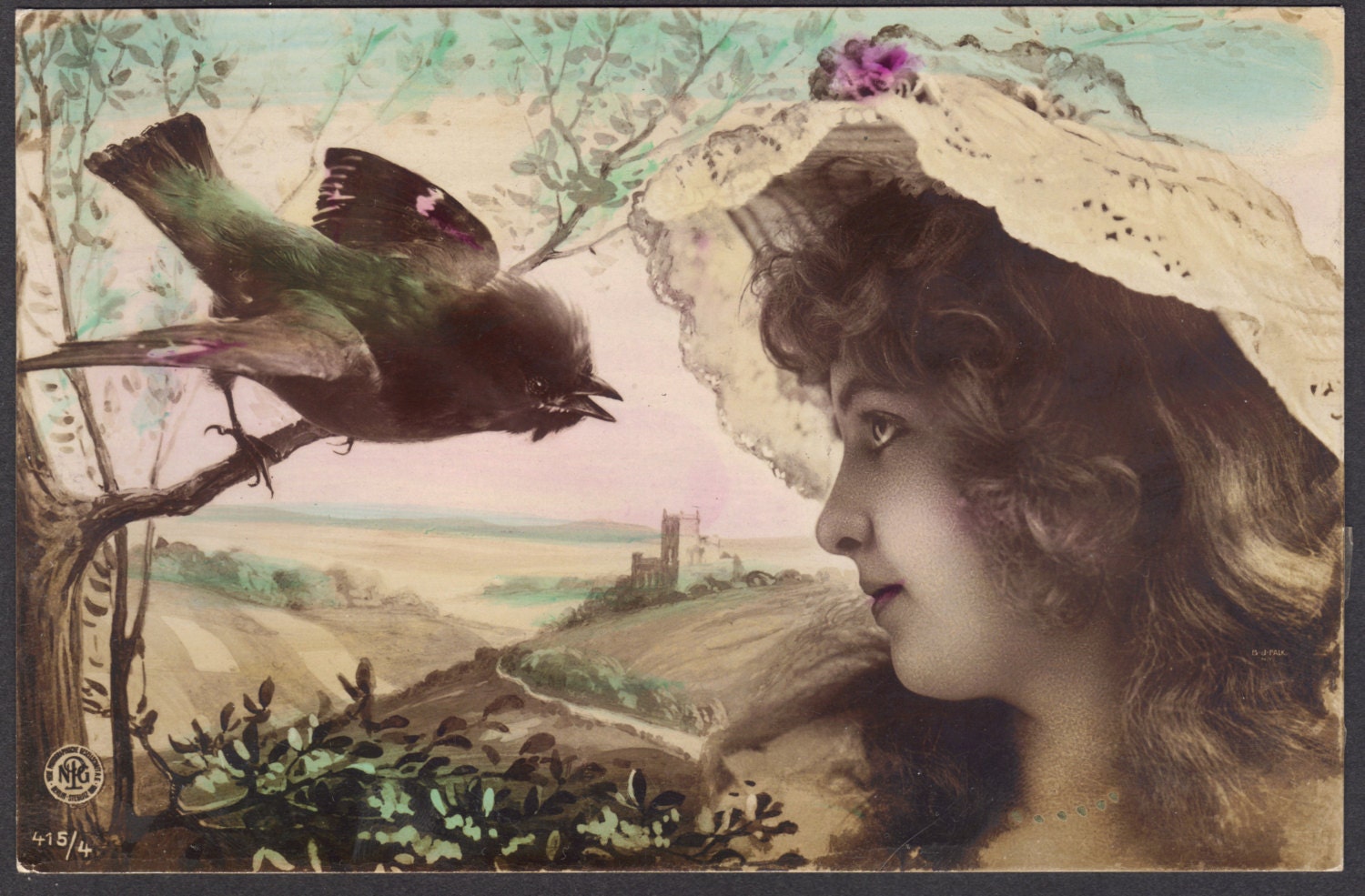
Leopold Reutlinger, the Belle Époque photographer, took thousands of photographs of famous Parisian actresses. These were published in black and white, cropped to close up and republished, hand tinted, glittered, sequined, published again, and when every imaginable possibility had been explored, he superimposed these images onto wonderfully fantastic, often surreal backgrounds. The "Artiste with Bird" series is one of our favorites and quite collectible. As of this writing, we have two such images, both by Reutlinger and in unusually fine condition.

AVAILABLE FOR PURCHASE Marguerite Brezil, Belle Epoque French Actress, Interspecial Romance Image by Reutlinger


AVAILABLE FOR PURCHASE Avian Romance Fantaisie by Leopold Reutlinger of Paris, circa 1905
Can't you just imagine these lovely ladies as heroines in fairy tales, in which for their kindness they have been rewarded the ability to speak the language of the birds? Or, perhaps the bird in the picture is actually an enchanted prince, in need of saving by the brave young woman.

One of the issues with Reutlingers "fantaisies," is that although the artiste's name was usually printed on the face of the card in its early incarnations, by the time they got to these dramatic creations, the name would often be left off. This was fine at the time, since their faces were very well known, but not today. We've been able to identify the first of these two beauties as Marguerite Brezil, but the identity of the second remains a mystery and we would welcome any clues that might shed some light on this.

These wonderful fantasy-inspired photographic images quite clearly reflect the same underlying ideals found in Victorian fairy paintings and Victorian attempts to portray fairies in photographs, a connection which ties them in with the Romanticism of the late 18th and early 19th centuries. In his examination of fairy paintings, Jeremy Mass identifies "the turn to mythological and fantasy elements, and in particular to the fairy's world, [ as allowing] an escape from these demands. 'No other type of painting concentrates so many of the opposing elements of the Victorian psyche: the desire to escape the drear hardships of daily existence; the stirrings of new attitudes toward sex, stifled by religious dogma; a passion for the unseen; the birth of psychoanalysis; the latent revulsion against the exactitude of the new invention of photography.'" That photographs, emblematic in some eyes of the science and technology that was displacing many traditional beliefs and occupations, could be manipulated to portray the longed-for simplicity and magic of a bygone (never-was) era was marvelously ironic and ironically marvelous. Photographs, which Jeremy Mass, and many others!, fuse with conformity to a hard and unforgiving realism have, from almost the very moment they came into existence, been used to portray the world in ways the eyes are rarely able to see, providing us with visual evidence of the magic we all long to see.

Sunday, February 3, 2013

Kamajoeh, Mozambique Beauty En Voile, circa 1905

As well as being a lovely image in and of itself, this is a very interesting postcard for a number of reasons. The subject of the image, almost certainly an actress or performer, is a woman of color whose name (probably Swahili or possibly Malagasy), suggests she may have come from the Portuguese colony of Mozambique in Africa, or the French colony of Madagascar off Africa's coast. Though the postcard bears a German stamp and was probably produced in Germany, the image itself is quite probably French, as her costume, with layers of filmy material wrapped low about her shoulders, and her hair, done up in the classic chignon so popular in that period, are distinctly French European in style. 

AVAILABLE FOR PURCHASE Kamajoeh, Mozambique Beauty En Voile, circa 1905


Why do we find this so fascinating? Primarily because—although dance, music, and costume in the France of the late 19th and early 20th centuries was clearly influenced by the cultures of European colonial holdings—it is uncommon to find on postcards images of performers of color who actually come from these colonies.

Theatrical entertainment in France at that time was full of the romantic idealization of foreign cultures. Margaretha McLeod, a young Dutch woman who apparently learned Indonesian dance while locked in a terribly unhappy marriage in the Dutch East Indies, left her husband, made her way to Paris and, in the proud tradition of P.T. Barnum, changed her name to Mata Hari, billed herself as a Javanese princess, became hugely successful with her sensual dance routines, and the rest is history. There were so many others, many images of whom, from time to time, grace the cards we sell in our shop, but almost always they are white Europeans.

Still, though such images as this one are uncommon, we feel it's important to point out that the egalitarian nature of French society was such that performers of all cultural, religious, and ethnic origins made their way to Paris, where many found success and fame. After all, it was in the Paris of the 1920s that Josephine Baker, the famous African American dancer and stage performer, found a broad acceptance and venue for her talent that had not been available to her in the United States of that time.

Finally, we want to acknowledge that we are mere dabblers in history, and certainly not historians. Our focus is limited and narrow, and our short posts far from even remotely complete. So we offer our observations in the spirit of enthusiastic collectors, and hope they are welcomed by fellow enthusiasts and that our over simplifications of complex historical issues and events are forgiven by those more knowledgeable than ourselves.

Tuesday, December 4, 2012

Featured Items: Dazzling Beauties

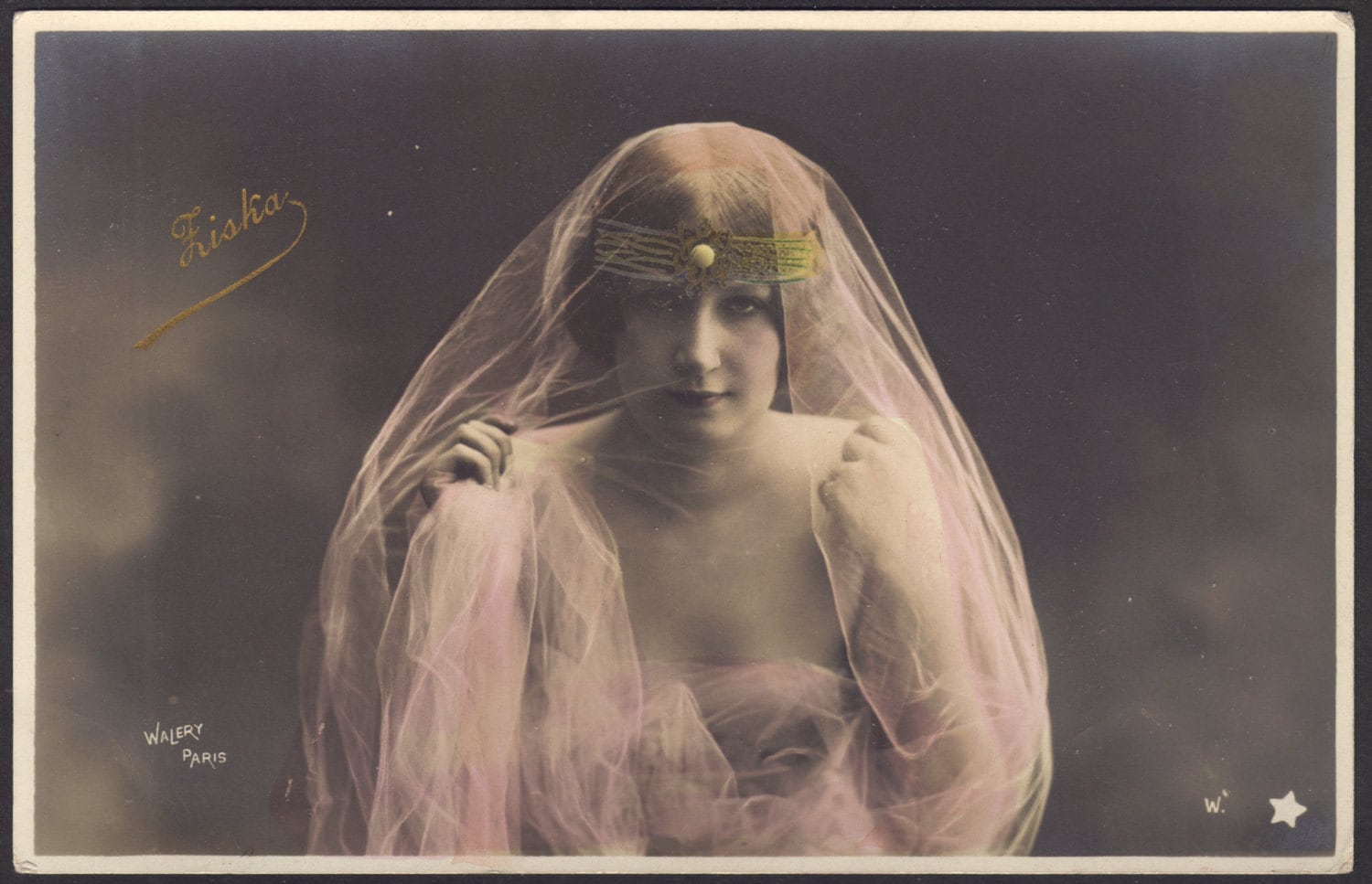
The currently featured items in Red Poulaine are postcards with portrait images of young women, all dazzling beauties.

This wonderful portrait in profile of young artiste Florence Cresby was taken at the truly fine, Scloss Studio of New York, (we don't believe we've ever seen an image of theirs which wasn't really grand), which is why we're guessing Flo was an American girl, but the card was published by SIP, or Societe Industrielle de Photographie, a wonderful French Publishing house which handled a lot of Reutlinger's work, among others. Which is why we're guessing she was performing in Paris :) What a beautiful young woman! What a marvelously concieved photograph! Card is in almost perfect, unposted condition with a tiny crease in bottom left corner. We so love it when we get lucky like this. Schloss studio date of 1899 in lower left quadrant. Graceful age discoloration, but otherwise, wow!

AVAILABLE FOR PURCHASE Florence Cresby, American Girl in Paris, 1899
Our next image is a beautiful portrait of the artiste D'Albray, her upturned eyes lending her a soulful expression. Her gown is decorated with a floral motif that reminds one of a medieval tapestry, and the large basketwork buttons at the corners of the squared neckline contribute to the effect. Perhaps she is portraying a princess awaiting her fairy godmother?

AVAILABLE FOR PURCHASE Mlle D'Albray Belle Epoque Artiste by Reutlinger, circa 1905
From Alfred Noyer's collectible and truly fine series, "Les Plus Belles Femmes de France," comes Le Rouge. Lovely profile portrait of a French woman of the 1910s, or 20s, beautifully coiffed and wearing thin gauze across her shoulders, and a necklace of tiny pearls.

AVAILABLE FOR PURCHASE Le Rouge, or, The Redhead, from Noyer's Les Plus Belles Series circa 1910s/20s
Probably published circa 1905, this French card, posted 1910, presents a lovely portrait of a young girl with flowers, a spirit of Spring. We don't know the girl's name, but we do know she is, you guessed it, a dazzling beauty.

AVAILABLE FOR PURCHASE Sweet Child of Spring posted 1910


Tuesday, November 20, 2012

A Handsome Man, Post WWI

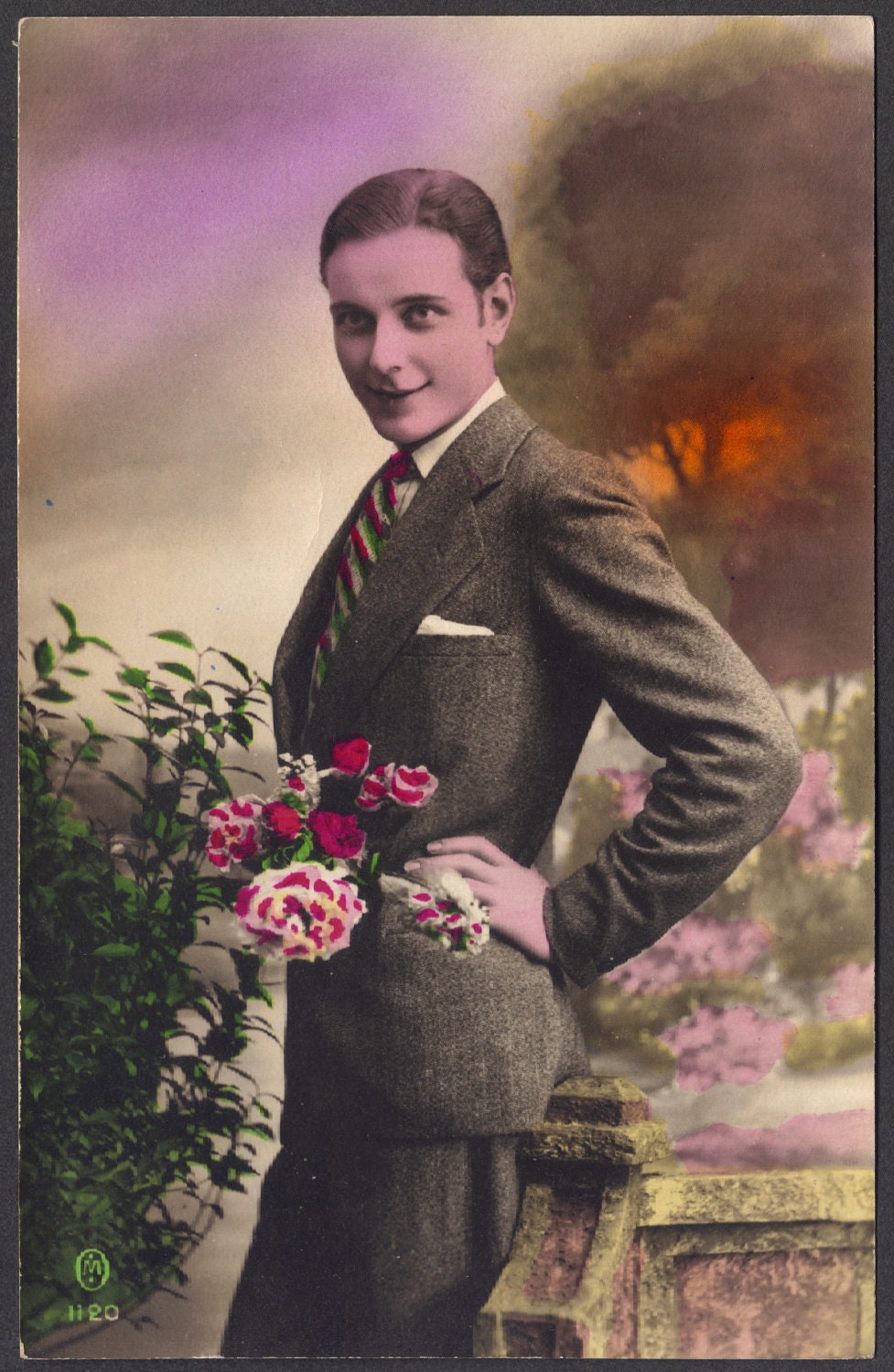
AVAILABLE FOR PURCHASE Hand-Tinted Handsome Fellow circa 1920s/30s

Move over girls! Handsome Jack has arrived!

We see many hand-tinted couples romance cards, but not so many hand-tinted men all on their own, so we're always pleased when one comes our way.

It's probably worth mentioning that, although men appearing in the earliest picture postcards were often bearded or wearing elaborate mustaches, those in picture postcards of the late teens, and into the thirties, were generally clean shaven, very neat and tidy. The features of most of the male models of this period were less apt to be those of a "Marlboro Man," and more along the lines of the Japanese "bishonen," or "pretty male," to the degree that we have sometimes wondered if a well-dressed man in some of these 20's period cards might not be, in fact, a pretty woman in male attire. Yet, although that must have happened on occasion, the pretty boy look reflected a change in taste and style, one that emphasized a cultured, polished appearance, rather than one that was more rugged and robust.  This preference for a "sensitive" guy might even suggest a marked increase in picture postcard images aimed at a larger, more independent, female postcard buying audience following World War I.

Wednesday, November 7, 2012

This Week's Featured Items: Family Photos

This week's featured items in the Red Poulaine shop are four photographs or RPPCs of families; two show family picnics, one a family grouped around a dining table, and the last a "posed" photo of the entire family and their chimney sweeps. Yes, chimney sweeps! Marvelous, we thought, and so we had to share.

SOLD An Edwardian Picnic in the Park, Early 1900s
This photographic postcard was published by the "Ace of Clubs" group and the reverse of the card was printed in French. The grouping in this image reminds us of paintings by the Impressionists, while the presence of the small black child, apparently part of the family, unusual for the time, adds a bit of happy mystery to the image.


AVAILABLE FOR PURCHASE A Picnic Lunch, Mid-1920s to Early 1930s
We place the date of this wonderful family picnic photo at somewhere between the mid-twenties to the early thirties. Was this a youngish grandmother with her adult children? We may never know, but we just love this image. High Summer, the meadow's yellowed grass, a stout wicker hamper, bread, wine, a lovely cheese perhaps... that baguette must have been wonderful. :) Don't you wish you could join them?


AVAILABLE FOR PURCHASE Coffee in the Parlor
We love an RPPC that takes us into a turn of the century home. It's like a trip in a time machine. On the reverse of the card is written in German (or something close to it), "The Jakobs family having coffee in the (something)room." The aging and wear of this image are apparent, but these relatively candid interior views come along rarely enough that we list them even when they are not in the finest condition.

AVAILABLE FOR PURCHASE The Entire Family, Including the Chimney Sweeps, 1932 or Earlier
Awesome image of a large family gathering, including a pair of chimney sweeps who stand, like two royal coachmen in attendance, to either side of the family. The chimney sweeps remind us of Dick Van Dyke singing, "good luck will rub off when I shakes 'ands wiv you,"in the film Mary Poppins; perhaps this family so valued the luck their sweeps brought them that they insisted on their presence for all important moments.

We don't often find photographs of chimney sweeps, so this is almost certainly a rare image. The photograph was taken in Poland by Zaklad Photography, with a handwritten date on the reverse of 1932, although the image looks a bit older.

Sunday, October 14, 2012

This Week's Featured Items: Parisian Actresses of La Belle Époque

This week's featured items are postcards spotlighting four actresses popular on Paris stages during La Belle Époque: Galathea Valerie, Joly Violetta (see our previous post, Mlle. Joly Violetta, Famous European Dancer), Regina Badet, and Nelly Viollette.

AVAILABLE FOR PURCHASE Galathea Valerie
AVAILABLE FOR PURCHASE Joly Violetta
AVAILABLE FOR PURCHASE Regina Badet
AVAILABLE FOR PURCHASE Nelly Villette

Wednesday, September 12, 2012

(Almost) Wordless Wednesday: Miss Ivy Lillian Close circa 1910s

AVAILABLE FOR PURCHASE Miss Ivy Lilian Close

Gorgeous soulful image of Miss Ivy Lillian Close. She was first Miss Britain of 1908, then a stage actress, then a silent film star in those very early days.

Tuesday, September 11, 2012

Monsieur G. Piprot, Postcard Producer and Photographer of the Misses Amy and Remple

If you are a vintage photograph and postcard enthusiast, who shares our interest in Parisian music hall performers and their postcard images, you may have noticed a star in the bottom corner of some of your favorite postcards. This is the production mark of Monsieur G. Piprot, who operated a postcard production company out of number 2 Rue de l'Amsterdam in Paris. He made use of a process called emaillographie, which like the process oranotypie (used by the prodigious Mr. Steglitz of Germany), was intended to add depth and clarity to the postcard print. The great Walery, Nadar, and many other famous Parisian photographers of the time were often published by M. Piprot under his star label. Not so common, were images actually photographed by G. Piprot, but we are lucky enough to have two such images, a pair of lovely stage performers, Miss Amy, and Miss Remple.

AVAILABLE FOR PURCHASEMiss Amy, photograph by G. Pirot
AVAILABLE FOR PURCHASE
Miss Remple, photograph by G. Pirot
These two young women are dressed in charmingly matched off-the-shoulder costumes and each sports a long, gorgeously thick braid. The cards have been hand-tinted, and the close observer will note that the colored panels on Miss Amy's dress correspond to the uncolored panels on Miss Remple's, and vice versa, so that each image presents a clever counterpart of the other.

One fun fact about these two cards is that they were posted by the same individual, Mateo, to two different women living in the same household. Mateo inscribed each card in a lovely hand, using violet ink.

Reverse of Miss Amy's postcard
Reverse of Miss Remple's postcard
We can't help but speculate whether Mateo, unable to make up his mind, was courting two sisters, and to wonder what reaction the women had on receiving the cards.


Two charming Oranotypes, (a process used in postcard production to maintain the depth and clarity of the photographic image), of a loving mother and her child. So sweet! The flowers in the hair are so expressive of the period. published by A.G. Steglitz in 1904. 

Mother and Daughter Oranotype, Image 1
Mother and Daughter Oranotype, Image 2
Posted in Brussels, Belgium in 1906 by someone with a fine and carefully practiced hand. 

Reverse of  Mother and Daughter Oranotype, Image 1
Reverse of Mother and Daughter Oranotype, Image 2
We look forward to listing these in our shop.

Sunday, September 9, 2012

La Belle Otero, the Last of "Les Grandes Trois"

Santiago de Compostela
On November 4th, 1868, in the town of Valga, Galicia, not far north of Spain's border with Portugal, Agustina Otero Iglesias was born into poverty, but also into the very midst of the Rexurdimento, the Galician cultural revolution, so that despite her poverty, she must often have heard the folksongs in her native Galician tongue being reborn all around her. Because of her family’s straightened circumstances, it was not possible for the child to remain with them. As was true for many small children born into poor families in those days, young Agustina left her home behind at a very early age, having been placed in service as a household maid in Santiago de Compostela, the capital city of Galicia.

It was while in Santiago de Compostela that, tragically, ten year old Agustina was brutally raped, a hideous act that would leave her physically incapable of conceiving a child.

By the early 1880's, Agustina, now fourteen, was already following the music in her heart. In the company of a young man we know only as Paco, she traveled to Lisbon, where, with Paco as her dancing partner, she began her career as a dancer and chanteuse. Youth and inexperience stood in her way, but her beauty, vivacity, and natural ability worked in her favor.


SOLD La Belle Otero, wearing a tambourine as a hat
Popular history suggests that shortly after establishing herself in Lisbon, and while still only fourteen years old, the young dancer made her first conquest as a courtesan, first enchanting, and then marrying a Count Guglielmo, who whisked her away from poverty and, presumably, away from Paco as well. With the new social standing gained by this marriage, Agustina was said to have met with greater opportunities for advancement. That is certainly one version of her story, though if it is true, how she ended up still singing in cafes at 18 and 19 is difficult to explain. We do know that she eventually met a "friend" with enough money to take her to Marseilles and, while there, to support her ambitions, and that from Marseilles she made her way to Paris.


AVAILABLE FOR PURCHASE La Belle Otero, photo by Reutlinger of Paris
While still in her teens, Agustina had changed her name to Caroline Otero and reinvented her history as well, claiming to be the product of a love match between a dashing nobleman and a dark-eyed Gypsy princess. So it was that upon her arrival in Paris, she was no longer Agustina, the poor peasant girl from a small town in Galicia, but  "La Belle Otero," the seductive Andalusian Gypsy dancer.

Once in Paris, and surrounding herself with the mystique of her new image,  it wasn't long before she found work as a dancer in the Folies Bergère. Before long, she was the talk of that city of lights, a top billing attraction, and within a few short years, one of the most famous women in France.


The great Folies Bergère music hall

Folies Bergère poster advertising La Belle Otero

Casino de Paris poster
advertising Liane de Pougy
Folies Bergère poster
advertising Emilienne d'Alençon
La Belle Otero was now a hugely popular performer, and also one of "Les Grandes Horizontales," an affectionate term that the people of France used for their great courtesans. She was, in fact, one of "Les Grandes Trois," or, "the three great ones." She, Liane de Pougy, and Emilienne d'Alençon, also famous music hall performers, were the three great courtesans of Europe. They granted their favors to kings and princes, but also to wealthy industrialists, amassing tremendous fortunes as a result of carefully planned liasons. Men fought duels over Otero's affections. It was claimed (though never substantiated), that six men took their own lives after she ended her affairs with them.


SOLD Emilienne d'Alençon, one of Otero's rivals
In this period known as La Belle Époque, Otero and others like her were loved and admired by royalty and commoners alike. They were made welcome at tables in the humblest of cafes, and given access to the inner circles of the most exclusive social gatherings. Their lives and loves, their rivalries, victories and defeats, were gobbled up by a ravenous public, much as people wait today with bated breath for the latest episodes of popular television dramas.

The fabulously costumed images of these stars of the stage were available to all, on the faces of picture postcards, a new medium whose "golden age" coincided with la Belle Époque. The tantalizing photographic images of popular entertainers like La Belle Otero, along with hundreds of others, offered for mere pennies, were visible in shop windows in towns and cities all across Europe and available in kiosks everywhere, in train stations, on street corners. By maintaining some control over the rights to their images, some performers managed considerable profits from the sales of these postcard images, as well.

SOLD La Belle Otero wearing a body stocking and a cape.
With the advent of moving pictures, Caroline Otero also enjoyed the distinction of being perhaps the world's first movie star. In 1898, the famous Lumière Company produced a one minute film of Otero dancing in the Czar's St. Petersburg. The film was afterwards viewed by wide audiences all across Europe, adding to her fame. It is a wonderful glimpse of her, and of that wonderful era and, at least at the time of this posting, is actually available for viewing online!


By 1914, the magic of La Belle Epoque was fading away, its spell broken by the roar of cannon and the horrors of the "Great War." The picture postcard's vast popularity also faded amidst that chaos, never quite regaining its place of prominence in the hearts of the people.


WWI French propaganda image
In 1918, at the war's end, La Belle Otero, still beautiful, still greatly admired, was fifty years old and made the decision to retire gracefully from the stage. At one point in her life she was quoted as saying, "Women have one mission in life: to be beautiful. When one gets old, one must learn how to break mirrors. I am very gently expecting to die." (Time Magazine, quoted in wikipedia) She purchased a huge mansion, lived like the countess she claimed to be, was frequently seen wagering vast amounts of money in the casinos of Monte Carlo, and apparently spent her fortune as if it would last forever, which of course, it did not. The photographer Edward Quinn took a photograph of her in the 1950s, standing on a balcony where, then in her eighties, she enjoyed feeding the pigeons.

In 1965, at the age of 97, while living in a small one room apartment, in the Novelty Hotel in Nice, Caroline Otero died as a result of a heart attack. She was remembered by neighbors and acquaintances as often speaking of her past glories, and of that golden age, La Belle Époque, which in many ways had been typified by the lovely and celebrated La Belle Otero.

AVAILABLE FOR PURCHASE La Belle Otero bids us "Adieu."
Exclusive coupon code for our fans: RPMUSINGS. Use this code during checkout from the Red Poulaine store on Etsy to receive a 10% discount on your purchase.

We are fortunate to have additional postcards of La Belle Otero on their way, featuring photographs taken by the great Reutlinger of Paris. These beautiful images will be available in Red Poulaine in the near future.

La Belle Otero in an elaborately decorated gown
La Belle Otero looking over her shoulder

Friday, September 7, 2012

Mlle. Joly Violetta, Famous European Dancer

At the turn of the twentieth century, the beautiful French star Joly Violetta graced the stages of theaters around the world . A dancer and pantomimist, her career began in Europe, but her popularity carried her to South Africa and Brazil, as well as the United States.

AVAILABLE FOR PURCHASE Joly Violetta  plays a gypsy in 1905
Joly Violetta often partnered with the Brazilian dancer Arnaud, who "assisted [her] in parodies and Brazilian dances." Alone, and with M. Arnaud, she trod the Vaudeville stage, headlining with Will Rogers and other famous acts of the time.


SOLD Mlle. Joly Violetta
Joly Violetta introduced a popular pantomime in Berlin, which she brought with her to the United States and performed in her first US appearance at the St. Paul Minnesota Orpheum Theater. Her performance was positively reviewed in the January 23, 1909 issue of the New York Star:


Despite her many successes on the stage, we have been able to learn very little about Joly Violetta's personal life, making her something of a mystery. We do not know where she was born, nor the date of her birth, and her later life is also obscure. Should anyone have any information which could shed some light on her biography, we would be delighted to learn of it.

We are lucky enough to have found another image of Joly Violetta, which will soon be available in the Red Poulaine Etsy shop:

As you can see by the embroidery on her blouse, Joly Violetta is wearing a costume that is either the same, or very similar to, the one she is wearing in the first postcard in this post. We find the details of this costume particularly wonderful, from the embroidery on the blouse and vest, to the simulated tatters, or flower petal designs, of the skirt, and we hope that you will agree that this is a wonderful find.