Showing posts with label Parisian music halls. Show all posts

Wednesday, January 9, 2013

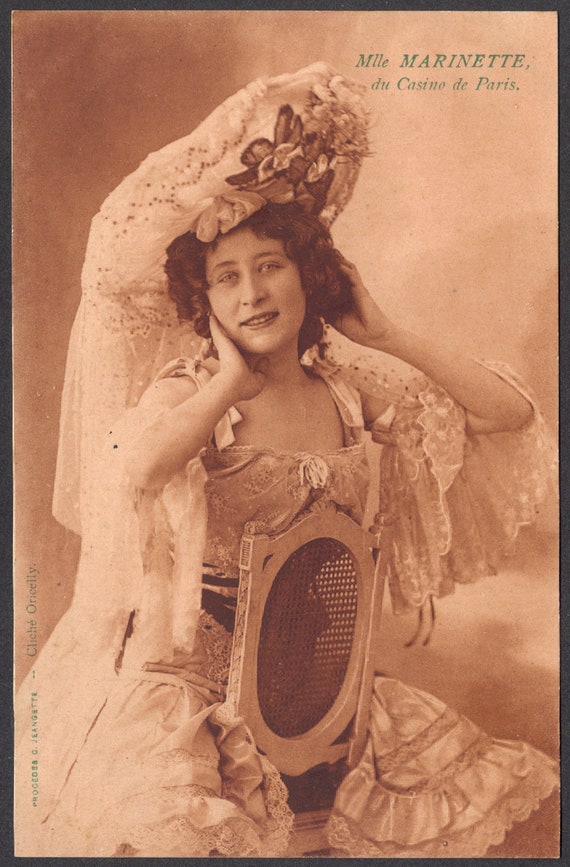
Almost Wordless Wednesday: Mlle. Marinette, du Casino de Paris

Mlle Marinette, du Casino de Paris


Marvellous image by Oricelly of Paris, of Mlle. Marinette, while she was employed at the Casino de Paris in the early 1900s. Oricelly was responsible for a number of stunning images published in sepia tones, of which this is certainly one.

Sunday, October 14, 2012

This Week's Featured Items: Parisian Actresses of La Belle Époque

This week's featured items are postcards spotlighting four actresses popular on Paris stages during La Belle Époque: Galathea Valerie, Joly Violetta (see our previous post, Mlle. Joly Violetta, Famous European Dancer), Regina Badet, and Nelly Viollette.

AVAILABLE FOR PURCHASE Galathea Valerie
AVAILABLE FOR PURCHASE Joly Violetta
AVAILABLE FOR PURCHASE Regina Badet
AVAILABLE FOR PURCHASE Nelly Villette

Sunday, September 9, 2012

La Belle Otero, the Last of "Les Grandes Trois"

Santiago de Compostela
On November 4th, 1868, in the town of Valga, Galicia, not far north of Spain's border with Portugal, Agustina Otero Iglesias was born into poverty, but also into the very midst of the Rexurdimento, the Galician cultural revolution, so that despite her poverty, she must often have heard the folksongs in her native Galician tongue being reborn all around her. Because of her family’s straightened circumstances, it was not possible for the child to remain with them. As was true for many small children born into poor families in those days, young Agustina left her home behind at a very early age, having been placed in service as a household maid in Santiago de Compostela, the capital city of Galicia.

It was while in Santiago de Compostela that, tragically, ten year old Agustina was brutally raped, a hideous act that would leave her physically incapable of conceiving a child.

By the early 1880's, Agustina, now fourteen, was already following the music in her heart. In the company of a young man we know only as Paco, she traveled to Lisbon, where, with Paco as her dancing partner, she began her career as a dancer and chanteuse. Youth and inexperience stood in her way, but her beauty, vivacity, and natural ability worked in her favor.


SOLD La Belle Otero, wearing a tambourine as a hat
Popular history suggests that shortly after establishing herself in Lisbon, and while still only fourteen years old, the young dancer made her first conquest as a courtesan, first enchanting, and then marrying a Count Guglielmo, who whisked her away from poverty and, presumably, away from Paco as well. With the new social standing gained by this marriage, Agustina was said to have met with greater opportunities for advancement. That is certainly one version of her story, though if it is true, how she ended up still singing in cafes at 18 and 19 is difficult to explain. We do know that she eventually met a "friend" with enough money to take her to Marseilles and, while there, to support her ambitions, and that from Marseilles she made her way to Paris.


AVAILABLE FOR PURCHASE La Belle Otero, photo by Reutlinger of Paris
While still in her teens, Agustina had changed her name to Caroline Otero and reinvented her history as well, claiming to be the product of a love match between a dashing nobleman and a dark-eyed Gypsy princess. So it was that upon her arrival in Paris, she was no longer Agustina, the poor peasant girl from a small town in Galicia, but  "La Belle Otero," the seductive Andalusian Gypsy dancer.

Once in Paris, and surrounding herself with the mystique of her new image,  it wasn't long before she found work as a dancer in the Folies Bergère. Before long, she was the talk of that city of lights, a top billing attraction, and within a few short years, one of the most famous women in France.


The great Folies Bergère music hall

Folies Bergère poster advertising La Belle Otero

Casino de Paris poster
advertising Liane de Pougy
Folies Bergère poster
advertising Emilienne d'Alençon
La Belle Otero was now a hugely popular performer, and also one of "Les Grandes Horizontales," an affectionate term that the people of France used for their great courtesans. She was, in fact, one of "Les Grandes Trois," or, "the three great ones." She, Liane de Pougy, and Emilienne d'Alençon, also famous music hall performers, were the three great courtesans of Europe. They granted their favors to kings and princes, but also to wealthy industrialists, amassing tremendous fortunes as a result of carefully planned liasons. Men fought duels over Otero's affections. It was claimed (though never substantiated), that six men took their own lives after she ended her affairs with them.


SOLD Emilienne d'Alençon, one of Otero's rivals
In this period known as La Belle Époque, Otero and others like her were loved and admired by royalty and commoners alike. They were made welcome at tables in the humblest of cafes, and given access to the inner circles of the most exclusive social gatherings. Their lives and loves, their rivalries, victories and defeats, were gobbled up by a ravenous public, much as people wait today with bated breath for the latest episodes of popular television dramas.

The fabulously costumed images of these stars of the stage were available to all, on the faces of picture postcards, a new medium whose "golden age" coincided with la Belle Époque. The tantalizing photographic images of popular entertainers like La Belle Otero, along with hundreds of others, offered for mere pennies, were visible in shop windows in towns and cities all across Europe and available in kiosks everywhere, in train stations, on street corners. By maintaining some control over the rights to their images, some performers managed considerable profits from the sales of these postcard images, as well.

SOLD La Belle Otero wearing a body stocking and a cape.
With the advent of moving pictures, Caroline Otero also enjoyed the distinction of being perhaps the world's first movie star. In 1898, the famous Lumière Company produced a one minute film of Otero dancing in the Czar's St. Petersburg. The film was afterwards viewed by wide audiences all across Europe, adding to her fame. It is a wonderful glimpse of her, and of that wonderful era and, at least at the time of this posting, is actually available for viewing online!


By 1914, the magic of La Belle Epoque was fading away, its spell broken by the roar of cannon and the horrors of the "Great War." The picture postcard's vast popularity also faded amidst that chaos, never quite regaining its place of prominence in the hearts of the people.


WWI French propaganda image
In 1918, at the war's end, La Belle Otero, still beautiful, still greatly admired, was fifty years old and made the decision to retire gracefully from the stage. At one point in her life she was quoted as saying, "Women have one mission in life: to be beautiful. When one gets old, one must learn how to break mirrors. I am very gently expecting to die." (Time Magazine, quoted in wikipedia) She purchased a huge mansion, lived like the countess she claimed to be, was frequently seen wagering vast amounts of money in the casinos of Monte Carlo, and apparently spent her fortune as if it would last forever, which of course, it did not. The photographer Edward Quinn took a photograph of her in the 1950s, standing on a balcony where, then in her eighties, she enjoyed feeding the pigeons.

In 1965, at the age of 97, while living in a small one room apartment, in the Novelty Hotel in Nice, Caroline Otero died as a result of a heart attack. She was remembered by neighbors and acquaintances as often speaking of her past glories, and of that golden age, La Belle Époque, which in many ways had been typified by the lovely and celebrated La Belle Otero.

AVAILABLE FOR PURCHASE La Belle Otero bids us "Adieu."
Exclusive coupon code for our fans: RPMUSINGS. Use this code during checkout from the Red Poulaine store on Etsy to receive a 10% discount on your purchase.

We are fortunate to have additional postcards of La Belle Otero on their way, featuring photographs taken by the great Reutlinger of Paris. These beautiful images will be available in Red Poulaine in the near future.

La Belle Otero in an elaborately decorated gown
La Belle Otero looking over her shoulder

Fatmé Sjemile, Escapee from the Sultan's Harem

On 26 Sep 1913, a young woman stepped off the ship France and onto US soil. She was just one of 1,826 passengers on the ship. According to the ship’s manifest and the Ellis Island paperwork, she was born in Turkey. But, we can speculate that the accuracy of her birthplace might only have been as accurate as her reporting of it, since many people arrived at Ellis Island without birth certificates or other proofs of identity.

Steamship France, Photo source: The Statue of Liberty-Ellis Island Foundation, Inc.
Although she was only 22, this lovely young woman had already achieved notoriety in the music halls of Paris. Now, possibly sensing the oncoming storm in Europe, or perhaps escaping more personal troubles, she was once more giving up the comforts and familiarity of her home in pursuit of a place where she could be free. Her name was Fatmé Sjemile, and she claimed she had been the favorite odalisque, or concubine, to the Sultan Abdul Hamid. Whether she was coming to America, as so many immigrants were, to avoid war or simply in search of a better life, or even fleeing agents of the Ottoman Empire, intent on capturing her and taking her back to the sultan’s palace, her spirit and determination were very much evident in the choices she made.


AVAILABLE FOR PURCHASE Fatmé Sjemile, Supreme Dancer of the Sultan of Turkey
At the turn of the twentieth century, Orientalism was at its height. French Colonial interests in the Mid-East, Asia, and North Africa offered inspiration to designers of Art Nouveau dress and jewelry. Mata Hari, a school teacher of Dutch origin, enthralled all of Europe with the fanciful Oriental image she had created for herself. In this postcard photograph, Fatmé wears a costume evocative of a 19th century Turkish dancing girl, precisely the image she wished to conjure for her audience. Even the texture of Fatmé’s hair is reminiscent of that of the Moss-Haired girls, the Circassian beauties, of P.T. Barnum’s invention fifty years before, who also were claimed to be harem girls escaped from Turkish sultans. 

We cannot know whether this flamboyant beauty’s claims were true, but we can appreciate the romance of her story: the harem girl who escaped from the sultan’s palace, made her way down the steep and treacherous mountains of Turkey and across Europe, and upon her arrival in Paris fascinated audiences with her Oriental dancing.


Madge Lessing, photographed by C.J. Horner of Boston. Dressed fancifully as a page, or perhaps as Cupid, Madge appears to be leaning against a friendly tiger in a scene reminiscent of John R. Neill's illustrations to some of the later OZ books, in particular, those featuring the Hungry Tiger.

Madge Lessing & friend, photo by C.J. Horner of Boston

Friday, September 7, 2012

Mlle. Joly Violetta, Famous European Dancer

At the turn of the twentieth century, the beautiful French star Joly Violetta graced the stages of theaters around the world . A dancer and pantomimist, her career began in Europe, but her popularity carried her to South Africa and Brazil, as well as the United States.

AVAILABLE FOR PURCHASE Joly Violetta  plays a gypsy in 1905
Joly Violetta often partnered with the Brazilian dancer Arnaud, who "assisted [her] in parodies and Brazilian dances." Alone, and with M. Arnaud, she trod the Vaudeville stage, headlining with Will Rogers and other famous acts of the time.


SOLD Mlle. Joly Violetta
Joly Violetta introduced a popular pantomime in Berlin, which she brought with her to the United States and performed in her first US appearance at the St. Paul Minnesota Orpheum Theater. Her performance was positively reviewed in the January 23, 1909 issue of the New York Star:


Despite her many successes on the stage, we have been able to learn very little about Joly Violetta's personal life, making her something of a mystery. We do not know where she was born, nor the date of her birth, and her later life is also obscure. Should anyone have any information which could shed some light on her biography, we would be delighted to learn of it.

We are lucky enough to have found another image of Joly Violetta, which will soon be available in the Red Poulaine Etsy shop:

As you can see by the embroidery on her blouse, Joly Violetta is wearing a costume that is either the same, or very similar to, the one she is wearing in the first postcard in this post. We find the details of this costume particularly wonderful, from the embroidery on the blouse and vest, to the simulated tatters, or flower petal designs, of the skirt, and we hope that you will agree that this is a wonderful find.

Thursday, September 6, 2012

1904 - Ma Jolie - Madame Morganti des Folies-Bergère - Sifflomane


Text from YouTube:
Ma Jolie
Mme. Morganti, Sifflomane
Folies-Bergère
Paris
Disque Odéon n°3926
1904
Ma Jolie est à l'origine une chanson créée par Dalbret, un petit chanteur de la Belle Epoque, moins connu que Mayol ou Fragson, mais qui avait une petite notoriété.

With thanks to Vera Violetta for bringing this lovely whistled tune to our attention.

Monday, September 3, 2012

Mlle Dargent at the Folies Bergere by Walery circa 1905

La Belle Époque means the Beautiful Era, and all of France was optimistic during this time of European peacefulness and prosperity. La Belle Époque began around 1890 and continued until 1914, ending with the start of World War I. During this time, Paris was at the heart of a number of artistic endeavors, known to all of Europe as a place where music and theater flourished.

AVAILABLE FOR PURCHASE  Mlle. Dargent of the Folies Bergère, photograph by Walery, circa 1905
In this lovely 100 plus year old card, is Mlle. Dargent of the Folies Bergère. The photograph was taken by the famous art photographer, M. Walery of Paris, and has been beautifully hand-tinted, possibly to match the original colors of Mlle. Dargent's dress.

Saturday, September 1, 2012

The Draffir Sisters Take Center Stage at Red Poulaine

We love sister acts! We love ruffles! We love sequins! Les Soeurs Draffir (the Draffir Sisters) provide us with all three. So charming! Now, by special arrangement, Les Soeurs Draffir are appearing here, on Red Poulaine's stage!

AVAILABLE FOR PURCHASE Les Soeurs Draffir

We so love what we do. We've booked a troupe of jugglers, and hope soon to make space for a dog act, but always of course, the ladies, the beautiful ladies.

We know only a little about the Draffir Sisters, not even their given names. However, we do know that they  were a box office draw, appearing in such diverse settings as the Folies Bergere and in operettas such as  La Petite Bohême ("The Little Bohemian,” which could also be translated as “The Little Gypsy”) by M. Henri Hirschmann in the spring of 1912. As you can see in this newspaper ad, their performance in the operetta was given top billing.

We were lucky enough to find this great image, photographed by Louis Martin of Paris, on a postcard originally destined for the offices of the Impressario, Raoul Pitau, a very important Parisian theatrical producer in those days. Now, by many strange twists and turns of fate it has arrived here, at the "offices" of Red Poulaine, some 100 or so years later, and still in fine condition.

Les Soeurs Draffir postcard back, showing the address of Raoul Pitau
By the way, we learned of Raoul Pitau, the "Impressario," that he was "bald as an ostrich egg," and that once, at a charming hotel in Nice, after plying a woman he had met on the train with wine and rum all through the night, that just at the moment of grand consummation an earthquake struck the city and the couple, along with many others, ran to the town square to be safely away from tall buildings, walls, etc. Well, the story goes that when things seemed to have returned to normal, the two lovers' fiery passions still unquenched, they returned to the hotel post haste in order that they might resume their play of affections. But, once again, at that most critical of moments, a second shock wave struck the city, driving them again out into the street, at which point they bowed to fate inexorable, bid one another fair adieu, and parted company forever.*

* We found this little tale of romance a la Belle Epoque in a page out of a journal by someone named Paulus (see translation), a theatrical personage in his own right. Paulus was a cafe concert performer who apparently benefited over many years from the talent management and close personal friendship of Mr. Pitau, who he said, "writhed" with frustration at the recollection of this incident.


Another sister act: Alice and Fanny de Tenders dancing La Matchiche.
Alice and Fanny de Tenders dance La Matchiche
The sisters de Tenders are currently making their way around the world on the way to our shop, so keep an eye out for their arrival!