Welcome to Red Poulaine's Musings. Here we hope to entertain and delight you with stories about the people and times from bygone eras and the vintage images that act as our windows into their times.
Red Poulaine is a husband and wife joint enterprise on Etsy. We take pride in offering fine, interesting vintage items to our customers, while providing the best customer service possible. Please come visit us at http://www.etsy.com/shop/redpoulaine today.
This card sold so quickly after we placed it for sale that it never even appeared on our blog. (We've been using an automated system to share items in our shop.) But, because we love this image, we wanted to make sure you got a chance to see it.
SOLD Damaged Goods with a Checkered Past, er, Background
Here's the original description for the card:
Absolutely stunning Salome, or Danse Orientale, image. So sadly, this
card has really been through the mill. We hope that one of our customers
will be able to overlook the condition along the borders of this card
and really love this beautiful image, and it is priced accordingly.
For more beautiful cards depicting dancers in Costumes Orientale, please visit our Songs of Salome collection.
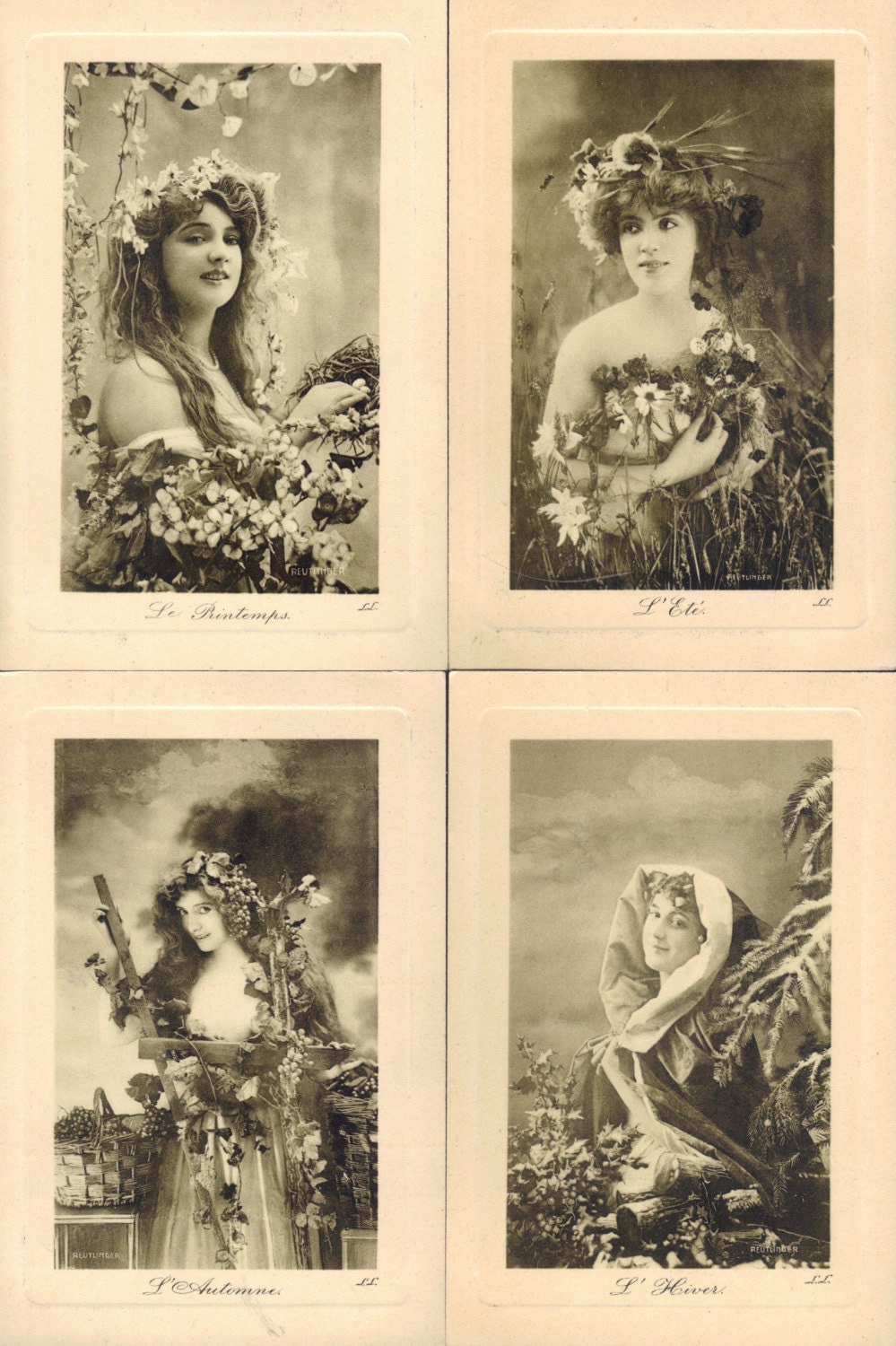
Here we have a series of four very special cards, representing the four seasons. Each of the seasons is personified by one of four famous Belle Époque stage performers. Each of these four cards is in particularly fine condition, though posted in 1909.
The Four Seasons, photographed by Reutlinger and posted in 1909
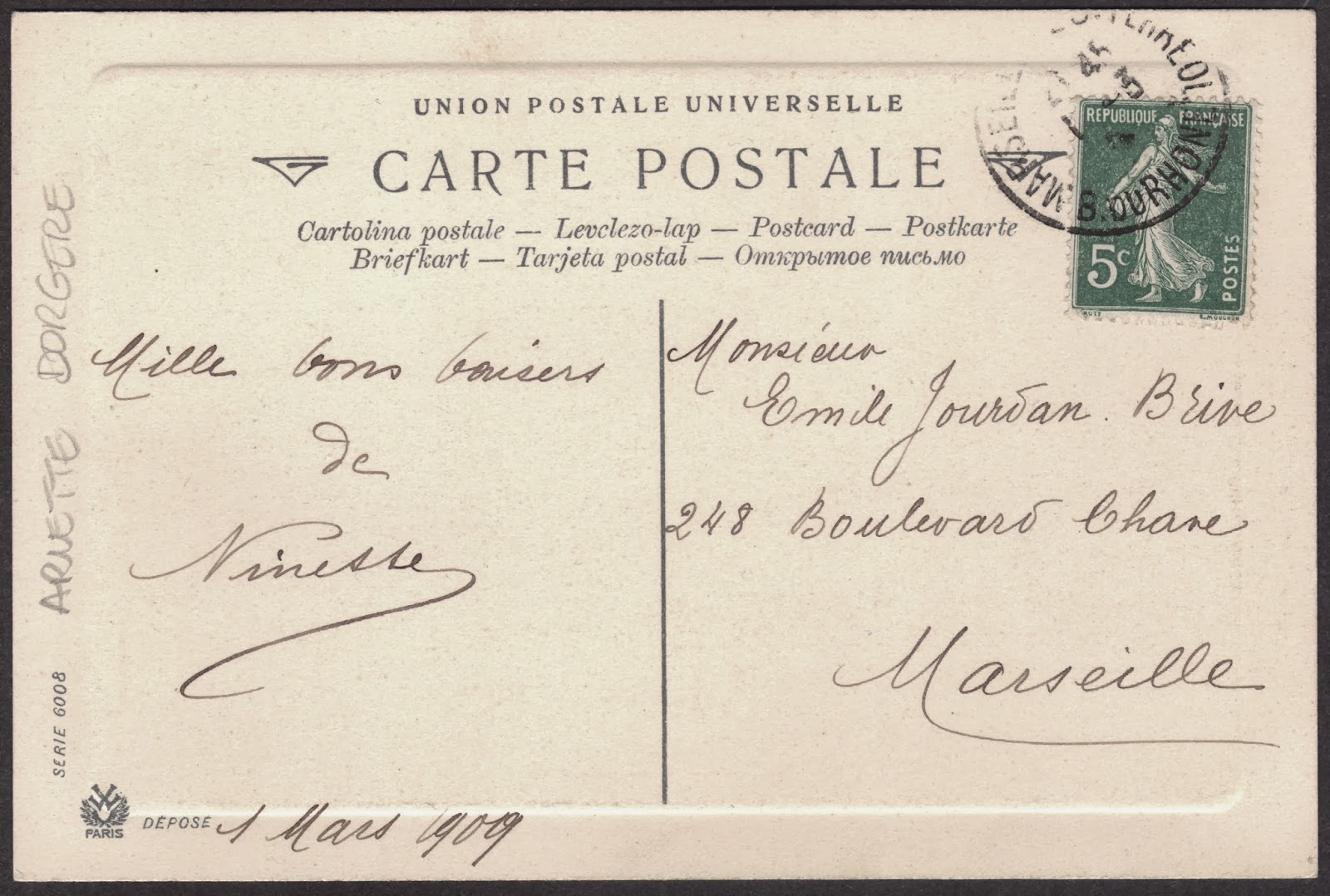
They must have been kept very carefully and lovingly, because, by their appearance, they are practically brand new! They were all sent by the same person, Ninette, to M. Emile Jourdan-Brive, who was clearly someone dear to her. Each includes a brief message, such as,"a thousand kisses from Ninette," written in a nice hand on the back of the card. Our researches suggest that Emile may have been a member of the Jourdan-Brive family of Marseille, who were well-known exporters of truffles, capers, wines, and perfumes to England during the Victorian era.
The images themselves, appear to be photogravures, made from photographs taken by the famous theatrical portraitist Leopold Reutlinger of Paris, probably circa 1905. Deeply impressed in fine, ivory-toned stock, these images are truly precious.
Although we are merchants, and generally sell our wares on a piece by piece basis, we simply cannot bring ourselves to break up so lovingly cared for, and romantic, a set of cards as this one. Consequently, we are selling these four cards as a set.
Note: There will be another post reflecting this listing due to our use of an automatic posting system, which ensures that every time we post an item in our shop a post appears in the blog. We are offering this post to provide you with complete information about the set, including high-res scans of the front and back of each card, since we are limited to only 5 images in our listing on Etsy.
Le Printemps, Spring
Le Printemps (Spring), is represented by the breathtaking Arlette Dorgere. Surrounded by early blossoms, her hair in a woodland sprite's disarray, she tenderly cradles a nest of tiny bird's eggs.
Le Printemps, by Reutlinger
Mlle. Dorgere was a very popular artiste who performed at the Scala, and in many other venues in Paris and elsewhere. We have not been able to find any information about her early life, but we know that her image was captured by the famous poster artist Jules Cheret, and that at about the time the photograph for this card was taken (circa 1904), she was already so successful that she was able to purchase a lovely chateau, the Chateau Vigneus sur Seine, in a quiet neighborhood south of Paris. It was on a large wooded lot, with a pond, and when the pressures of her work grew heavy, she would ride in her chauffeur-driven limousine to this retreat. In 1929, she sold the chateau, which she had renamed Chateau Dorgere, and retired quietly to Morocco, which was then a colonial protectorate of France.
Reverse of Le Printemps
Translation: A thousand beautiful kisses from Ninette
L’ Eté, Summer
L’ Eté (Summer), is represented by Mlle. Marcelle Yrven. In this image, she clutches flowers to her breast, while smiling joyfully, a goddess of the season.
L' Eté, by Reutlinger
Mlle. Yrven (1877-1949) was a fascinating woman who was not only a wonderful stage performer, but also an author, a poet, and outspoken on the subject of women in society. She wrote a short book on feminism, "La Comedienne Et Le Feminisme," as it related to women in the theater, which was not only interesting politically, but historically, as it pertained to La Belle Époque theater, really fascinating. We don't think it is available in English online, but it is short enough that if you have a little French, and the online translator, you can work through it.
Reverse of L' Eté
Translation: Best kisses from Ninette
L' Automne, Autumn
L' Automne (Autumn), is the season during which the wine grapes are harvested, as depicted by the maenad Mlle. Renee Despres, wearing vines and fruit of the vine.
L' Automne, by Reutlinger
This is a wonderful image in which she smiles at us invitingly, offering us the celebration of the season. Unfortunately, we have no biographical information on her, apart from the fact that she did appear on the playbills of a number of theaters in Paris, and that, from other images we've seen, she was a most elegant lady of the Belle Époque theater.
Reverse of L' Automne
Translation: Embraces (or, perhaps, kisses) Fernand for me Ninette [We find this just a bit confusing, since these cards all were addressed to M. Emile Jourdan-Brive, but perhaps Fernand was his middle or nickname.]
L' Hiver, Winter
L' Hiver (Winter), is here pictured not so differently than it might be in England, or elsewhere in Europe or the United States. We have the yule logs, Holly, the evergreen tree, and is that a bit of mistletoe Miss Campton wears in her hair beneath her hood?
L' Hiver, by Reutlinger
Miss Campton, like many performers in the Paris of that time, was English; she was born Emily Straham Cager in Brighton, in April of 1882. Here, photographed by Reutlinger, she was also often found in stunning images produced by Professor Stebbing, another well-known and prolific Belle Époque photographer. She was apparently a very special friend of Paul Derval, who for many years directed the Folies Bergere, and though they did not, as far as we know, marry, when she died at a relatively young age of cancer, in Paris, she was interred in the Derval family tomb.
Reverse of L' Hiver
Translation: Another kiss from Ninette
As a complete set, these cards evoke the magical and celebratory relationship between people and nature that often seems the very essence of so much art during this period.
The listing for this set will be available within the next 24 hours.
Like too many of our favorite images, this card has come and gone in a matter of a few hours, but she and her fabulous costume can have a place on our blog forever. We don't know the model's name, but we love this image!
The same model appears on another postcard below, image by Jean Agelou.
Grace La Rock, who, with Helmut Schmidt, operates Boudoir Cards, a beautiful site and a valuable source of information on postcards of La Belle Époque, as well as French and ethnic erotic postcards, has done a watercolor painting inspired by Agélou's image of our unidentified model. Helmut and Grace are customers of ours and, on hearing about this painting, we asked if we might share it on our blog.
So many of our customers are involved in art of one sort or another and draw inspiration from these fine old images, and we are so very pleased when we can share examples of this with our readers. Below, is the original postcard image and the painting Grace created from it. Just wonderful.
Photograph by Jean Agélou of Unidentified Artiste Lounging in Lingerie and Wonderful Hat
Original Painting by Grace La Rock
Here is what Grace had to say about this painting:
Capturing me with her hypnotic eyes, and voluptuous curves, I find this vintage doll rather intriguing. She was my first water color rendering after almost 20 years. I prefer pale vintage rose for color, but chose to make her into more of a cupcake like she is. I plan to paint other poses of her in the future with more muted tones. This photograph was originally made by Jean Agélou, and shows that nudity is not necessary to become erotic. If only I had her hat and vintage lingerie.
Talk about a time machine.... The feel of the period
derived from a card like this one is sensational. There is something about a fine photograph in natural
sepia tones that is just so...wonderful. Images of Eve being tempted by the snake abound, being a favorite of artists of all ages, but rarely has Eve managed to look quite so humorously nonchalant about the encounter as she does in this image by Henri Manuel.
This postcard, published about 1900, features a superbly naive image of an unidentified model
“en collant” (in a body
stocking) with a really great snake! One has to wonder, when viewing an
image of this kind, whether the goal was humor, titillation, gender
politics, a biblical reference of any kind, or a mix of oh, so many
things, but the quality of the image is undeniable. Her facial
expression seems to us to say,
“Et alors! You think I can't handle
this?”
This card was published
by SIP (the Societe Industrielle de Photographie), one of the most
prolific French postcard publishers at that time. The image was
photographed by Henri Manuel, and given the age of the card (its
production date, by its undivided back, is likely to have been before
1904), the photo would have been taken not long after Monsieur Manuel
and his brother, Gaston (about whom we can find no information
whatsoever), opened their first portrait studio in Paris, in 1900.
Henri
Manuel's name appears on many of the cards we bring into our shop, and
though most of the subjects we deal in are very lighthearted, Manuel
himself was a serious photographer, and an astute business man. He
became well known not only for his portraits of theatrical
personalities, risque nudes, and romantic fantaisies, but more, for his
portraits of famous politicians, art, architecture, and in 1910,
“Manuel’s studio began providing a commercial service to news agencies
for photographs known as ‘L’Agence universelle de reportage Henri
Manuel.’” His studio grew to be the largest in Paris, a
recognized center for the development of the
photographic arts (please forgive the pun ☺), and for the three decades between 1914 and 1944,
Henri Manuel held the post of official photographer for the French
government. Because we know his studio operations were shut down during
WWII, we wonder if during the last years he held that government post
(when France was under German occupation), he worked for
“Free France,”
but we haven't yet found a lot of history on that period. Henri Manuel
passed away in 1947.
Just to give you an idea of the broad scope
of the man's work, you can examine a few of the approximately 2500
photographs Manuel's studio produced of French prisons and juvenile facilities between the years 1929 and 1931, for the French Department of
Justice. Pretty grim stuff, but though Red Poulaine is very much about
the frolicsome fun, we feel it's important to give you background on our
photographers and artistes when possible, and well...we just love the
stories.
In Ida Fuller, née Pinckney (October 1, 1867-August 5, 1922), the well known Belle Époque "interpretive" dancer, we have a very clear example of the competitive twists and turns that sometimes occurred between performers of la Belle Époque.
Ida Fuller became widely known for her "skirt" dancing, also known as "butterfly" or "serpentine" dancing. This was a variety of dance which was, as far as we can determine, developed by the famous dancer, choreographer, and inventor, Loïe Fuller (January 15, 1862-January 2, 1928), a remarkable woman whose name became, in many ways, synonymous with Art Nouveau and the Belle Époque. Only one of the ways in which this is remarkable is the fact that Loïe Fuller (born Marie Louise Fuller) was a somewhat short, chubby girl from Illinois, not known for being a great beauty, who after gaining a middling reputation as an actress and singer in the States, made her way to Paris, opened at the Folies Bergeres, and became an almost instant success. Although she did return, now and then, to the U.S., and maintained her citizenship here, she basically adopted France as her home, and France, most certainly, adopted her.
Loïe Fuller also founded a number of dance schools in the United States and Europe for students interested in following the path of this iconic dancer. A group of students at one such school, L'École de Loïe Fuller, can be seen in the following image:
Called her "muses," or "Fullerettes" Miss Fuller is said to have doted on her students (one of whom was, for a short time, Isadora Duncan), and in the choreography and production end of performances with these girls, her work was almost as highly regarded as was she herself for her own interpretive dance routines.
A pioneer of modern dance, Loïe Fuller was also the developer of the "serpentine," or "skirt" dance. Part of the magic of this style, which involved the manipulation of sometimes hundreds of yards of silk, creating flowing patterns around and above the dancer, was the effect of colored lights shone up through a glass floor upon which the dancer performed. Miss Fuller was one of the earliest developers of colored gels for theatrical lighting, as well as a number of chemical formulas for use in lighting effects. Though not born into high society, or highly educated, she counted among her closest friends, top ranking scientists and inventors, members of European royalty, and artists of all mediums.
Volumes could be (and have been), written about Loïe Fuller, dubbed "La Loie" by Symbolist poet Stephane Mallarme and often affectionately called Lo-Lo by her admiring fans. The style of dance she introduced to the world was much copied and imitated. Her work was even parodied. In his book, The Victorian Visitors: Culture Shock in Nineteenth Century Britain, Rupert Christiansen tells of one amusing example: "the music hall star Little Tich, who parodied her [Loïe Fuller's "serpentine" dancing], as Miss Turpentine, swanning around the stage in yards of rapturous muslin and then breaking the sublime illusion by stopping to scratch her leg."
Scores of women claimed a close relationship to Loïe Fuller. Some even claimed to be her sister, going so far as to use the last name of Fuller, most of them illegitimately. But at least one could legitimately claim a familial relationship and the use of the Fuller name, and that one was Ida Fuller.
Less information can be found regarding Ida Fuller than Loïe. Born Ida Pinckney, in Forest City Iowa, in 1867, in biographical articles concerning Loïe, Ida is often dismissed as a mere imitator, a pretender to Loïe's own unique art form, the serpentine dance. That Ida was a latecomer, who made use of Loïe's already developed style to work out her own routines, is almost certain. To dismiss her, however, as a mere imitator, is probably not entirely fair.
It has been suggested that Ida's "claims" that she was a relation of Loïe's, were untrue. Our research suggests otherwise. Ida Pinckney married Frank Rodney Fuller, Loïe's elder brother, making the two women sisters-in-law. Frank was an electrician with extensive knowledge of Loïe's lighting effects, reputed to have been involved in her earliest successes with her dance routines, and it is likely that he used his skills to help his wife in her own dance routines.
The Lake Mills Graphic, a newspaper published in Lake Mills, Iowa, made note of Ida Fuller as she passed through town. The following snippets were shared on a genealogical forum by one of Ida Fuller's relatives:
Lake Mills Graphic, Iowa, 17 Oct 1894:
Lake Mills Graphic, Iowa 6 July 1898:
We also found a copy of an emergency passport application filled out by Ida in 1898, in Vienna. Witnessing this application is Frank R. Fuller, who, as mentioned above, was Loïe Fuller's older brother.
U.S. Passport Application for Ida Fuller, Issue Date: 26 Nov 1898*
This document at least establishes that Ida's claim to a familial relationship, if by marriage, is true enough.
Additionally, the "Fire Dance," a routine for which Loie herself became very well known, and to whom its invention is generally credited, was, (evidenced by our research), actually an invention not of Loïe's, but of Ida's, who performed the routine widely, both in Europe and in the United States.
In Forty Years of Observation of Music and Drama, by Robert Grau, 1909 Broadway Publishing Co., Grau, clearly a fan of Loïe Fuller's work, praised her artistic accomplishments, and bemoaned the fact that her genius had gone unappreciated in America. However, when touching on Ida, he writes (on page 240):
Ida Fuller is not a sister of Loie, but her sister in law. She married Frank Fuller, an electrician, who was closely identified with Loie's first success It is only fair to Ida to explain that her greatest achievement, the basic foundation of the success which she has so struggled for, the fire dance, is her own creation, as more than one important interest in theatricals has discovered by decisions in courts of equity, which give to Ida Fuller, for all time, undisputable protection to her patents and creations.
Loie's brother Burt (Loie's younger brother), also apparently an electrician, is often credited with having worked closely with Loie in the production of her routines, and Frank (her older brother), often goes unmentioned. We suspect that a rift developed between Loie and Frank, and can only imagine the unfortunate vituperations which must have arisen between them when Frank assisted his wife, Ida, in the development of the "Fire Dance."
On the other hand, we need to remember that although Loïe Fuller had the reputation of being extremely secretive as far as her "serpentine" dance routines and their lighting effects were concerned, in show business, whether in the moving picture industry, which was in its early infancy at that time, or on the stage, between dancers, or stage magicians (whose illusions immediately come to mind when thinking of Loïe and Ida Fuller's work), feuds between performers made the press, and what made the press made for public interest, and that translated into showers of gold. So we may never know for certain whether or not Ida and Frank actually hijacked Loïe's invention of serpentine dancing, or whether it was willingly shared among members of the same family.
If in France the reception of this style of dancing was embraced with excitement and enthusiasm, it was not always so elsewhere. Below is a quote from On and Off, a collection of theatrical interviews published in London, in 1894 by journalist Gilbert Dalziel, who refers to himself as "Mr. Call Boy" (note that the satirical voice of the book calls into question the accuracy of anything reported) in which he reveals, during the introduction to an interview with dancer Mimi St. Cyr, the contempt he feels for this style:
"As certainly as the Serpentine dance has been overdone, so has it been misnamed. The Serpentine dance, as we know it, is not serpentine at all. It's a waving of the skirts which is far more suggestive of clothes hanging out to dry in a high wind than of serpents."
We think it is rather a shame that Mr. Call Boy should have written so derisively of the style of dance in which Ida Fuller specialized, particularly when earlier in the book, he publishes an interview she granted him! Following is a portion of that interview in which Ida Fuller briefly, and somewhat humorously talked about one aspect of her dancing:
"I hear that this dancing with the arms is much more fatiguing than dancing with the legs. Is that a fact, Miss Fuller?"
"It is just that, Mr. Call Boy. And for why? In dancing with your arms you have to hold them up so, or stretch them out like that (suiting actions to words), and all the blood runs out of them. There's not much natural strength where there's no blood, you know, and consequently one kind of dancing is more tiring than the other. I find the Butterfly dance a tremendous strain. Dancing with your legs is a different thing altogether. They are more or less in their natural position; the feet are mostly pointed to the floor, and when a leg is thrown above the head, it is only for a moment. It is back again before it knows it has been there!"
In Art Nouveau: The French Aesthetic, Victor Arwas describes the physical challenges of this kind of dancing, particularly in terms of the manipulation of the long bamboo rods to which were attached the flowing silks. In fact, La Loie, and presumably Ida Fuller also, sometimes manipulated hundreds of yards of silk during her performances, causing them to gracefully billow and take shape as high as thirty feet in the air above her.
But, as to the artistic merits of this style of dance, our readers can be the judge. The following YouTube video will treat you to a delightful collection of very early motion picture clips, wherein a number of women (who knows, perhaps one of them is Ida Fuller!), perform this style of dance.
*Although we have read that Loie Fuller, herself, never made a motion picture of her work, we observe that the dancer in clip number seven does at least resemble La Loie.
*This image of Ida Fuller's U.S. Passport Application was from Ancestry.com. (Source Citation: National Archives and Records Administration (NARA); Washington D.C.; Emergency Passport Applications (Issued Abroad), 1877-1907; Collection Number: ARC Identifier 1187503 / MLR Number A1 515; NARA Series: M1834; Roll #: 14; Volume #: 22. Source Information: Ancestry.com. U.S. Passport Applications, 1795-1925 [database on-line]. Provo, UT, USA: Ancestry.com Operations, Inc., 2007.)
The ravishingly beautiful Signorina
Almirante starred in some of the earliest silent films. She came from a
theater family, and began her career on stage. She made a number of
successful films, only one of them a talkie.
The film represented in
this image, "L'Arzigogolo," whose title translates as "The Convoluted,"
was made in 1924, and although the star is listed as Italia Almirante,
it was in 1919 that Italia Almirante married the well known journalist
Amerigo Manzini, and was thereafter most frequently known by
Almirante-Manzini. The film was the smash hit of the season, with
twisted romance, intrigue and murder.
Alberto Collo, her co-star (we
simply love his costume), was a very popular silent film actor who did
continue with talkies. His last film was made in 1954, at the age of 76.
In 1955, in Turin, he simply disappeared.
In 1935, Signorina
Almirante-Manzini moved to Brazil (conceivably she and her husband felt
uncomfortable in the rapidly changing political environment of the
time-many did-particularly journalists).
In Brazil, she continued
with theater until 1941, when she died, reportedly as a result of being
bitten by a poisonous insect.
A marvelously evocative unposted card, published by
Signore Falci of Milan in the early 1920s.
Here's a fun video composed of clips from vintage footage, showing a bit of what life was like in the 1920s. Tell you what, we'd love to have one of those fold-up cars!
We are happy to announce that, as the happy purchaser of our 1,000th item on Etsy, Karen Donaldson (oneundonebird) will be receiving the very special Cléo de Mérode postcard featured in our Giveaway. Congratulations, Karen!
Exquisite Cleo De Merode Giveaway Card, circa 1900
We are currently getting our packages ready to ship, so Karen should be receiving her gift in just a few short days.
Many thanks to all of our wonderful customers who have helped us to reach this milestone! We are grateful to each and every one of you.
We've recently fielded a few questions about how the giveaway works, and we want to make sure all of you have the answers.
First, cards placed on reserve do not count toward the giveaway. Only actual purchases registered by Etsy as completed sales will count. You can see our total number of sales on the menu at the left side of our shop page, as shown in the following image:
NOTE: The number (984 sales) shown in this image reflects our sales status as of the moment we captured this image. To obtain the current status, you must click through to check our shop on Etsy.
Second, each card purchased is counted toward our total number of sales. Etsy counts each item purchased as a separate sale, even when there are multiple items in an order. If a customer comes in and purchases three cards in a single order, that will count as three sales. We really have nothing to do with counting the sales, as we are using Etsy's counter to determine the final outcome of the giveaway.
We have had customers come in and purchase more than 20 cards at once. That could happen this next minute, and the level would be reached. Or people could buy them one at a time, right up until the 1000th sale, and that could take quite some time.
What this means for you is that it will be possible for someone, maybe you, to swoop in and purchase multiple cards, bringing our total sales to 1,000 in one fell swoop! Or, you could wait, carefully watching until the next purchase will be the 1,000th. It's a bit like one of those radio call-ins, where the 17th caller wins.
Will you be the lucky customer to buy our 1,000th item and receive the lovely Cléo card? We hope so! And we're watching closely so we can announce the final outcome.
The featured cards in our shop currently include images of women with beautiful, long hair.
Prior to the 1920s, the traditional hairstyles for women almost always seemed to include long hair. That hair might be pinned up to fantastic heights, but take out the pins and the hair fell well past the shoulders, sometimes to the waist, hips, or even farther. And, as anyone who's ever worn long hair knows, taking care of that extra long mane takes lots of time and effort. Which may be one reason that we look with such amazement at these images of women wearing their long and luxurious hair down, so that it accentuates their beauty and grace.
The first of our featured cards is, of course, the card that we will be giving away with our 1,000th purchase. (See details.) In this image, Cléo de Mérode wears her hair down and we can see that, at least in front, her hair descends below her bustline, indicating that the full length is almost certainly well down her back. As always, of course, she is lovely.
The second of our featured images is a lovely photograph of an unidentified model, holding a bouquet of violet-colored flowers, whose hair falls down her back to arrive in the vicinity of her derriere. This model's hair may be the longest of those featured. The beautifully hand-colored card was published by Misange, most probably in either France or Germany sometime about 1910.
Our next featured image depicts an actress with beautiful long curls and a wild feathered hat. The expression on her face is so wonderful, making us think that she offers some words of wisdom for some wanderer. Perhaps, given the deliberately tattered nature of her gown, she is a fairy in disguise, and is about to gift some hero or heroine with some magical ability. Her hair, certainly, is worthy of any fairy queen.
Of note is the fact that this is a signed card, apparently signed in 1912 following a stage performance in Beaune (pronounced almost as in the English word "bone"), Burgundy, which is between Paris and Geneva. Based on her signature, the actress' name is Miry Cassari, or perhaps Lassari, but we have been unable to find any information about her and she remains a mystery. This is a wonderful image, and in a way there is something wistfully romantic and magical about the autograph of a forgotten actress. So often we have read about the immortality of the old gods having been dependent upon the worship of their followers. Perhaps, merely through the appreciation of this fine, evocative image, we can breathe a little life into the "joie de vivre" expressed by this lovely young woman, so long ago, and share in some of it ourselves.
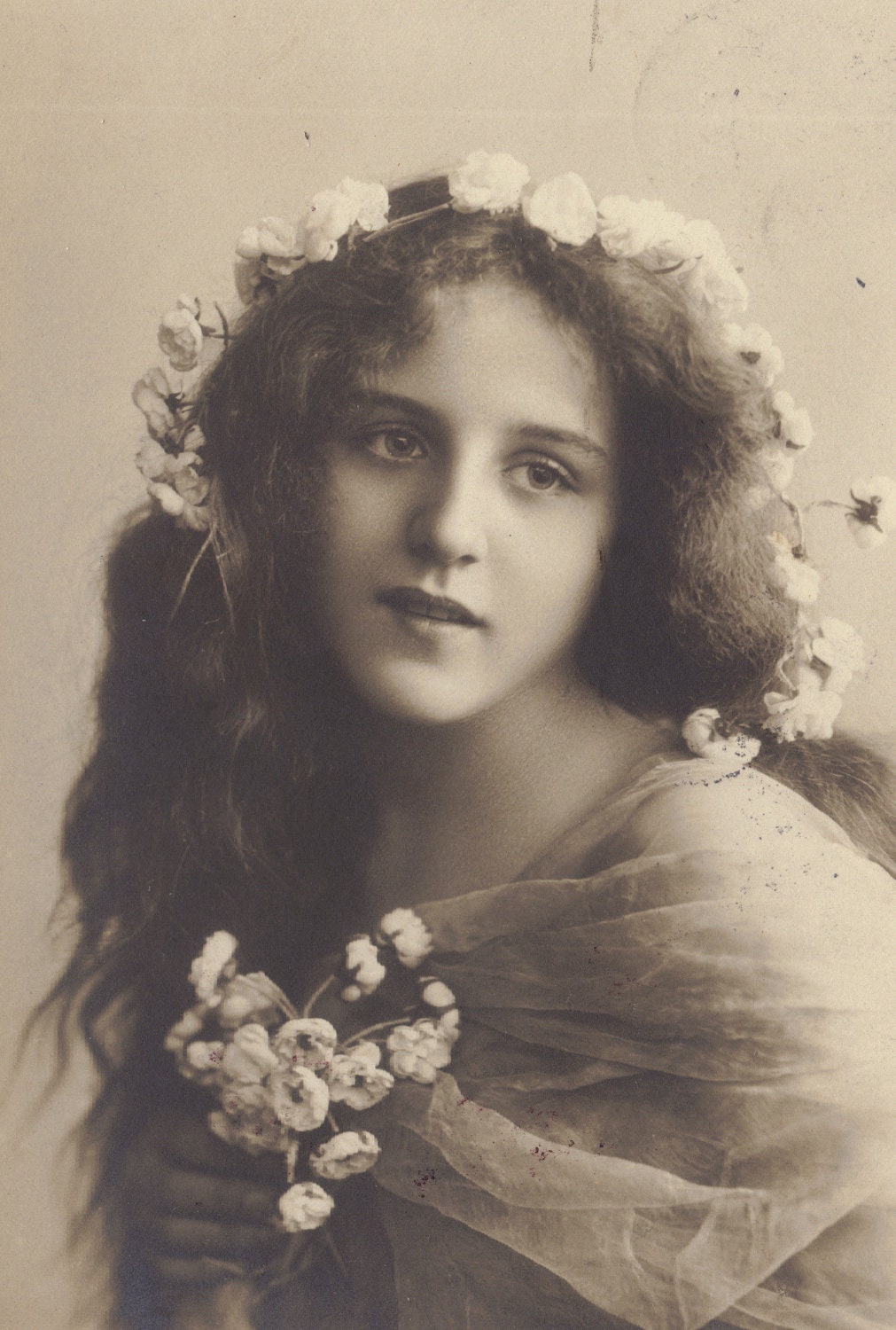
The final featured item is this lovely biogravure by Steglitz, circa 1905. The maiden portrayed in this image is crowned by a wreath of flowers, which, together with her long, unbound hair symbolizes Spring and the purity and innocence of youth. Appropriately, the photographer has captured her with her gaze turned down, deftly maintaining the Arcadian ambiance.





 The ravishingly beautiful Signorina
Almirante starred in some of the earliest silent films. She came from a
theater family, and began her career on stage. She made a number of
successful films, only one of them a talkie.
The ravishingly beautiful Signorina
Almirante starred in some of the earliest silent films. She came from a
theater family, and began her career on stage. She made a number of
successful films, only one of them a talkie.