Showing posts with label France. Show all posts

Sunday, July 14, 2013

Happy Bastille Day!

We have so many wonderful postcards and images from France, so many French actresses (and the occasional actor), so many French photographers, that we just can't let France's National Day, Bastille Day, pass without notice.

Eiffel Fireworks by Timo Elliot
Happy Bastille Day!

Wednesday, April 3, 2013

Guest Blogger Mayra Esquivel: Biography of Jeanne Lanvin, Fashion Designer, 1867 – 1946

Every now and then, we come across someone who is able to share a new perspective on a subject of interest to our readers. Mayra Esquivel is such an individual. A student studying Fashion Design at Pima Community College, Mayra's interest in the fashion designers whose work adorned the fashionable women of the late nineteenth and early twentieth centuries has led to this biography of Jeanne Lanvin. We hope you enjoy Mayra's article as much as we have.

Jeanne Lanvin, Fashion Designer, 1867 – 1946
by Mayra Esquivel, Fashion Student, Pima Community College


Jeanne Lanvin. Photograph by Talbot.
Jeanne-Marie Lanvin was born in Brittany, France. She was the oldest of 11 children, since her family was really poor she didn’t have much education. When she turned 13, she was employed as an apprentice by a hat maker. Although she was spending more time cleaning the workshop and delivering the hats, she learned well how to make hats, so she started to make and sell dolls hats on her own in the toy stores of the neighborhood. In 1885, at the age of 18, with good business experience and enough savings she opened her own hat company. In the beginning it was difficult, but later on her business was successful, and she was able to expand and move to Rue du Faubourg Saint Honoré, where the company remains.

Jeanne Lanvin got married in 1896 and divorced in 1903. Born of this union was her only daughter, Marguerite. For Lanvin, being a single mother had a negative effect on her business. In 1907 she married a journalist, Xavier Melèt, but it was not a happy marriage; it was considered an arrangement of convenience. They remained married until 1953 when Melèt died.

Lanvin was the first to design children’s clothes. She designed for her daughter, using her as a model, and creating scaled-down versions of clothing for adults. Her hat clients loved her designs and the fact that mother and daughter could wear similar clothes. In 1909, Jeanne began making dresses for sale. She made no distinction between women’s and children’s wear; her designs were youthful, sophisticated, and featured exquisite handmade detail. The demand for her designs persuaded Jeanne to open a couture house selling mother-daughter garments and, thus, started her career as “Grand Couturier.” Since Marguerite was the unofficial model, as she was growing, Jeanne’s collections grew to target additional clients matching her daughter’s age.

Marie Blanche Polignac, née Lanvin
Her designs were easy to recognize for her skilful use of embroidery, fine craftsmanship, and a particular shade of blue, “Lanvin Blue”. The inspirations in her embroidery patterns were influenced by other cultures: from the Middle East, the geometric shapes, vertical rows, and horizontal border patterns; from China, the traditional symbol of longevity. Her designs used silk, taffeta, velvet, silk chiffon, organza, lace, tulle, and included a lot of free-flowing ribbons, ruffles, flowers, and linked ornaments like appliqué, couching, quilting, parallel stitching, and her main touch, the embroidery. Her creations were considered ultra-feminine, with fitted bodices and long, full skirts. The “robe de style” was one of the well-known collections. Features often found in her designs included scooped-necks, drop waists, cap sleeves, or sleeveless bodices, and full skirts with volume at the hips. These designs were comfortable and classic, appropriate for all ages of women. In order to keep the “robe de style” interesting from season to season she updated her designs. In the mid-1920’s they were abundant, including double silhouettes, and three-quarter-length skirts. In the mid-1930’s they came full circle, with floor-length skirts. Even though Lanvin’s designs were not always contemporary, she was an advocate of modernity. She was a designer who didn’t drape or sketch her ideas, and her inspirations came from many art movements.

"It's still raining", fashion plate from La Gazette du Bon Ton, 1915, showing (left to right) tailored suits by Paquin, Lanvin, and Doeuillet and a coat by Paquin.
In 1926, Lanvin added a menswear division, becoming the first couturier that dressed whole families. For the men’s collection, Jeanne hired her nephew Yves and they succeed among ambassadors, members of the Academie Francaise, and aristocrats. Later she launched an interior-design branch, run by designer Armand-Albert Reteau. She created dozens of perfumes, but none of them were commercially successful until she designed Arpège. The perfume was introduced on the 30th birthday of her daughter and it became the most successful perfume. It had the house’s logo on the bottle: Jeanne in a flowing evening dress holding Marguerite’s hands.

The key of her successful career was that she knew her clientele. Jeanne Lanvin was one of the first
designers who created a true empire; her legacy has proven timeless and is one of the oldest surviving
couture houses. In 1946, Jeanne Lanvin died and her daughter, now known as Marie-Blanced, took over the company until 1958 when she died. Now Lanvin is headed by Alber Elbaz. Elbaz is not reinventing the House of Lanvin, he is following and developing the same environment Lanvin did. His sophisticated and delicate designs create a sublime silhouette suitable and flattering for various types of bodies. He is keeping the style of youth, femininity, and beauty, the same as Jeanne Lanvin’s.

Lanvin’s client list includes celebrities as Nicole Kidman, Kate Moss, Chloé Sevigny, Sofia Coppola, First Lady Michelle Obama, Queens of Italy, Roumania and English princesses House of Lanvin has numerous international locations, several in the United States. In 2011 three boutiques were opened in Moscow. They are traditional boutiques making clothes for both mothers and daughters, in honor of Jeanne Lanvin.

Copyright 2013, Mayra Esquivel. Published with the permission of the author. All rights remain with the author.

Sunday, March 24, 2013

Dramatically Tinted Images from La Belle Époque

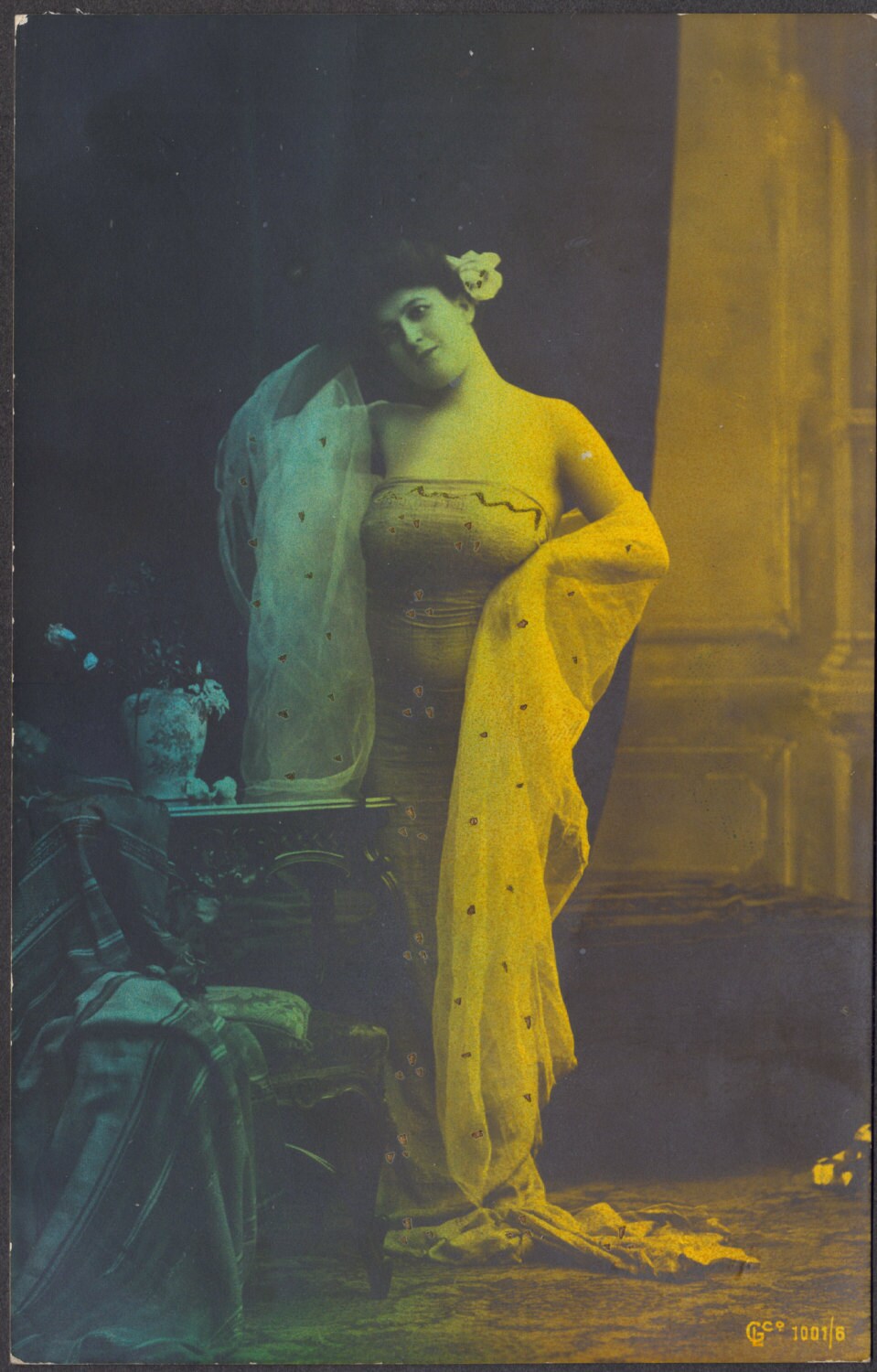
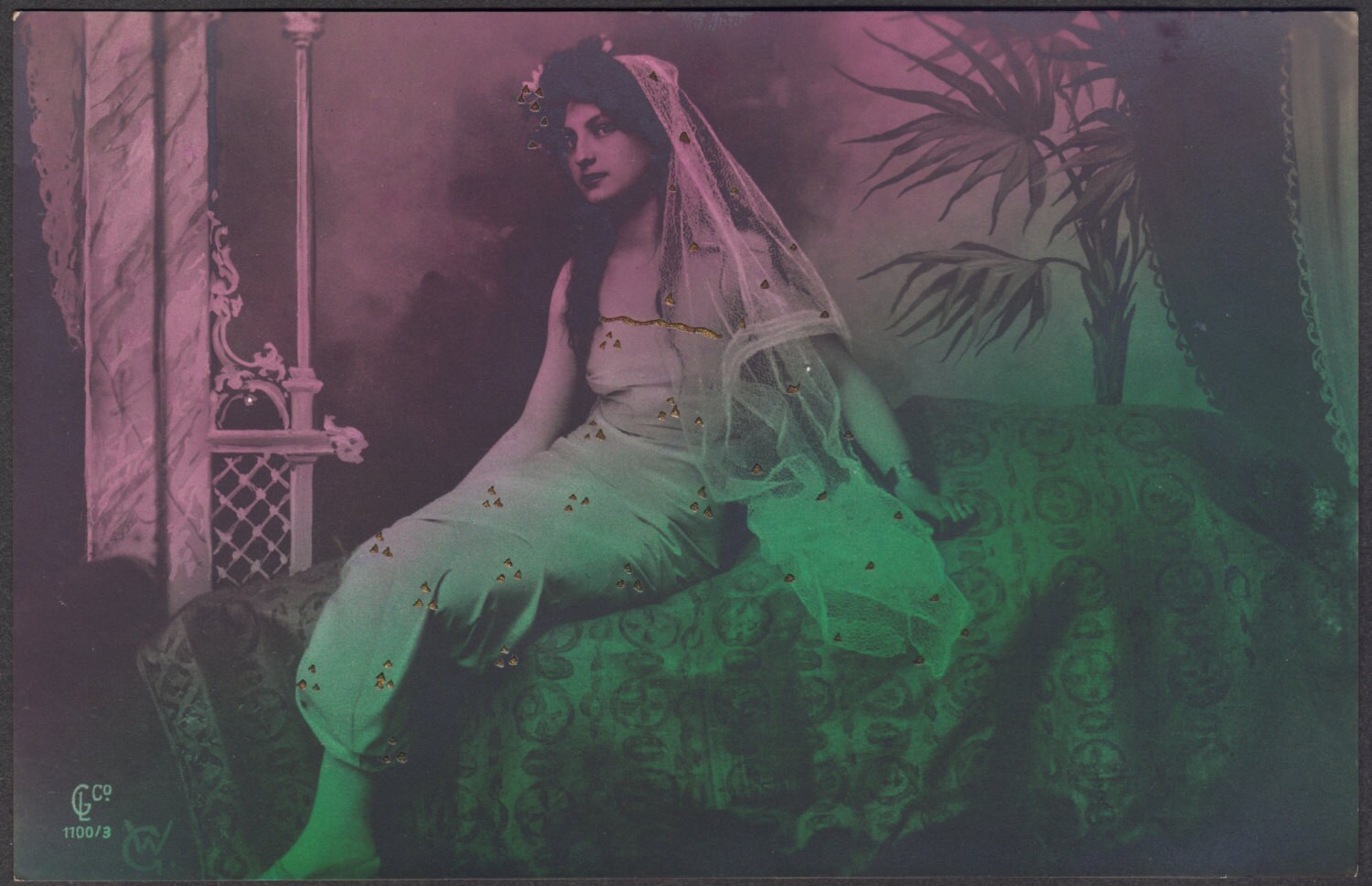
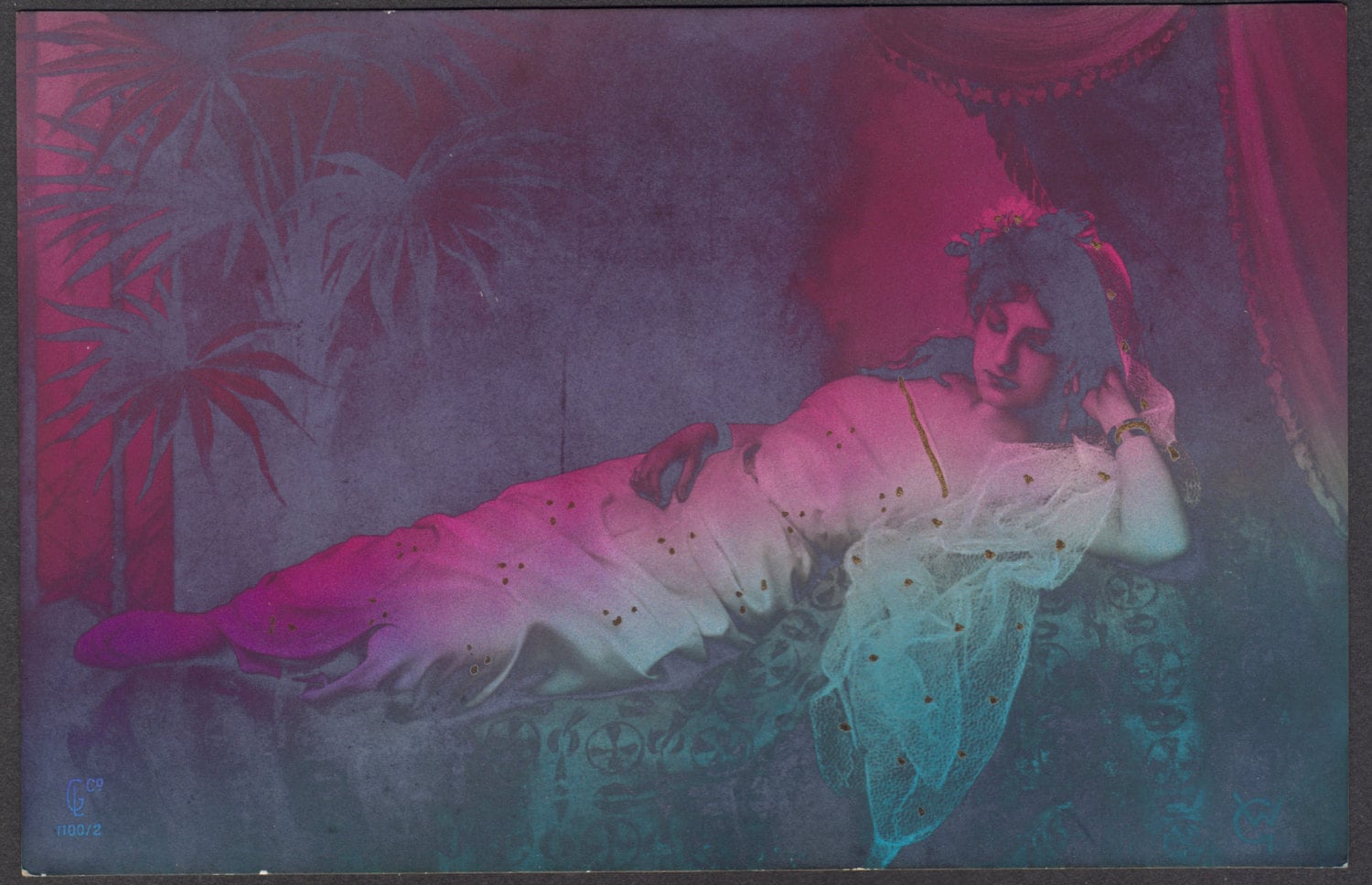
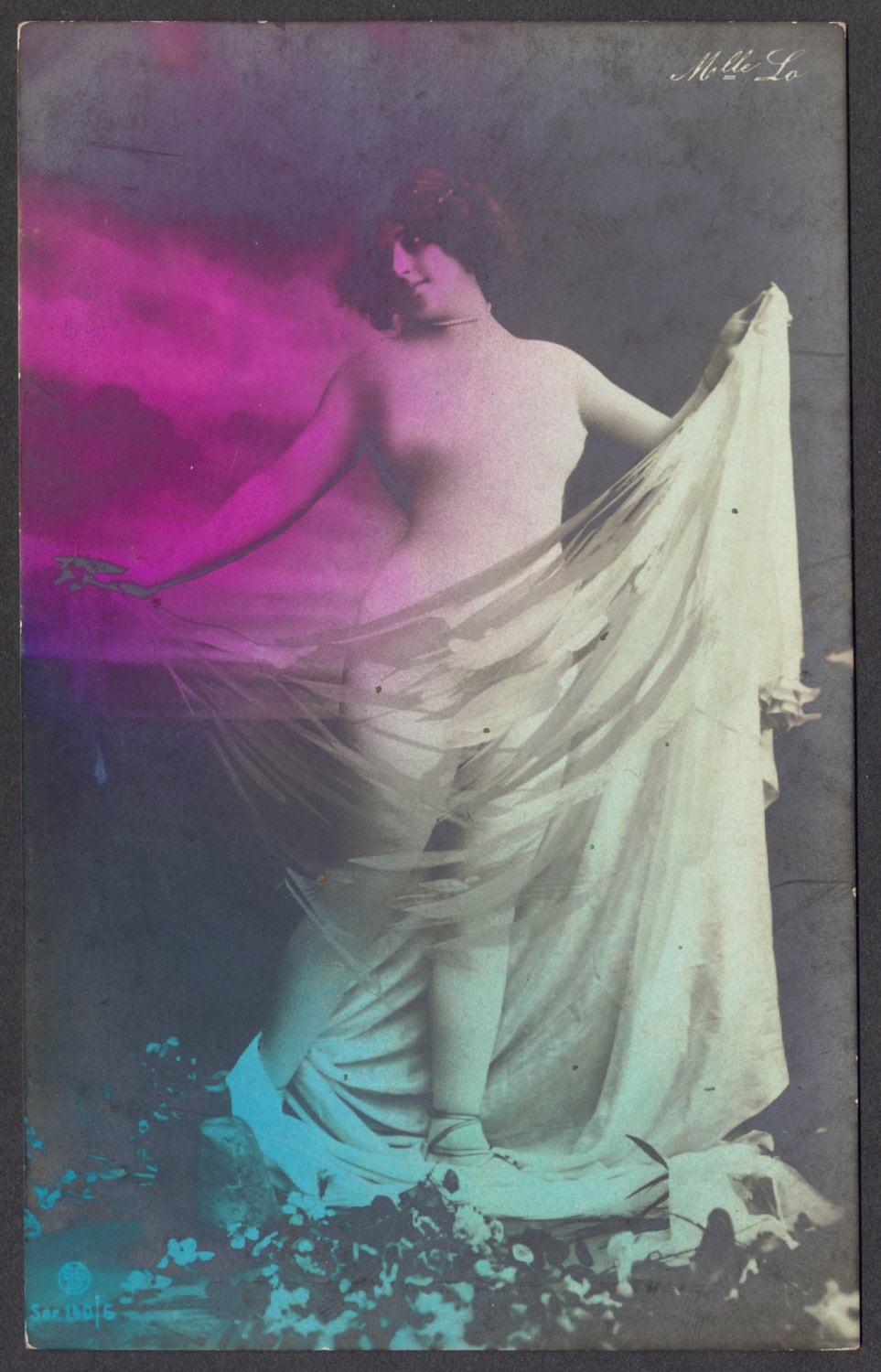
These gorgeous and weirdly ethereal images were accomplished using a type of coloration that was briefly popular during the early part of the twentieth century and which sometimes achieved amazing results. We know their vivid shades resulted from early experimentation with color tinting, but we simply can't find any credible information about the process used to create these fantastically tinted images. Over and over again, while researching hand-tinting of vintage photographs, we stumble across the sentiment that color was added to black and white photographs due to a desire to create images that more accurately mimicked life, but these images show that there were often other, more artistic, aesthetics at work.

The first of these images uses shades of blue fading into yellow. This enhances the impression that the woman in the picture is standing just on the border between shadow and illumination. While there are many possible interpretations of the symbolism in standing on the verge of both darkness and light, our favorite is that of standing with one foot in the mundane world and the other in Faerie, and such perception would be very in keeping with the sentiments of the era.

AVAILABLE FOR PURCHASE Dramatically Tinted Belle Epoque Image of Young Woman, circa 1905
The following two images seem to be from a single photo shoot and were produced by the same studio as the first, although with a different model. Here, the coloration helps to lend an air of mystery and romance to the young woman, while her filmy gown and scarf, the draped couch upon which she reclines, and the decor, complete with potted palm, all contribute the sense that one has been given a rare glimpse into the Sultan's palace. The rich colors in the two images create very different moods: the seated figure could almost be a mermaid under the sea, while the deep fuchsia lends a sultry sensuality to the image of the reclining woman.

SOLD Dramatically Tinted Belle Epoque Boudoir Image, circa 1905
SOLD Dramatically Tinted Belle Epoque Harem Image, circa 1905
The last of our featured items is a postcard in which Mademoiselle Lo appears in a body stocking and veil. Body stockings were used for a short time at the turn of the century in an attempt to avoid prosecution for violation of decency laws discouraging onstage and photographic nudity, but the intended effect was that the actress appeared to be nude, or very nearly so. In this image, the cloudy sky on the left side of the image, along with Mlle. Lo's arm, face, and a bit of her torso, have been shaded with a deep rose, hinting perhaps of some impending storm or doom. Below the horizon, the shade used is a deep blue, suggestive of water, so that we may imagine that Mlle. Lo has just stepped from the sea onto land. Perchance she portrays some magical being of the sea, come to air herself for a short time before returning to her watery home. Or, maybe she is depicting a character in a play whose reasons for standing on this lonely beach are more tragic, or more playful. We may never know the full story behind this image, but we find its beauty and mystery haunting.

AVAILABLE FOR PURCHASE Mademoiselle Lo, French Artiste Nude en Voile, Fantaisie, circa 1905

Sunday, February 3, 2013

Kamajoeh, Mozambique Beauty En Voile, circa 1905

As well as being a lovely image in and of itself, this is a very interesting postcard for a number of reasons. The subject of the image, almost certainly an actress or performer, is a woman of color whose name (probably Swahili or possibly Malagasy), suggests she may have come from the Portuguese colony of Mozambique in Africa, or the French colony of Madagascar off Africa's coast. Though the postcard bears a German stamp and was probably produced in Germany, the image itself is quite probably French, as her costume, with layers of filmy material wrapped low about her shoulders, and her hair, done up in the classic chignon so popular in that period, are distinctly French European in style. 

AVAILABLE FOR PURCHASE Kamajoeh, Mozambique Beauty En Voile, circa 1905


Why do we find this so fascinating? Primarily because—although dance, music, and costume in the France of the late 19th and early 20th centuries was clearly influenced by the cultures of European colonial holdings—it is uncommon to find on postcards images of performers of color who actually come from these colonies.

Theatrical entertainment in France at that time was full of the romantic idealization of foreign cultures. Margaretha McLeod, a young Dutch woman who apparently learned Indonesian dance while locked in a terribly unhappy marriage in the Dutch East Indies, left her husband, made her way to Paris and, in the proud tradition of P.T. Barnum, changed her name to Mata Hari, billed herself as a Javanese princess, became hugely successful with her sensual dance routines, and the rest is history. There were so many others, many images of whom, from time to time, grace the cards we sell in our shop, but almost always they are white Europeans.

Still, though such images as this one are uncommon, we feel it's important to point out that the egalitarian nature of French society was such that performers of all cultural, religious, and ethnic origins made their way to Paris, where many found success and fame. After all, it was in the Paris of the 1920s that Josephine Baker, the famous African American dancer and stage performer, found a broad acceptance and venue for her talent that had not been available to her in the United States of that time.

Finally, we want to acknowledge that we are mere dabblers in history, and certainly not historians. Our focus is limited and narrow, and our short posts far from even remotely complete. So we offer our observations in the spirit of enthusiastic collectors, and hope they are welcomed by fellow enthusiasts and that our over simplifications of complex historical issues and events are forgiven by those more knowledgeable than ourselves.

Monday, November 12, 2012

This Week's Featured Items: Hand-Tinted French Postcards of Beautiful Hats

This week's featured items in the Red Poulaine shop are four postcards featuring hats, each beautifully hand-tinted. Three of the cards have images of large-brimmed sunhats, while in the fourth the hat is a cloche with a narrow brim.

AVAILABLE FOR PURCHASE Hand-Tinted 1920's Flapper in Gorgeous Hat

This lovely card by Opera of Paris shows a cheerful young woman as the hat model. The hat itself is made of a textured fabric, with the crown circled by an elaborate ribbon. The card has been beautifully hand-tinted, depicting the model as a strawberry blond, while the red ribbon with gold edging contrasts marvelously with the solid black of the hat. A wonderful card for anyone interested in the fashions of the 20s and, especially, in hats.

AVAILABLE FOR PURCHASE Hand-Tinted 1920's Flapper in Wonderful Hat
Here's a card from French postcard publisher RP that features a model wearing a rose red sunhat with a pink underbrim of crinkled fabric. The hat truly highlights the delicate features and wistful expression of the model. The pale yellow-green hand-tinting of the dress provides a marvelous almost neutral shade that complements the deep rosy shades of the hat and the model's lipstick. We can just imagine her at an elegant garden tea party, looking up into the eyes of her first beau and soon-to-be fiancé. Alternatively, she's a mushroom fairy, possibly the queen of the woodland mushrooms, who has deigned to grace a favoured table at the lucky hostess' garden party and the young man who is smitten by her beauty may disappear for the next seven years.

AVAILABLE FOR PURCHASE Hand-Tinted 1920s Flapper in Marvelous Hat
The third of our sunhat postcards is also from France, by the publisher Leo. This card, like the others, has been hand-painted, and her blond hair has just a tint of red. Her pearl necklace has been painted to match her hot pink lipstick, while her hat is a lovely shade of blue and has trimmed with fine golden-yellow lace.


AVAILABLE FOR PURCHASE Beautiful Hand-Tinted Image of Young Woman 1923
This is a very charming image and the model has a truly wonderful smile. Still, we chose this one for our shop primarily because of the wonderful example it presents of fine hand-coloration. Truly remarkable work. From the detail work on her silk blouse, the gentle rouging of her cheeks, to the implied reflection of light off the satin ribbon on her hat. So wonderful! A celebration of Spring!