Showing posts with label Victorian. Show all posts

Saturday, June 15, 2013

Images of the Fantastic in La Belle Époque

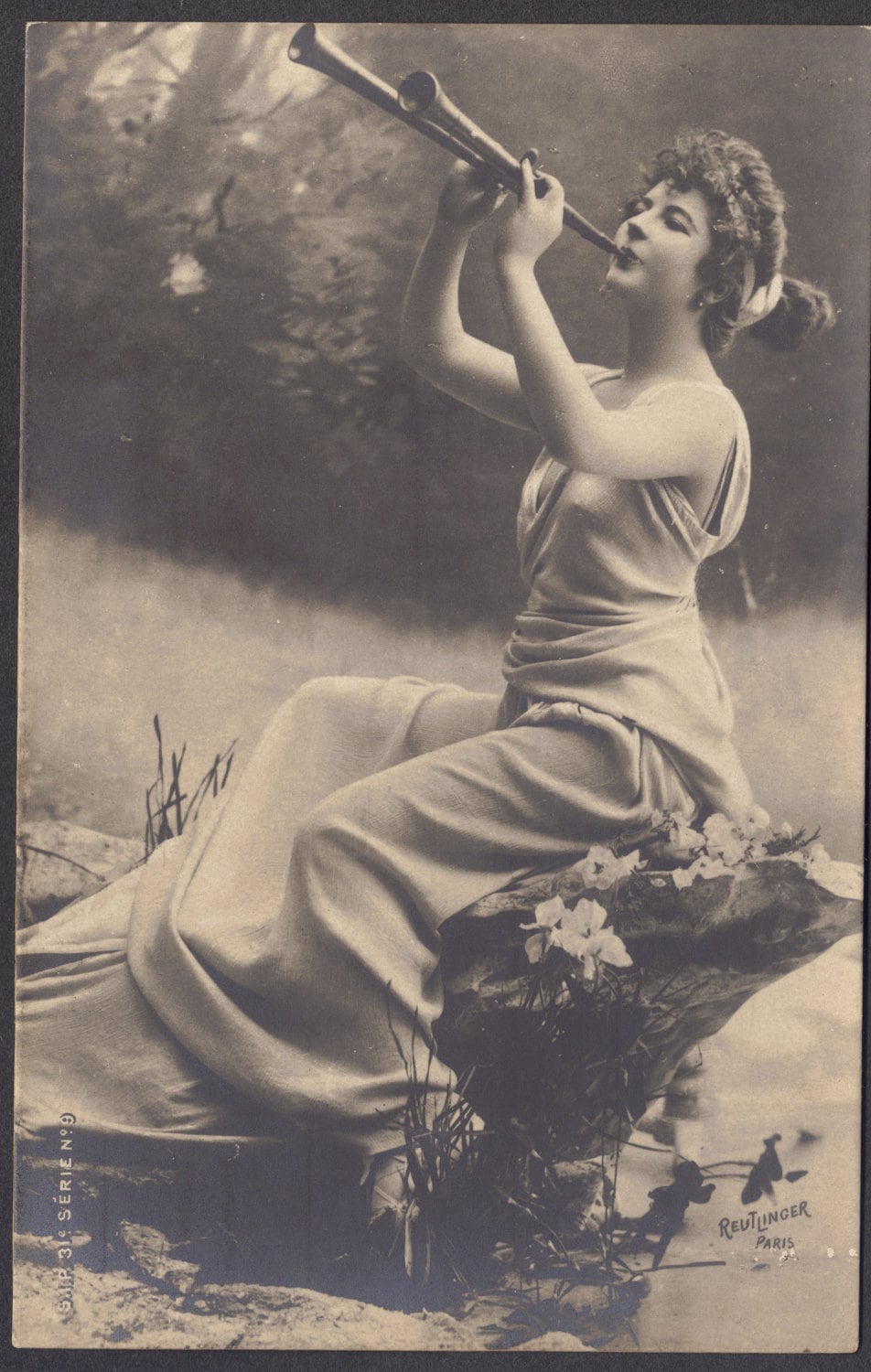
One aspect of La Belle Époque, not just in France either, was a very palpable embrace of antiquity, and though often in a rather naive fashion by today's standards, one gets the sense that people were turning away from the onslaught of the industrial explosion and towards the real, and imagined, simplicity of earlier times. With this came a sense of the possibility of magic, and the ubiquity of images like this one, in which we wouldn't be terribly surprised to see faeries or woodland sprites cavorting about.

SOLD Wood Nymph at the Well
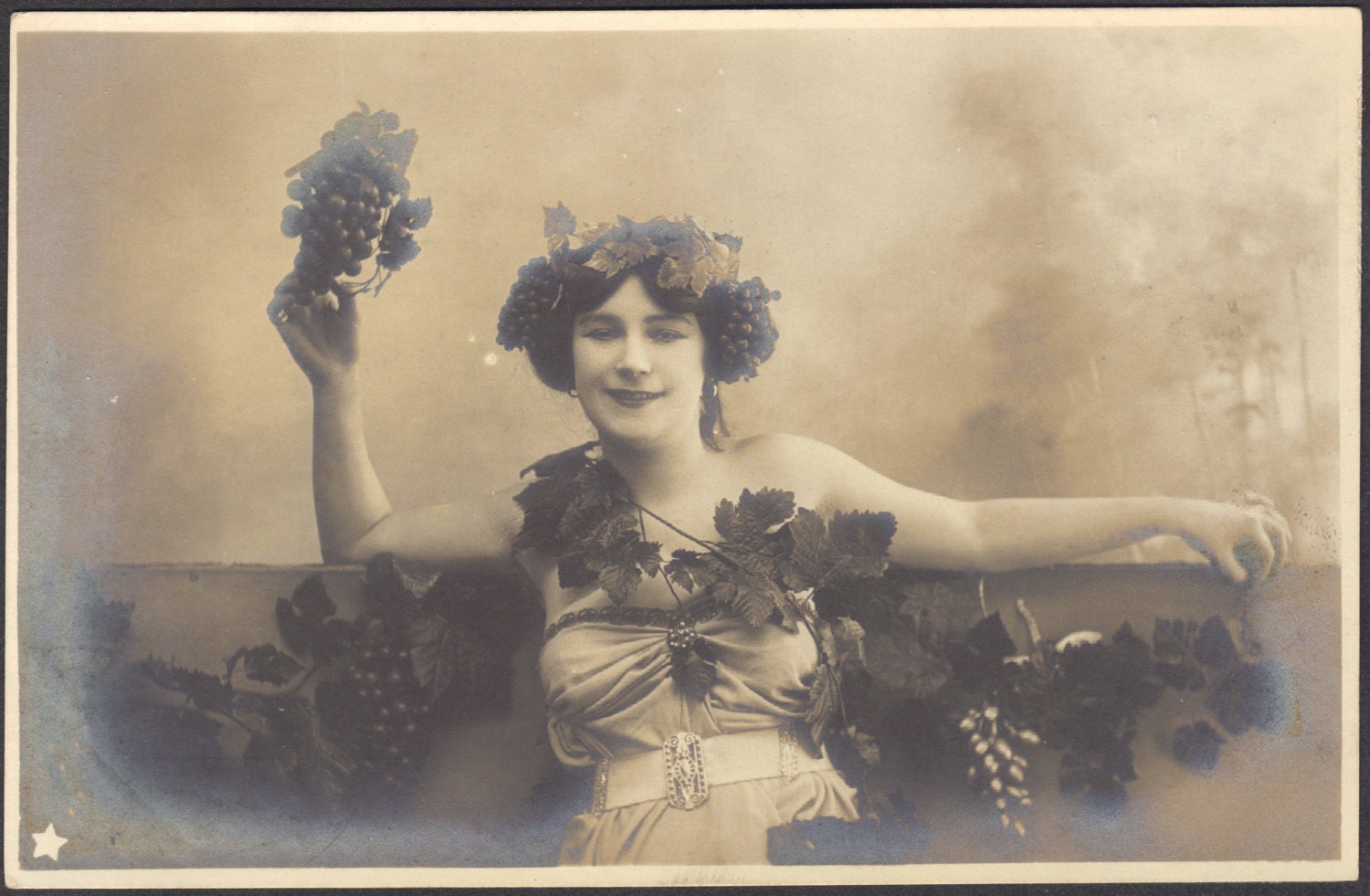
Or, perhaps we expect at any moment to see a faun, satyr, or even Bacchus, himself!

SOLD Nymph Calling Forth the Woodland Sprites circa 1905

We love the way in which the magical is suggested in these images, without the introduction of a single truly fantastic element. These images make us feel much as we might when reading a fairy tale, that at any moment something truly marvelous will happen.

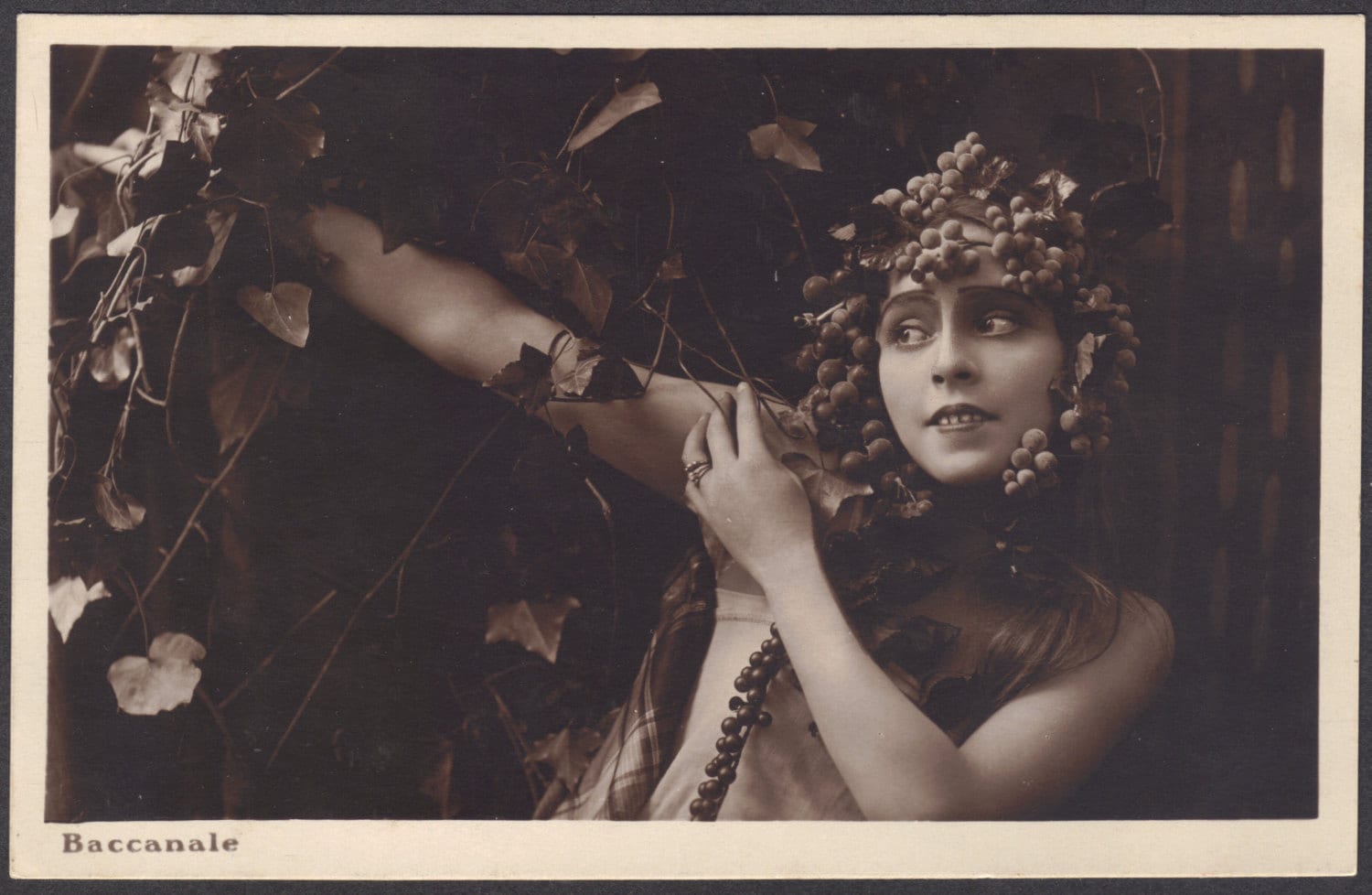
Nymphs, Naiads, Dryads, and Faerie folk so often cropped up in La Belle Époque. Found throughout the period from popular entertainment to commercial advertising, these images reflected a blossoming of Western occult experimentation and a yearning for magic, for myth made manifest. We've written before of our fondness for images depicting the Marvelous Maenad, which is not only a subgenre of the "Lovely Lady" category, but of fantasy postcards, as well.

AVAILABLE FOR PURCHASE Maenad at the Garden Wall, circa 1900
Maenads could be seductive, inviting the viewer to join them in the Bacchanal, as in the previous image, but they could also be depicted as shy and elusive creatures of the wilderness, emerging from a tangle of vines, perhaps looking back with a mixture of amusement and discomfiture at a pursuer.

AVAILABLE FOR PURCHASE Maenad Peering Through the Trees, circa 1910s/20s
Even more interesting, we think, is the fact that this new medium, the picture postcard, made available to anyone with a penny or two the possibility of possessing such an image, one in which an obviously very real human being is pictured in a fairyland setting. We take photographs for granted today, of course, but think about it for just a moment—at the turn of the 20th century, this was all entirely new. Prior to this time, fantastic photo images of human beings were seldom accessible to the common man, woman or child, and we cannot take lightly the effect of "likeness" on the human psyche, and it's worth considering the effect this mass phenomenon had on society. Mass phenomenon, you wonder? Really? Absolutely. Just as an example, in the United States alone, "the official figures from the U.S. Post Office for their fiscal year ending June 30, 1908, cite 677,777,798 postcards mailed. At that time the total population of the United States was only 88,700,000!" (Thanks to emotionscards.com for their fascinating article that provided us with that factoid.)

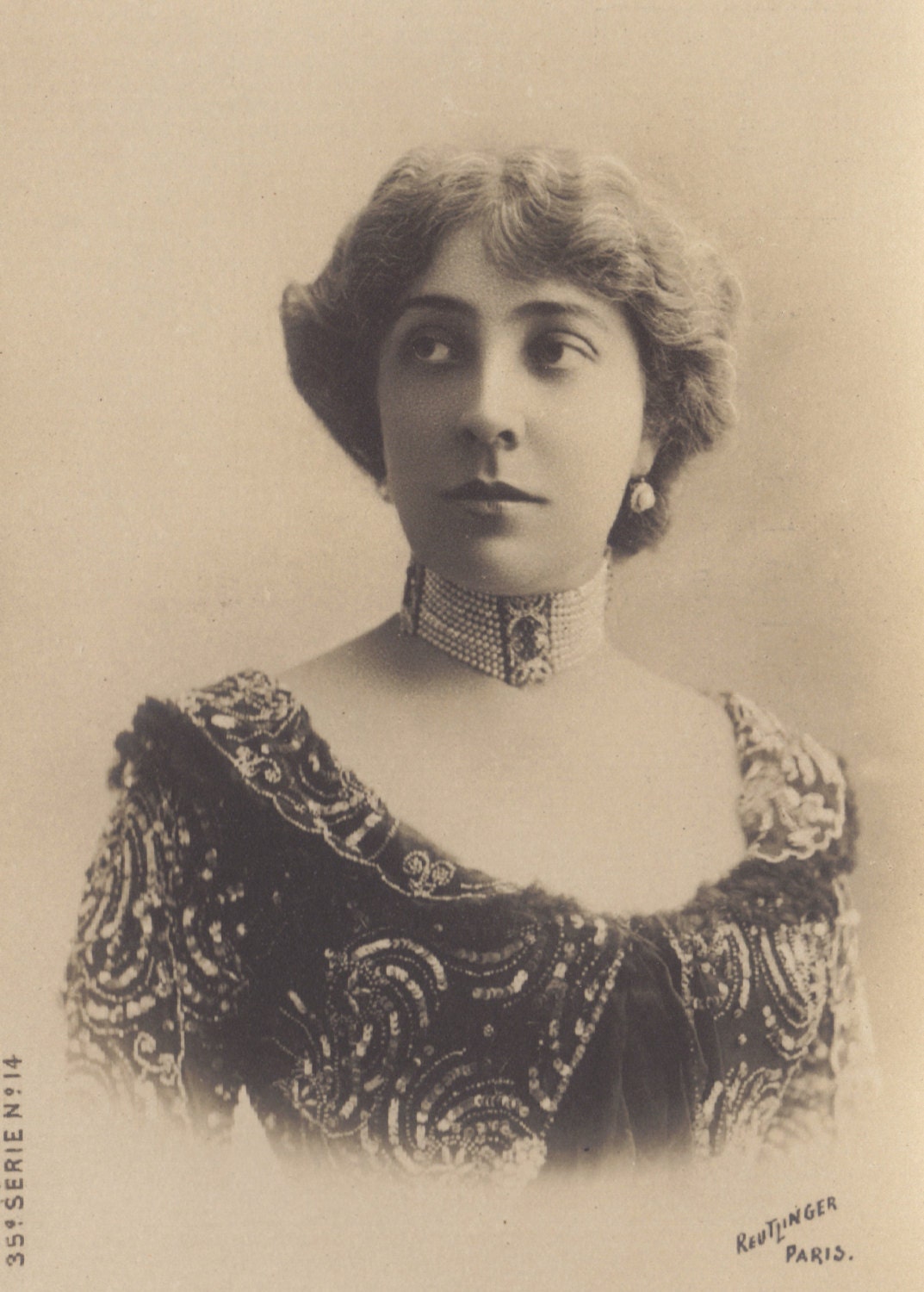
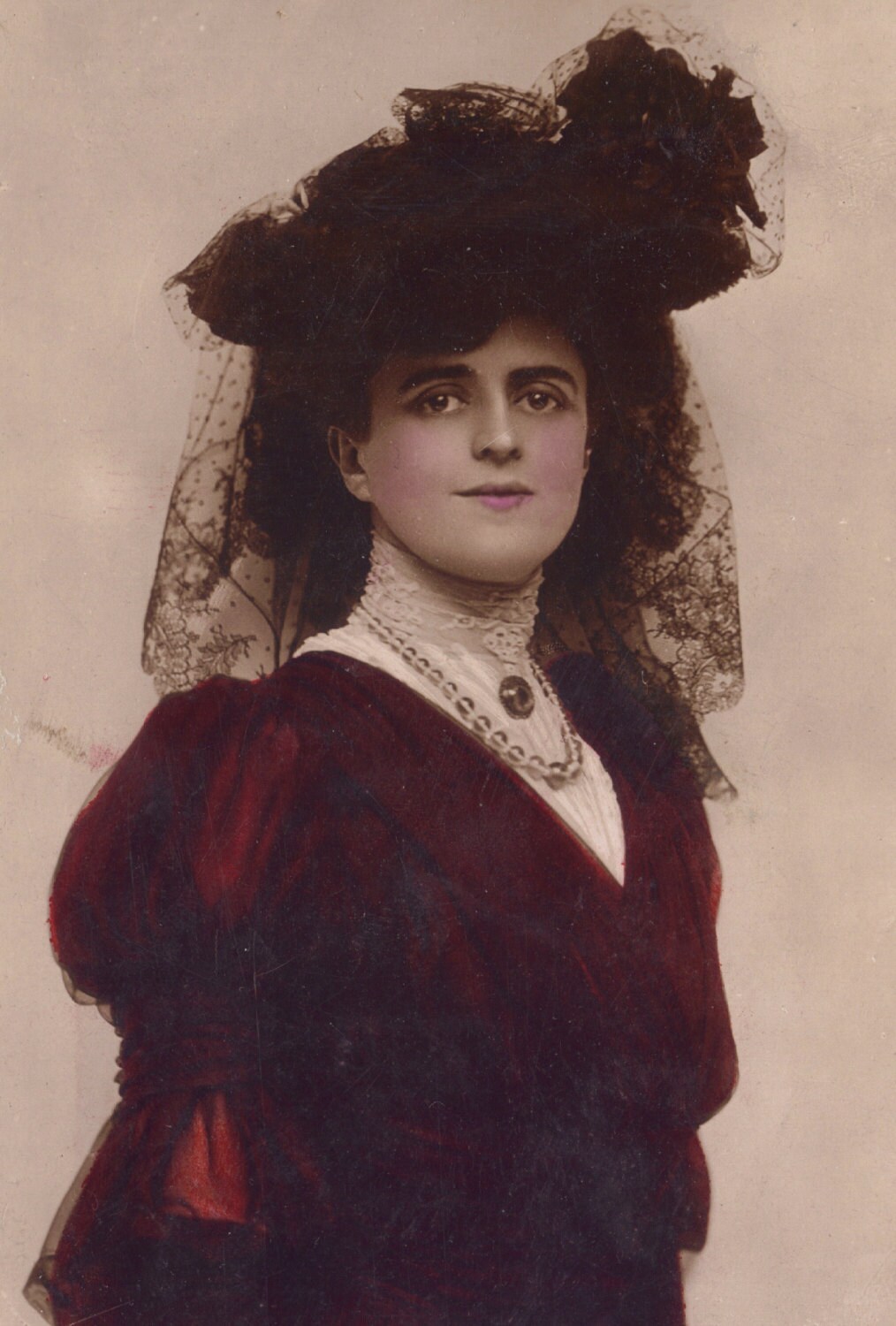
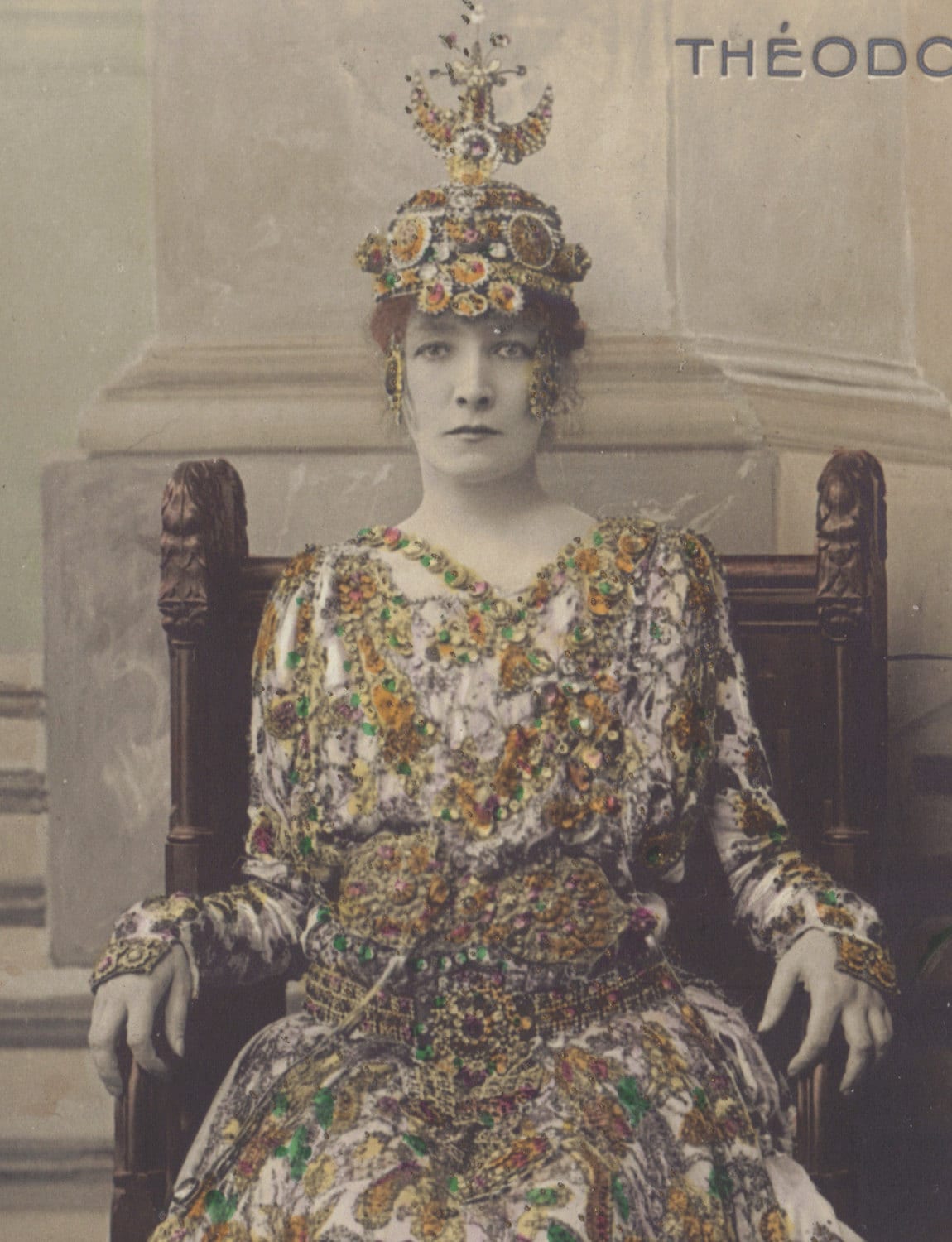
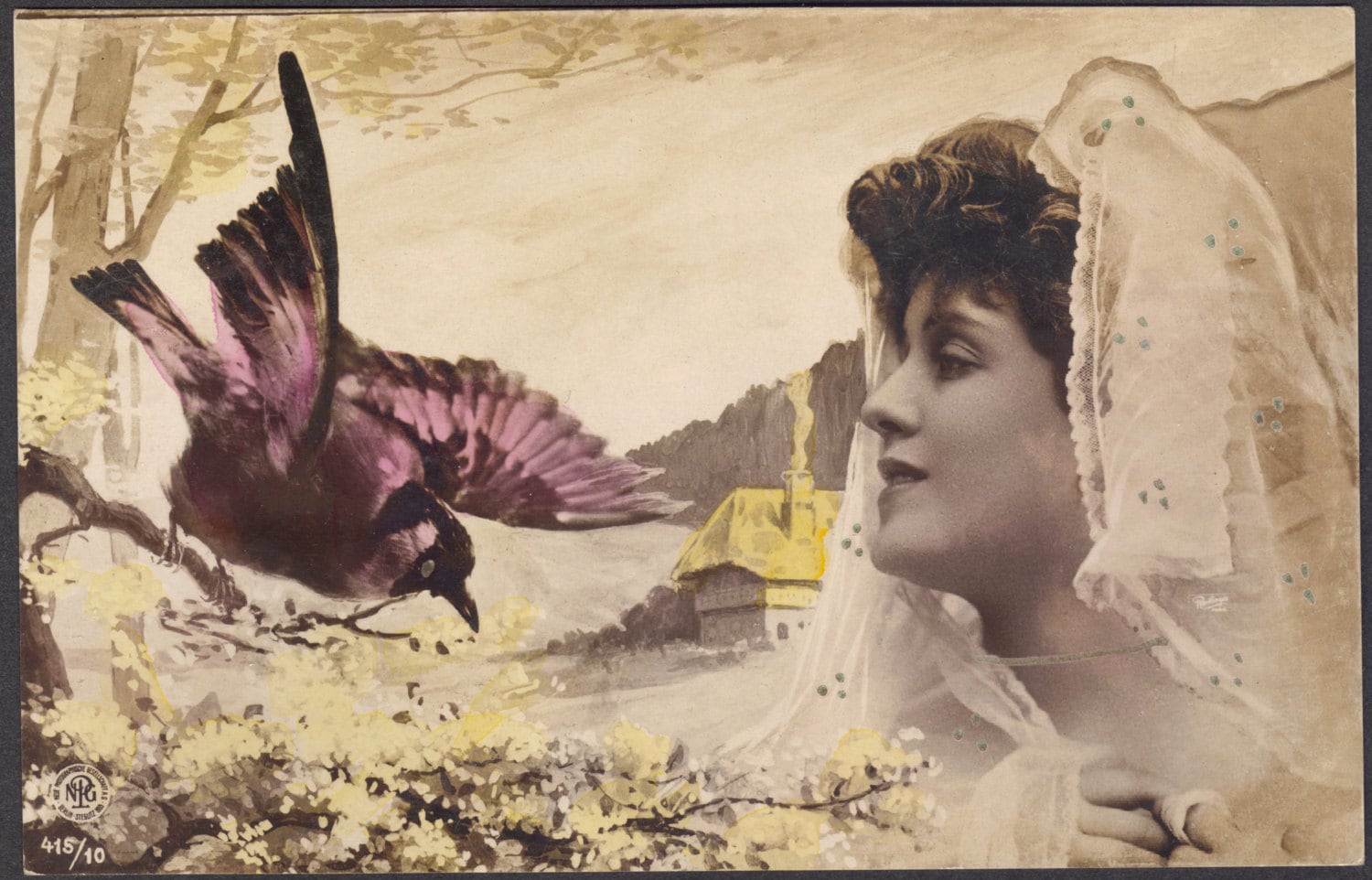
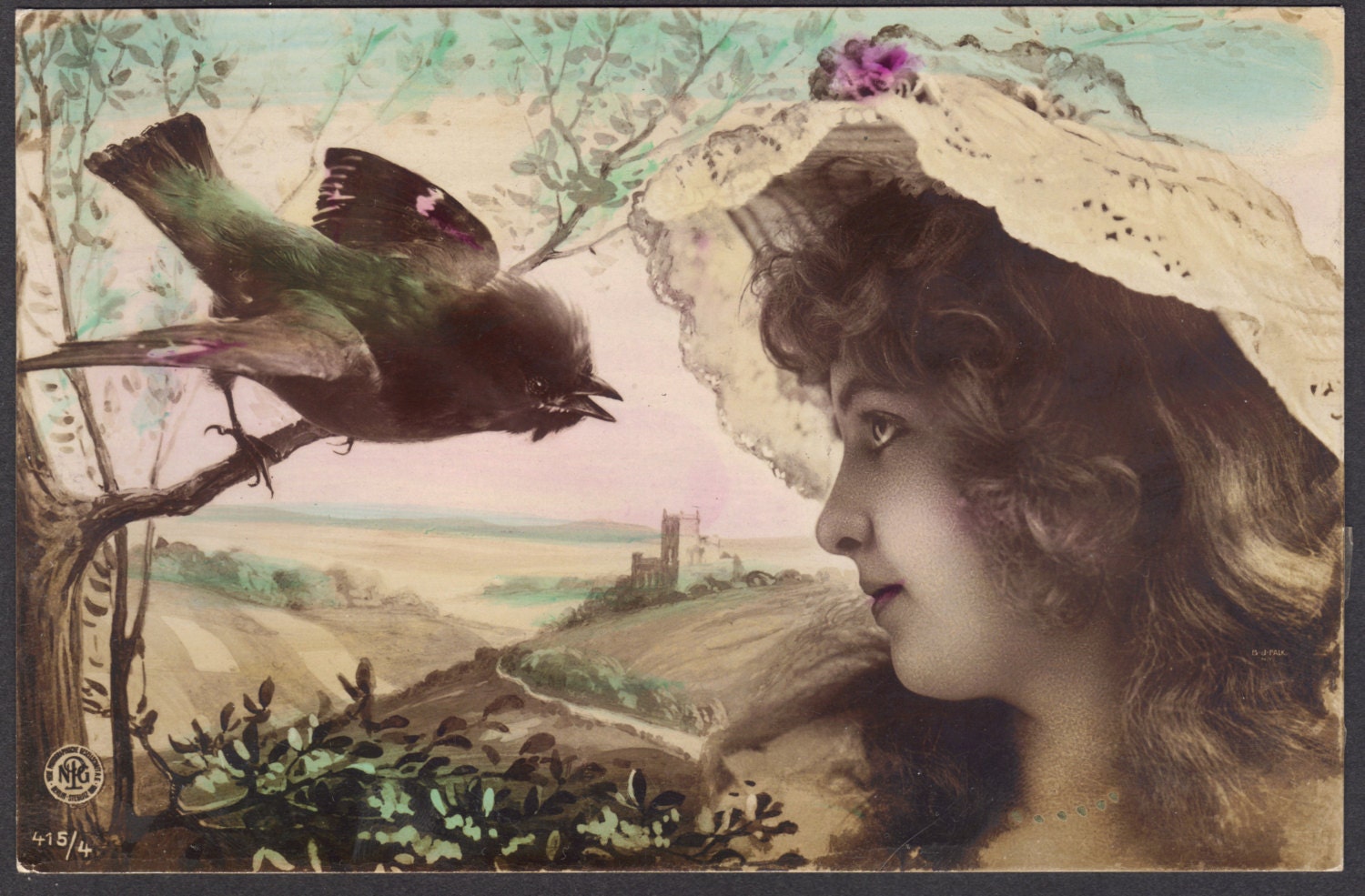
Leopold Reutlinger, the Belle Époque photographer, took thousands of photographs of famous Parisian actresses. These were published in black and white, cropped to close up and republished, hand tinted, glittered, sequined, published again, and when every imaginable possibility had been explored, he superimposed these images onto wonderfully fantastic, often surreal backgrounds. The "Artiste with Bird" series is one of our favorites and quite collectible. As of this writing, we have two such images, both by Reutlinger and in unusually fine condition.

AVAILABLE FOR PURCHASE Marguerite Brezil, Belle Epoque French Actress, Interspecial Romance Image by Reutlinger


AVAILABLE FOR PURCHASE Avian Romance Fantaisie by Leopold Reutlinger of Paris, circa 1905
Can't you just imagine these lovely ladies as heroines in fairy tales, in which for their kindness they have been rewarded the ability to speak the language of the birds? Or, perhaps the bird in the picture is actually an enchanted prince, in need of saving by the brave young woman.

One of the issues with Reutlingers "fantaisies," is that although the artiste's name was usually printed on the face of the card in its early incarnations, by the time they got to these dramatic creations, the name would often be left off. This was fine at the time, since their faces were very well known, but not today. We've been able to identify the first of these two beauties as Marguerite Brezil, but the identity of the second remains a mystery and we would welcome any clues that might shed some light on this.

These wonderful fantasy-inspired photographic images quite clearly reflect the same underlying ideals found in Victorian fairy paintings and Victorian attempts to portray fairies in photographs, a connection which ties them in with the Romanticism of the late 18th and early 19th centuries. In his examination of fairy paintings, Jeremy Mass identifies "the turn to mythological and fantasy elements, and in particular to the fairy's world, [ as allowing] an escape from these demands. 'No other type of painting concentrates so many of the opposing elements of the Victorian psyche: the desire to escape the drear hardships of daily existence; the stirrings of new attitudes toward sex, stifled by religious dogma; a passion for the unseen; the birth of psychoanalysis; the latent revulsion against the exactitude of the new invention of photography.'" That photographs, emblematic in some eyes of the science and technology that was displacing many traditional beliefs and occupations, could be manipulated to portray the longed-for simplicity and magic of a bygone (never-was) era was marvelously ironic and ironically marvelous. Photographs, which Jeremy Mass, and many others!, fuse with conformity to a hard and unforgiving realism have, from almost the very moment they came into existence, been used to portray the world in ways the eyes are rarely able to see, providing us with visual evidence of the magic we all long to see.
Tuesday, December 4, 2012

Featured Items: Dazzling Beauties

The currently featured items in Red Poulaine are postcards with portrait images of young women, all dazzling beauties.

This wonderful portrait in profile of young artiste Florence Cresby was taken at the truly fine, Scloss Studio of New York, (we don't believe we've ever seen an image of theirs which wasn't really grand), which is why we're guessing Flo was an American girl, but the card was published by SIP, or Societe Industrielle de Photographie, a wonderful French Publishing house which handled a lot of Reutlinger's work, among others. Which is why we're guessing she was performing in Paris :) What a beautiful young woman! What a marvelously concieved photograph! Card is in almost perfect, unposted condition with a tiny crease in bottom left corner. We so love it when we get lucky like this. Schloss studio date of 1899 in lower left quadrant. Graceful age discoloration, but otherwise, wow!

AVAILABLE FOR PURCHASE Florence Cresby, American Girl in Paris, 1899
Our next image is a beautiful portrait of the artiste D'Albray, her upturned eyes lending her a soulful expression. Her gown is decorated with a floral motif that reminds one of a medieval tapestry, and the large basketwork buttons at the corners of the squared neckline contribute to the effect. Perhaps she is portraying a princess awaiting her fairy godmother?

AVAILABLE FOR PURCHASE Mlle D'Albray Belle Epoque Artiste by Reutlinger, circa 1905
From Alfred Noyer's collectible and truly fine series, "Les Plus Belles Femmes de France," comes Le Rouge. Lovely profile portrait of a French woman of the 1910s, or 20s, beautifully coiffed and wearing thin gauze across her shoulders, and a necklace of tiny pearls.

AVAILABLE FOR PURCHASE Le Rouge, or, The Redhead, from Noyer's Les Plus Belles Series circa 1910s/20s
Probably published circa 1905, this French card, posted 1910, presents a lovely portrait of a young girl with flowers, a spirit of Spring. We don't know the girl's name, but we do know she is, you guessed it, a dazzling beauty.

AVAILABLE FOR PURCHASE Sweet Child of Spring posted 1910


Wednesday, November 7, 2012

This Week's Featured Items: Family Photos

This week's featured items in the Red Poulaine shop are four photographs or RPPCs of families; two show family picnics, one a family grouped around a dining table, and the last a "posed" photo of the entire family and their chimney sweeps. Yes, chimney sweeps! Marvelous, we thought, and so we had to share.

SOLD An Edwardian Picnic in the Park, Early 1900s
This photographic postcard was published by the "Ace of Clubs" group and the reverse of the card was printed in French. The grouping in this image reminds us of paintings by the Impressionists, while the presence of the small black child, apparently part of the family, unusual for the time, adds a bit of happy mystery to the image.


AVAILABLE FOR PURCHASE A Picnic Lunch, Mid-1920s to Early 1930s
We place the date of this wonderful family picnic photo at somewhere between the mid-twenties to the early thirties. Was this a youngish grandmother with her adult children? We may never know, but we just love this image. High Summer, the meadow's yellowed grass, a stout wicker hamper, bread, wine, a lovely cheese perhaps... that baguette must have been wonderful. :) Don't you wish you could join them?


AVAILABLE FOR PURCHASE Coffee in the Parlor
We love an RPPC that takes us into a turn of the century home. It's like a trip in a time machine. On the reverse of the card is written in German (or something close to it), "The Jakobs family having coffee in the (something)room." The aging and wear of this image are apparent, but these relatively candid interior views come along rarely enough that we list them even when they are not in the finest condition.

AVAILABLE FOR PURCHASE The Entire Family, Including the Chimney Sweeps, 1932 or Earlier
Awesome image of a large family gathering, including a pair of chimney sweeps who stand, like two royal coachmen in attendance, to either side of the family. The chimney sweeps remind us of Dick Van Dyke singing, "good luck will rub off when I shakes 'ands wiv you,"in the film Mary Poppins; perhaps this family so valued the luck their sweeps brought them that they insisted on their presence for all important moments.

We don't often find photographs of chimney sweeps, so this is almost certainly a rare image. The photograph was taken in Poland by Zaklad Photography, with a handwritten date on the reverse of 1932, although the image looks a bit older.

Monday, October 1, 2012

One Million Roses

SOLD Marguerite de Sevre
The story is told this way:

Once, there was a poor and humble Georgian named Niko Pirosmani. He was a house painter, a painter of signs, and of simple pictures of people and animals that had in them a spark of magic to touch the hearts of his fellow Georgians.

Niko Pirosmani, painter, Tbilisi, Georgia, 1916. Portrait by Eduard Klar.
Eduard Klar [Public domain], via Wikimedia Commons
One day a famous French actress on tour stopped for a bit in Tblisi, the town where Niko lived, and Niko fell in love. It was said that of all things this actress loved flowers, especially red roses, so Niko, being only a simple man, and feeling a desperate kind of passion, took all the money he had in this world, he sold all of his canvases, his brushes, everything he owned he sold, and with this money he bought red roses; thousands, perhaps a million of them, and he filled the public square beneath her hotel window with these brilliant flowers. A few old grandmothers say that they can still remember how, throughout Tblisi, on that day, the air was heavy with the perfume of those roses.

Die Schauspielerin Margarita "The actress Margarita," 1909
Niko Pirosmanashvili (1862–1918) [Public domain], via Wikimedia Commons
In the morning when the actress, whose name was Marguerite de Sevre, awakened, she looked out her window to find the morning sun shining down upon the thousands, perhaps a million, scarlet roses in the square below. Watching from a discreet distance, Niko saw her surprised smile, and wept for joy. Marguerite saw the flowers, but she did not see Niko.

Well, Marguerite de Sevre returned to Paris, back to the bright gaiety of her life there. But Niko, poor Niko, financially ruined by this one impulsive act, lived out the rest of his life alone and slowly died of liver failure and malnutrition.

Ah well, perhaps it is only a story.


The story became a folktale in the Soviet Union, and a popular song, "One Million Roses," was based upon it. This song remains a favorite with audiences today throughout Russia and other nations that were once part of the USSR.


We were fortunate enough to locate another De Sevre, as well as an image of Suzanne Derval posing in the same chair. These images will be available for purchase in our shop on Etsy in the very near future.

Suzanne Derval
Marguerite de Sevre


Thursday, September 13, 2012

Saharet, the India Rubber Lady

SOLD Saharet
The Australian dancer Saharet was born Clarissa (or Clarise) Rose Campbell in either Melbourne or Ballarat, in 1879.[1, 2] A talented and limber dancer known for her ability to do high kicks, "a reviewer described Saharet as an India rubber lady in her rendition of a dislocation dance."[1]

Beautiful and vivacious, she led a full and interesting life. We hope to share a more complete biographical post with our readers at some time in the future. Today, we are sharing this video of a 1905 silent film clip, showing Saharet dancing the Bolero.[3]


Note A shorter video of the same film clip, but with an added musical sound track, is available at http://www.youtube.com/watch?v=1crlXwGhXcM.

An interesting side note to the silent film clip shown in these videos is that it was directed by the Frenchwoman Alice Guy (married name Blanché), who was, according to IMDB, the first woman to become a film director.[4, 5]

[1] Saharet. (2012, August 2). In Wikipedia, The Free Encyclopedia. Retrieved September 13, 2012, from http://en.wikipedia.org/w/index.php?title=Saharet&oldid=505444955
[2] Saharet. n.d. In HAT-History of Australian Theatre. Retrieved September 13, 2012, from 
http://www.hat-archive.com/Saharet.htm
[3] Change Before Going Productions. (2012, April 28). Saharet performs the bolero (1905) - Alice Guy Blanche - Madame Saharet boléro. In YouTube. Retrieved September 13, 2012, from http://www.youtube.com/watch?v=uD0nJYf4Cg4
[4] Saharet, boléro. n.d. In IMDB. Retrieved September 13, 2012, from http://www.imdb.com/title/tt1649402/
[5] Alice Guy. n.d. In IMDB. Retrieved September 13, 2012, from http://www.imdb.com/name/nm0349785/


Hot Pink Hand-Tinted Vintage Photograph of a Romantic Couple on a Beach