Showing posts with label Beautiful Era. Show all posts

Wednesday, January 9, 2013

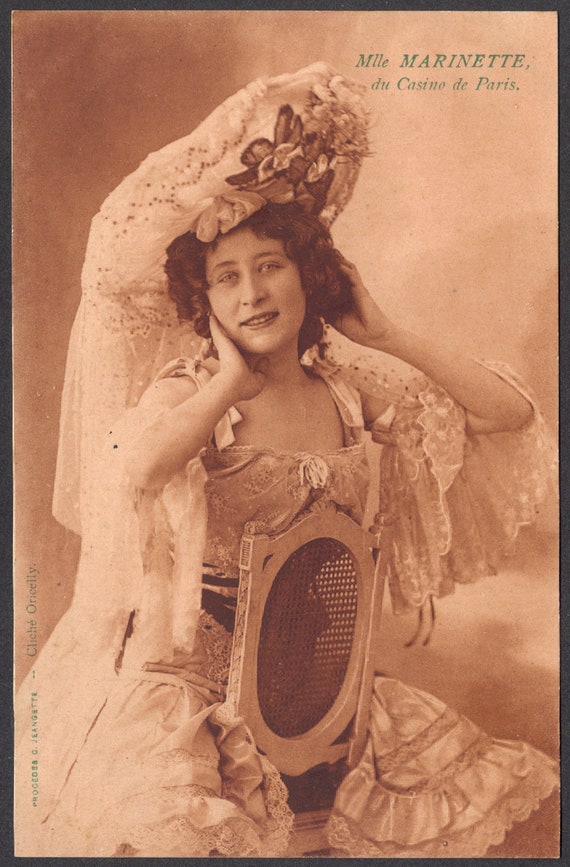
Almost Wordless Wednesday: Mlle. Marinette, du Casino de Paris

Mlle Marinette, du Casino de Paris


Marvellous image by Oricelly of Paris, of Mlle. Marinette, while she was employed at the Casino de Paris in the early 1900s. Oricelly was responsible for a number of stunning images published in sepia tones, of which this is certainly one.

Saturday, January 5, 2013

Featured Items: 1920s Lingerie Models Reclining

Our current featured items are four lingerie models from the 1920s, reclining leisurely on the furniture.

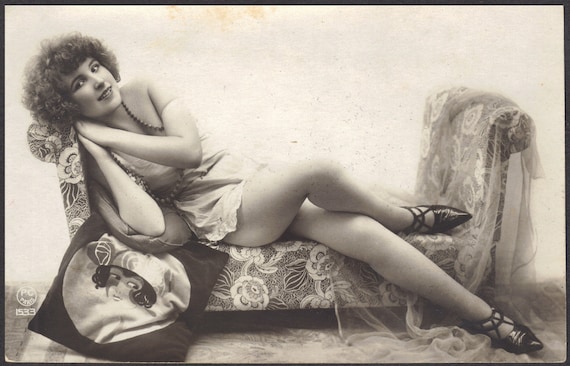
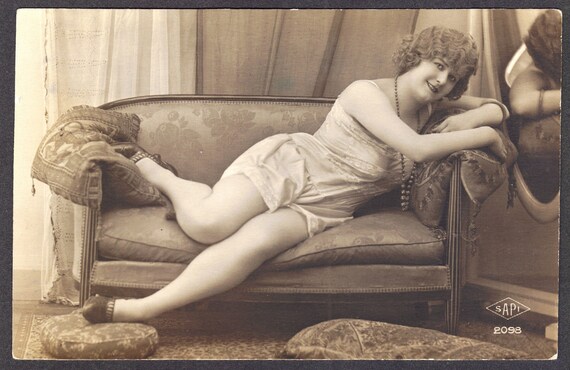
This cute model has a sweet smile for the camera as she reclines on a fun backless couch. The classic flapper pillow leaning against the couch near the model's head is a wonderful touch.

Risque PC Paris Lingerie Model with Flapper Pillow and Pointy Shoes
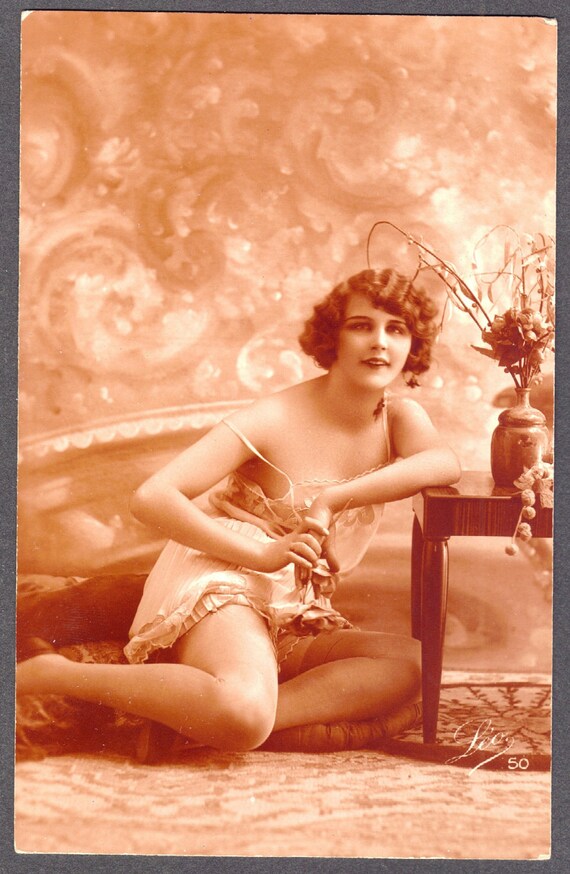
The casual pose as the models leans against a coffee table near an arrangement of flowers, with a single flower dangling from her hand, helps to make this card something special.

French Risque Leo 50, 1910s/20s Lingerie Card
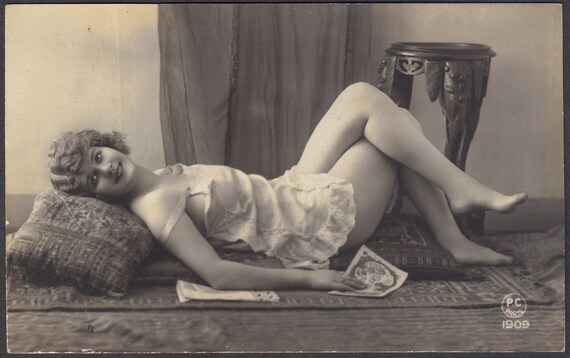
This young lady doesn't really look like she's posing. No, we think she was taking a break and reading a magazine when the photographer called her name and took the shot.

Very Cute Risque French Lingerie Model PC Paris circa 1920
This is such a fun shot. The model's pose on the couch and her coquettish smile, with the pillows strewn everywhere, make it looks as  if she's simply alighted here for a moment before she'll be hopping back up to throw on her flapper dress and a beaded headdress, ready to head out for a night of frolicsome fun, dancing the Charleston.

Risque Rppc Extra Cute French Lingerie Model 1920s

Thursday, January 3, 2013

Featured Items: Beautiful Art Nouveau Images by Photographer Arjalew

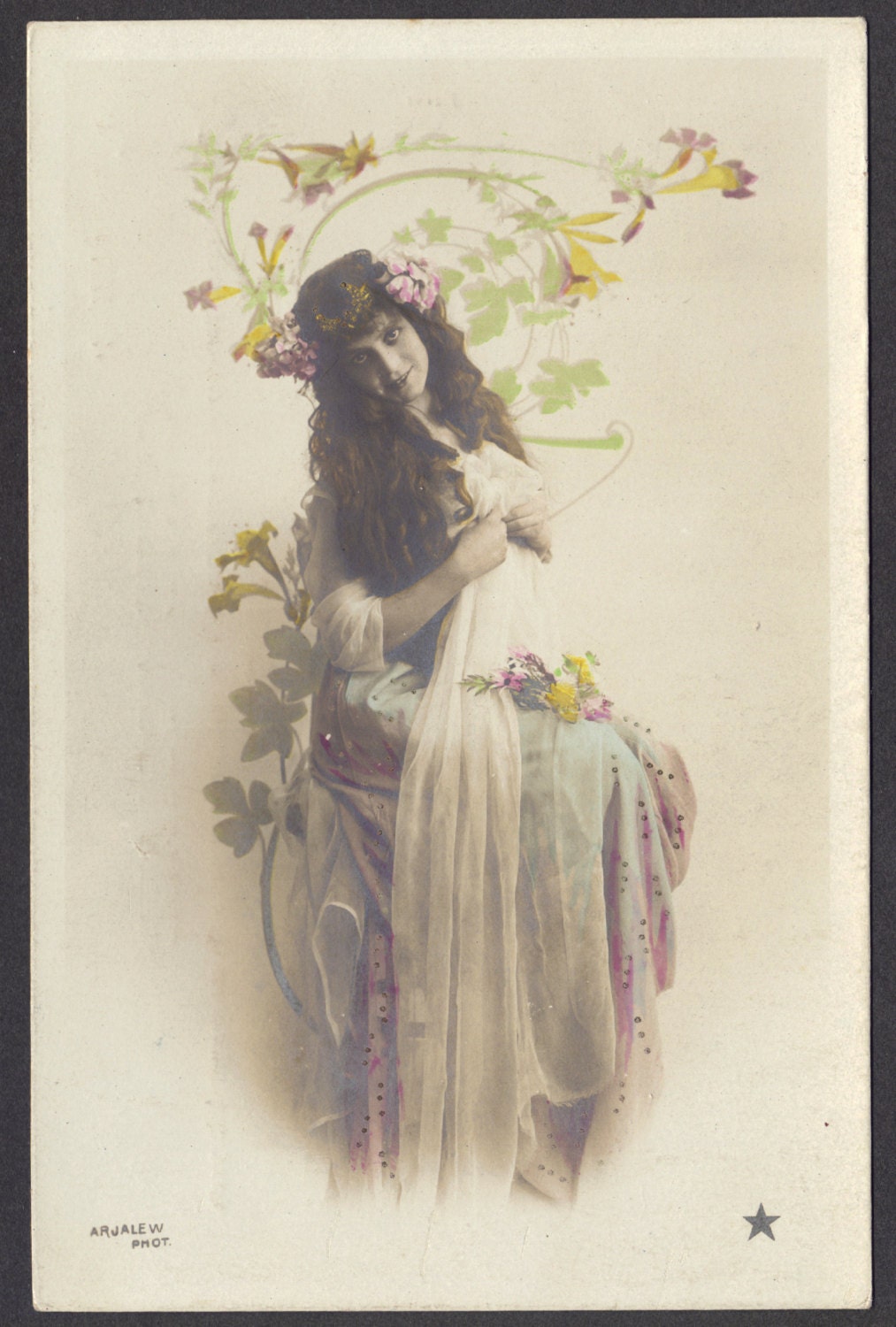
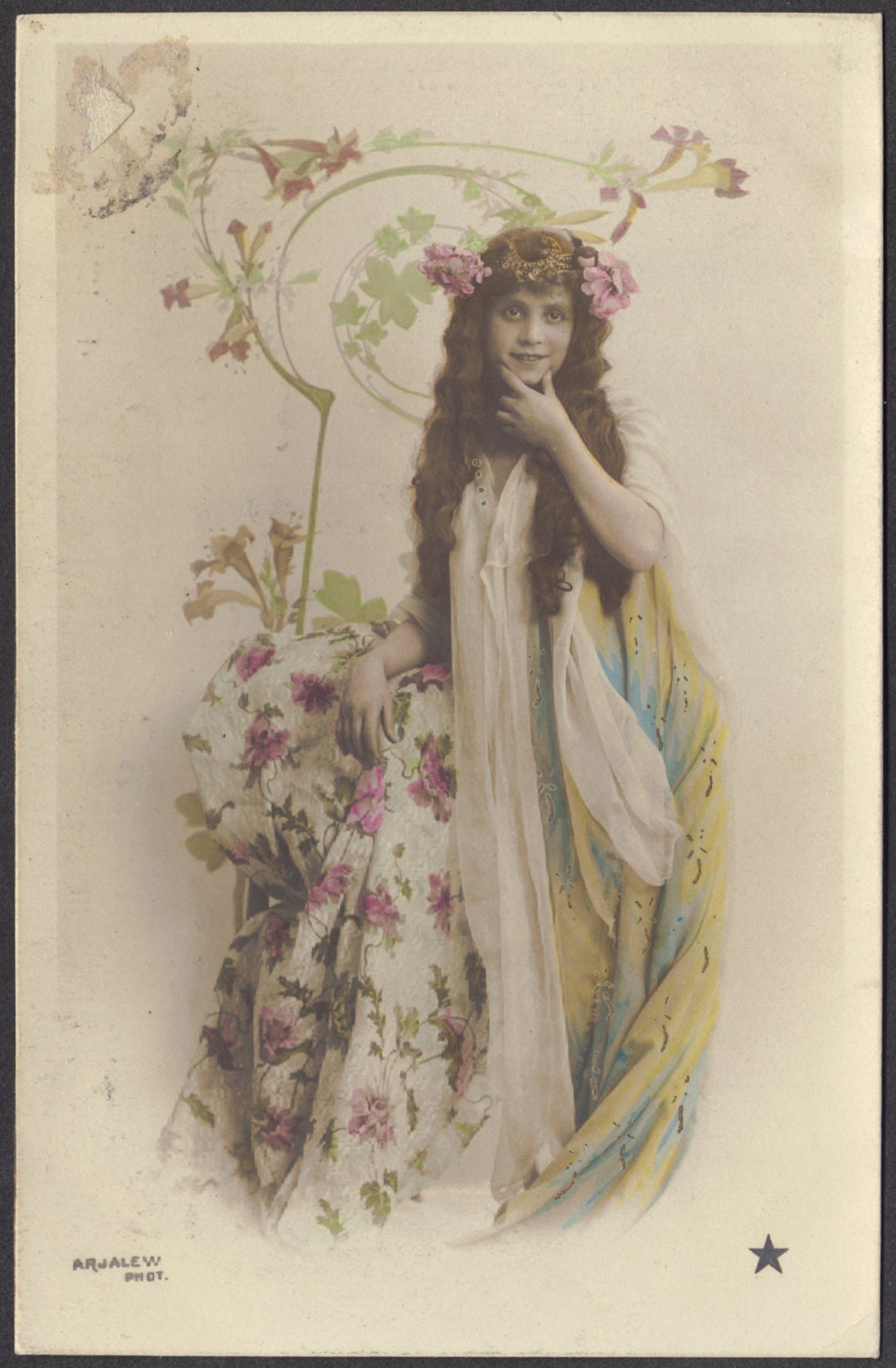
It's pretty amazing when our featured items sell so fast that we can't even get our blog post up, but that's what happened to two out of this beautiful collection of images. Fear not, you will still have the opportunity to view all four of these wonderful Art Nouveau images by the Belle Époque photographer, Arjalew (pronounced ari-ya-lev). Monsieur Arjalew was a Parisian photographer who operated a studio out of 17 Boulevard Poissoniere in Paris. His surname suggests a Polish heritage to us, but we are not experts and have been unable to find confirmation; one source, a French dealer in postcards, has listed Arjalew's work as Judaica, but we cannot confirm this, either. What we do know is that Arjalew created some really stunning Art Nouveau images, often using illustrated backgrounds with that quintessential Art Nouveau floral imagery  So, we now present to you, for your viewing pleasure, four of his lovely images, previously published as postcards.

The first two of these images are companion pieces, depicting as they do the same lovely young woman with her impish smile. She wears flowing draperies and flowers to either side of her face. In one she stands and in the other she sits, but in both the background is a wonderful design of leaves and flowers, very much like the designs found in the artwork of Alphonse Mucha. These images remind us, also, of the artwork of John R. Neill, whose portraits of Ozma and the other young ladies who inhabited Oz so often depicted them in flowing gowns and with flowers framing their faces.

AVAILABLE FOR SALE Beautiful Art Nouveau Portrait of Young Woman by Arjalew, circa 1905
AVAILABLE FOR SALE Beautiful Art Nouveau Portrait by Arjalew, circa 1905

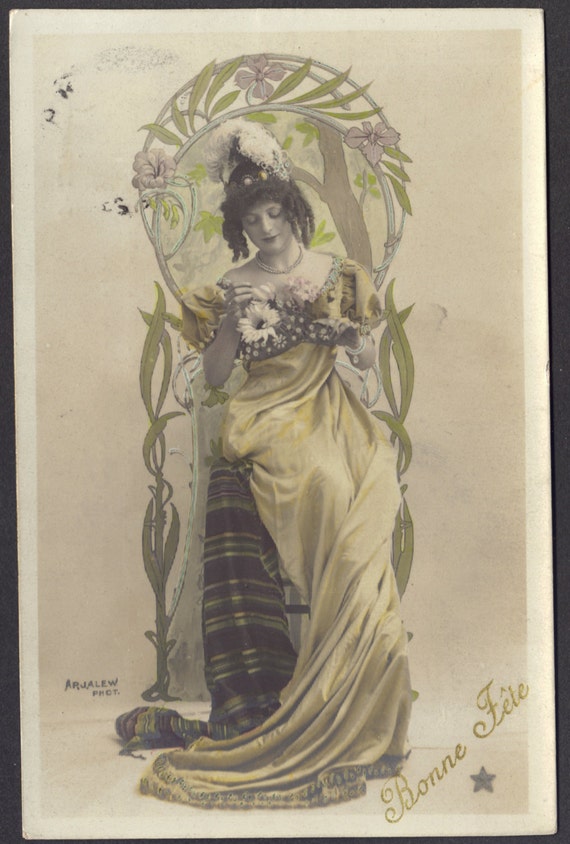
The following image, with its annotation "Bonne Fête," may have been intended as a card to be given on a birthday, or in celebration of the feast day of one's patron saint. Once more, we see that an enchanting Art Nouveau background has been used to frame the model whose attention seems to be coquettishly focused on the flowers she holds in her hands, rather than on the photographer and the camera he points at her.

SOLD Lovely Art Nouveau Image by Arjalew, circa 1905

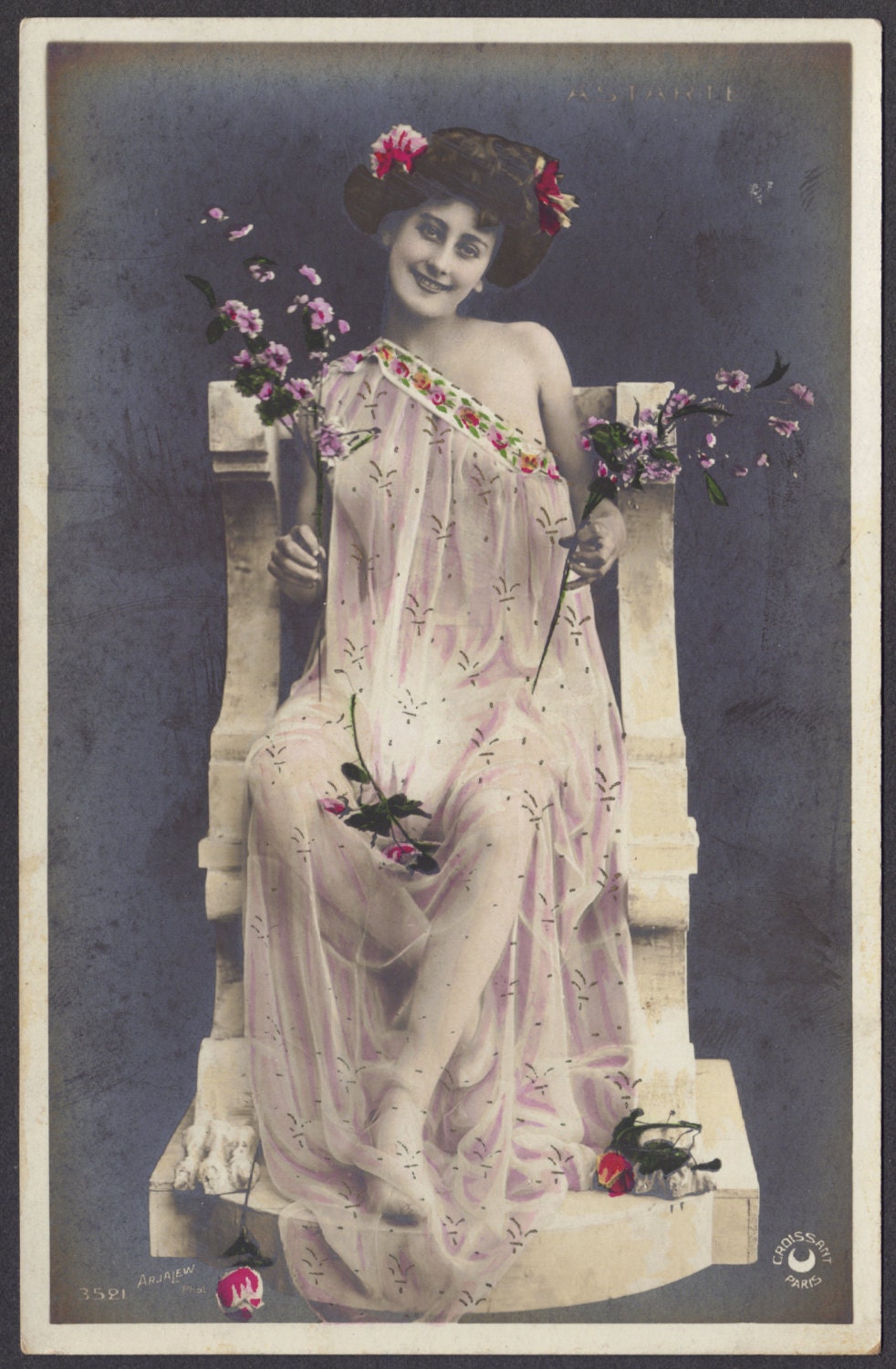
Our final image is of a young woman who is identified by the annotation in the top right corner as Astarte, the Greek name for a goddess whose roles encompassed fertility and sexuality and who was once "known as the deified evening star." Astarte's robes follow the Classical pattern so favored by Arjalew and other photographers of La Belle Époque, but are daringly sheer, in keeping with her roles involving sex and procreation. Unlike the other cards in this set, the background is plain, designed to disappear, so that only the model and the heavy stone throne upon which she reclines are visible. Yet this image, in keeping with the others, makes liberal use of flowers as a design element crucial to the depiction of youth and beauty, sexuality, and fertility.

SOLD Stunning Art Nouveau Astarte by Arjalew, circa 1905


Sunday, October 14, 2012

This Week's Featured Items: Parisian Actresses of La Belle Époque

This week's featured items are postcards spotlighting four actresses popular on Paris stages during La Belle Époque: Galathea Valerie, Joly Violetta (see our previous post, Mlle. Joly Violetta, Famous European Dancer), Regina Badet, and Nelly Viollette.

AVAILABLE FOR PURCHASE Galathea Valerie
AVAILABLE FOR PURCHASE Joly Violetta
AVAILABLE FOR PURCHASE Regina Badet
AVAILABLE FOR PURCHASE Nelly Villette

Monday, October 1, 2012

One Million Roses

SOLD Marguerite de Sevre
The story is told this way:

Once, there was a poor and humble Georgian named Niko Pirosmani. He was a house painter, a painter of signs, and of simple pictures of people and animals that had in them a spark of magic to touch the hearts of his fellow Georgians.

Niko Pirosmani, painter, Tbilisi, Georgia, 1916. Portrait by Eduard Klar.
Eduard Klar [Public domain], via Wikimedia Commons
One day a famous French actress on tour stopped for a bit in Tblisi, the town where Niko lived, and Niko fell in love. It was said that of all things this actress loved flowers, especially red roses, so Niko, being only a simple man, and feeling a desperate kind of passion, took all the money he had in this world, he sold all of his canvases, his brushes, everything he owned he sold, and with this money he bought red roses; thousands, perhaps a million of them, and he filled the public square beneath her hotel window with these brilliant flowers. A few old grandmothers say that they can still remember how, throughout Tblisi, on that day, the air was heavy with the perfume of those roses.

Die Schauspielerin Margarita "The actress Margarita," 1909
Niko Pirosmanashvili (1862–1918) [Public domain], via Wikimedia Commons
In the morning when the actress, whose name was Marguerite de Sevre, awakened, she looked out her window to find the morning sun shining down upon the thousands, perhaps a million, scarlet roses in the square below. Watching from a discreet distance, Niko saw her surprised smile, and wept for joy. Marguerite saw the flowers, but she did not see Niko.

Well, Marguerite de Sevre returned to Paris, back to the bright gaiety of her life there. But Niko, poor Niko, financially ruined by this one impulsive act, lived out the rest of his life alone and slowly died of liver failure and malnutrition.

Ah well, perhaps it is only a story.


The story became a folktale in the Soviet Union, and a popular song, "One Million Roses," was based upon it. This song remains a favorite with audiences today throughout Russia and other nations that were once part of the USSR.


We were fortunate enough to locate another De Sevre, as well as an image of Suzanne Derval posing in the same chair. These images will be available for purchase in our shop on Etsy in the very near future.

Suzanne Derval
Marguerite de Sevre


Friday, September 28, 2012

(Video Friday) Pierre-Auguste Renoir (1841-1919), Painting

We were delighted to discover this wonderful silent movie footage of Renoir, as he paints. It appears that Renoir had a assistant who, similarly to a surgical assistant today, handed him his tools and cared for many of his needs while he painted. In this short clip, Renoir also chats with a man whose identity we do not know, but who might have been a client, patron, or friend.

Tuesday, September 25, 2012

Welcome to Summerisle, circa 1920

For those of you who don't avidly watch every single Neo-Pagan horror movie ever exported from the UK since the 1940s, Summerisle is the fictional setting for the 1973 film, "The Wicker Man," which Christopher Lee (as he nearly always does), makes thoroughly worth seeing, in spite of almost everything else! :)

AVAILABLE FOR PURCHASE Angelic Schoolgirls at Summerisle School for Girls
Anyway, leaving all that silliness aside, what a charming image! The lovely sepia tones, and less than perfectly clear resolution, only add to its hauntingly atmospheric allure. So sweet!

Right up until the moment one of those beautifully costumed young ladies, or that somewhat severe looking, while still rather sexy (in a kind of "dominant" way), boarding school headmistress, drops some hallucinogenic herbal tincture into your cup of Earl Grey tea, and they offer you up as a burnt sacrifice to ensure a bountiful harvest!!! Oh yeah! Like that's not going to happen!!!

***Please note*** severe looking, but still rather sexy, headmistress may not be visible in photograph, but is probably, even now, peering at you from behind a lace curtain in an upper story window.

Thursday, September 13, 2012

Saharet, the India Rubber Lady

SOLD Saharet
The Australian dancer Saharet was born Clarissa (or Clarise) Rose Campbell in either Melbourne or Ballarat, in 1879.[1, 2] A talented and limber dancer known for her ability to do high kicks, "a reviewer described Saharet as an India rubber lady in her rendition of a dislocation dance."[1]

Beautiful and vivacious, she led a full and interesting life. We hope to share a more complete biographical post with our readers at some time in the future. Today, we are sharing this video of a 1905 silent film clip, showing Saharet dancing the Bolero.[3]


Note A shorter video of the same film clip, but with an added musical sound track, is available at http://www.youtube.com/watch?v=1crlXwGhXcM.

An interesting side note to the silent film clip shown in these videos is that it was directed by the Frenchwoman Alice Guy (married name Blanché), who was, according to IMDB, the first woman to become a film director.[4, 5]

[1] Saharet. (2012, August 2). In Wikipedia, The Free Encyclopedia. Retrieved September 13, 2012, from http://en.wikipedia.org/w/index.php?title=Saharet&oldid=505444955
[2] Saharet. n.d. In HAT-History of Australian Theatre. Retrieved September 13, 2012, from 
http://www.hat-archive.com/Saharet.htm
[3] Change Before Going Productions. (2012, April 28). Saharet performs the bolero (1905) - Alice Guy Blanche - Madame Saharet boléro. In YouTube. Retrieved September 13, 2012, from http://www.youtube.com/watch?v=uD0nJYf4Cg4
[4] Saharet, boléro. n.d. In IMDB. Retrieved September 13, 2012, from http://www.imdb.com/title/tt1649402/
[5] Alice Guy. n.d. In IMDB. Retrieved September 13, 2012, from http://www.imdb.com/name/nm0349785/


Hot Pink Hand-Tinted Vintage Photograph of a Romantic Couple on a Beach


Tuesday, September 11, 2012

Monsieur G. Piprot, Postcard Producer and Photographer of the Misses Amy and Remple

If you are a vintage photograph and postcard enthusiast, who shares our interest in Parisian music hall performers and their postcard images, you may have noticed a star in the bottom corner of some of your favorite postcards. This is the production mark of Monsieur G. Piprot, who operated a postcard production company out of number 2 Rue de l'Amsterdam in Paris. He made use of a process called emaillographie, which like the process oranotypie (used by the prodigious Mr. Steglitz of Germany), was intended to add depth and clarity to the postcard print. The great Walery, Nadar, and many other famous Parisian photographers of the time were often published by M. Piprot under his star label. Not so common, were images actually photographed by G. Piprot, but we are lucky enough to have two such images, a pair of lovely stage performers, Miss Amy, and Miss Remple.

AVAILABLE FOR PURCHASEMiss Amy, photograph by G. Pirot
AVAILABLE FOR PURCHASE
Miss Remple, photograph by G. Pirot
These two young women are dressed in charmingly matched off-the-shoulder costumes and each sports a long, gorgeously thick braid. The cards have been hand-tinted, and the close observer will note that the colored panels on Miss Amy's dress correspond to the uncolored panels on Miss Remple's, and vice versa, so that each image presents a clever counterpart of the other.

One fun fact about these two cards is that they were posted by the same individual, Mateo, to two different women living in the same household. Mateo inscribed each card in a lovely hand, using violet ink.

Reverse of Miss Amy's postcard
Reverse of Miss Remple's postcard
We can't help but speculate whether Mateo, unable to make up his mind, was courting two sisters, and to wonder what reaction the women had on receiving the cards.


Two charming Oranotypes, (a process used in postcard production to maintain the depth and clarity of the photographic image), of a loving mother and her child. So sweet! The flowers in the hair are so expressive of the period. published by A.G. Steglitz in 1904. 

Mother and Daughter Oranotype, Image 1
Mother and Daughter Oranotype, Image 2
Posted in Brussels, Belgium in 1906 by someone with a fine and carefully practiced hand. 

Reverse of  Mother and Daughter Oranotype, Image 1
Reverse of Mother and Daughter Oranotype, Image 2
We look forward to listing these in our shop.

Monday, September 3, 2012

Mlle Dargent at the Folies Bergere by Walery circa 1905

La Belle Époque means the Beautiful Era, and all of France was optimistic during this time of European peacefulness and prosperity. La Belle Époque began around 1890 and continued until 1914, ending with the start of World War I. During this time, Paris was at the heart of a number of artistic endeavors, known to all of Europe as a place where music and theater flourished.

AVAILABLE FOR PURCHASE  Mlle. Dargent of the Folies Bergère, photograph by Walery, circa 1905
In this lovely 100 plus year old card, is Mlle. Dargent of the Folies Bergère. The photograph was taken by the famous art photographer, M. Walery of Paris, and has been beautifully hand-tinted, possibly to match the original colors of Mlle. Dargent's dress.

Sunday, September 2, 2012

Berthe Bady, Actress (1866-?)

The Belgian-born actress Berthe Bady was perhaps best known for her perfomances as Hilda in the 1894/95 touring production of Henrik Ibsen's The Master Builder and for her 1897 portrait painted by the famous French Post-Impressionist artist and Art Nouveau illustrator Henri de Toulouse Lautrec.

Henri Toulouse Lautrec
Portrait of Berthe Bady by Henri de Toulouse-Lautrec, 1897 
This painting was apparently the only portrait of an actress Lautrec ever painted in which he did not use the theater with which she was associated as a background, a fact which suggests to us that his interest in her as a model was more particularly one of respect for her as an individual, and fellow artist, and less in association with her environment.

Henry Bataille
From 1893 until 1912, Mme. Bady was married to French playwrite and poet, Henry Bataille, and starred in the production of his play Maman Colibri (Mother Hummingbird), a comedy in four acts, which opened at the Théâtre du Vaudeville in 1904, and was popular enough to be reprised in 1911 at Théâtre de l'Athénée, and again at the legendary Comédie-Française in 1920. Mme. Bady also performed with co-stars Albert T'Sterstevens, Sylvio De Pedrelli, in the incomplete 1918 French silent film Ecce Homo (aka Le Soleil Noir) written and directed by Abel Gance.

Théâtre de l'Athénée

We are very pleased to have in our shop this lovely image of Mme. Bady, photograph by Boyer & Bert, and thrilled to offer an original publicity card advertising her reprise performance of Maman Colibri at the Théâtre de l'Athénée in 1911.

AVAILABLE FOR PURCHASE Berthe Bady
AVAILABLE FOR PURCHASE Publicity card for Berthe Bady  in  the play Maman  Colibri
It is cards of this sort (almost all of those we sell, really), which qualify under our own perhaps unrealistically romantic, but heartfelt, heading of "miniature time machines." Of course, any image of a past time and place that attracts us, tends to draw us in some fashion out of our present moment and into that of the image, but these wonderful cards, these were actually published in that moment; and unlike reprints of images, these cards were held in the hands of real people for whom Berthe Bady, Henry Bataille, Toulouse Lautrec, etc., were living, breathing parts of their world. For this reason, it always feels to us as if there is something extra special, almost magical, about these cards in their ability to transport us into that past time and place.

Additional Sources:
NOTE Multiple film adaptations of Maman Colibri have been made, including one released in 1929 by L'Alliance cinamatographique Eurpéenne and starring Maria Jacobini (available at Europa Film Treasures) and another released in 1937 by Badalo and distributed by Paris Cinéma Location, starring Huguette Duflos, Jean-Pierre Aumont and Jean Worms (see more on IMDB: 1929 and 1937). 


Direct from the Casino de Paris of the Roaring Twenties, and photographed by the renowned Paris Plaisirs, are Mesdemoiselles Zazani and Noel, flappers extraordinaire.

Mlle. Zazani and her megaphone
Mlle. Noel

We await them with bated breath. We hope you do, too.