Showing posts with label stage performers. Show all posts

Tuesday, July 2, 2013

Cléo de Mérode Giveaway Winner!

We are happy to announce that, as the happy purchaser of our 1,000th item on Etsy, Karen Donaldson (oneundonebird) will be receiving the very special Cléo de Mérode postcard featured in our Giveaway. Congratulations, Karen!

Exquisite Cleo De Merode Giveaway Card, circa 1900
We are currently getting our packages ready to ship, so Karen should be receiving her gift in just a few short days.

Many thanks to all of our wonderful customers who have helped us to reach this milestone! We are grateful to each and every one of you.

Friday, June 28, 2013

Tremendous Tresses

The featured cards in our shop currently include images of women with beautiful, long hair.

Prior to the 1920s, the traditional hairstyles for women almost always seemed to include long hair. That hair might be pinned up to fantastic heights, but take out the pins and the hair fell well past the shoulders, sometimes to the waist, hips, or even farther. And, as anyone who's ever worn long hair knows, taking care of that extra long mane takes lots of time and effort. Which may be one reason that we look with such amazement at these images of women wearing their long and luxurious hair down, so that it accentuates their beauty and grace.

The first of our featured cards is, of course, the card that we will be giving away with our 1,000th purchase. (See details.) In this image, Cléo de Mérode wears her hair down and we can see that, at least in front, her hair descends below her bustline, indicating that the full length is almost certainly well down her back. As always, of course, she is lovely.

Exquisite Cleo De Merode Giveaway Card for 1,000th Purchase, circa 1900

The second of our featured images is a lovely photograph of an unidentified model, holding a bouquet of violet-colored flowers, whose hair falls down her back to arrive in the vicinity of her derriere. This model's hair may be the longest of those featured. The beautifully hand-colored card was published by Misange, most probably in either France or Germany sometime about 1910.

Polka Dots and Peonies. So Lovely. circa 1905/10

Our next featured image depicts an actress with beautiful long curls and a wild feathered hat. The expression on her face is so wonderful, making us think that she offers some words of wisdom for some wanderer. Perhaps, given the deliberately tattered nature of her gown, she is a fairy in disguise, and is about to gift some hero or heroine with some magical ability. Her hair, certainly, is worthy of any fairy queen.

Miry Cassari Belle Epoque Stage Performer in a Lovely Big Hat, dedicated, circa 1912

Of note is the fact that this is a signed card, apparently signed in 1912 following a stage performance in Beaune (pronounced almost as in the English word "bone"), Burgundy, which is between Paris and Geneva. Based on her signature, the actress' name is Miry Cassari, or perhaps Lassari, but we have been unable to find any information about her and she remains a mystery. This is a wonderful image, and in a way there is something wistfully romantic and magical about the autograph of a forgotten actress. So often we have read about the immortality of the old gods having been dependent upon the worship of their followers. Perhaps, merely through the appreciation of this fine, evocative image, we can breathe a little life into the "joie de vivre" expressed by this lovely young woman, so long ago, and share in some of it ourselves.

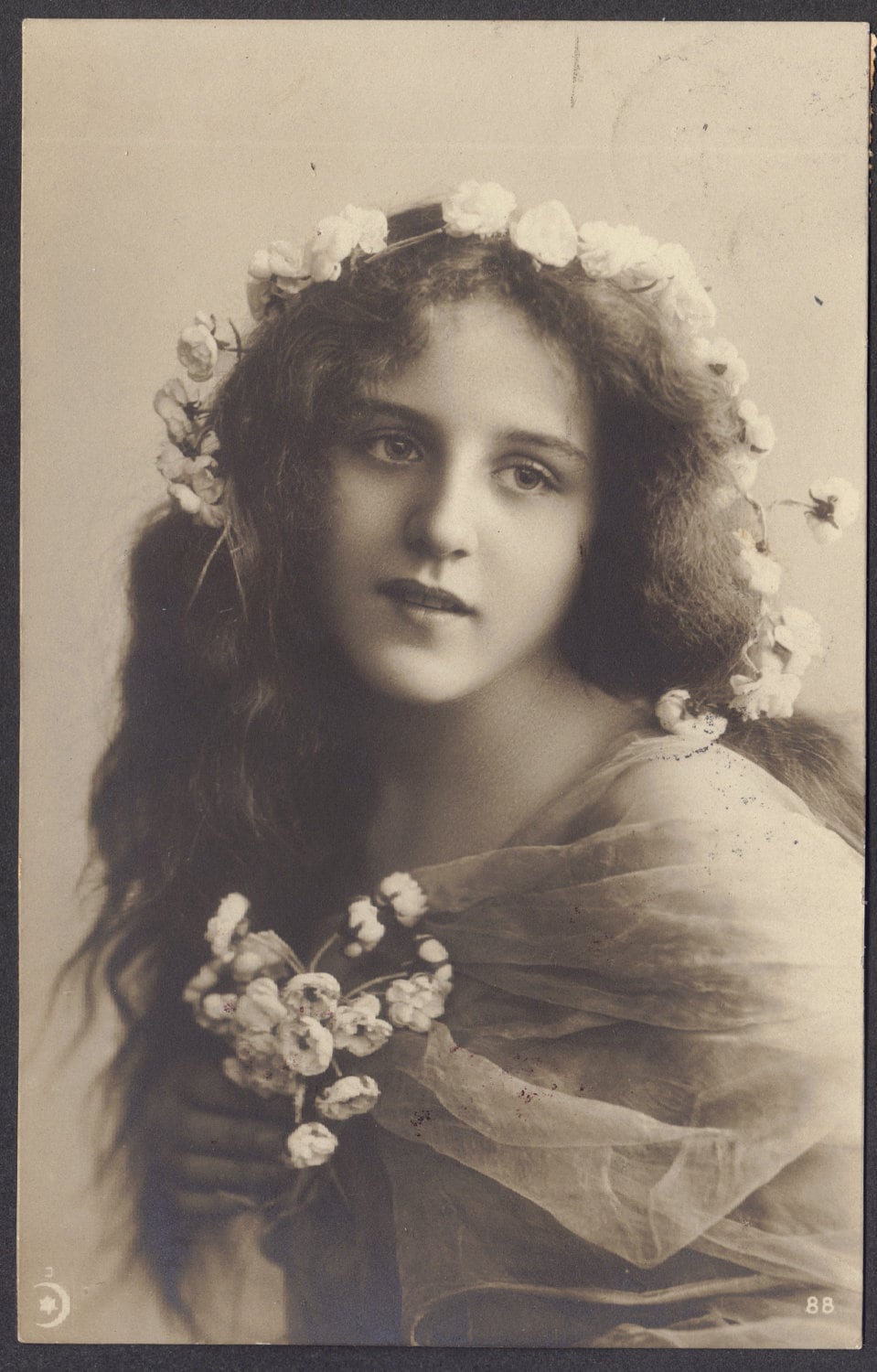
The final featured item is this lovely biogravure by Steglitz, circa 1905. The maiden portrayed in this image is crowned by a wreath of flowers, which, together with her long, unbound hair symbolizes Spring and the purity and innocence of youth. Appropriately, the photographer has captured her with her gaze turned down, deftly maintaining the Arcadian ambiance.

Crown of Flowers, Jugendstil Epoche Maiden, Biogravure by Steglitz, circa 1905


Sunday, February 3, 2013

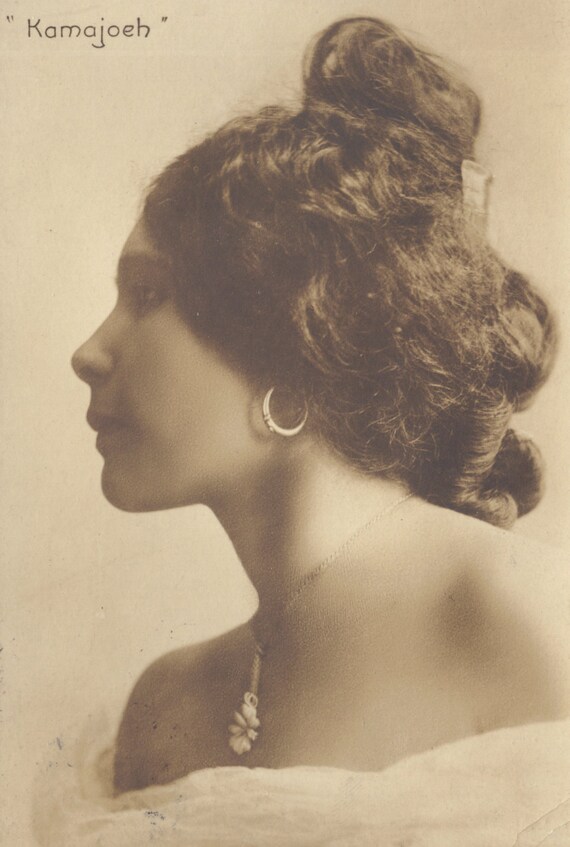
Kamajoeh, Mozambique Beauty En Voile, circa 1905

As well as being a lovely image in and of itself, this is a very interesting postcard for a number of reasons. The subject of the image, almost certainly an actress or performer, is a woman of color whose name (probably Swahili or possibly Malagasy), suggests she may have come from the Portuguese colony of Mozambique in Africa, or the French colony of Madagascar off Africa's coast. Though the postcard bears a German stamp and was probably produced in Germany, the image itself is quite probably French, as her costume, with layers of filmy material wrapped low about her shoulders, and her hair, done up in the classic chignon so popular in that period, are distinctly French European in style. 

AVAILABLE FOR PURCHASE Kamajoeh, Mozambique Beauty En Voile, circa 1905


Why do we find this so fascinating? Primarily because—although dance, music, and costume in the France of the late 19th and early 20th centuries was clearly influenced by the cultures of European colonial holdings—it is uncommon to find on postcards images of performers of color who actually come from these colonies.

Theatrical entertainment in France at that time was full of the romantic idealization of foreign cultures. Margaretha McLeod, a young Dutch woman who apparently learned Indonesian dance while locked in a terribly unhappy marriage in the Dutch East Indies, left her husband, made her way to Paris and, in the proud tradition of P.T. Barnum, changed her name to Mata Hari, billed herself as a Javanese princess, became hugely successful with her sensual dance routines, and the rest is history. There were so many others, many images of whom, from time to time, grace the cards we sell in our shop, but almost always they are white Europeans.

Still, though such images as this one are uncommon, we feel it's important to point out that the egalitarian nature of French society was such that performers of all cultural, religious, and ethnic origins made their way to Paris, where many found success and fame. After all, it was in the Paris of the 1920s that Josephine Baker, the famous African American dancer and stage performer, found a broad acceptance and venue for her talent that had not been available to her in the United States of that time.

Finally, we want to acknowledge that we are mere dabblers in history, and certainly not historians. Our focus is limited and narrow, and our short posts far from even remotely complete. So we offer our observations in the spirit of enthusiastic collectors, and hope they are welcomed by fellow enthusiasts and that our over simplifications of complex historical issues and events are forgiven by those more knowledgeable than ourselves.

Tuesday, December 4, 2012

Featured Items: Dazzling Beauties

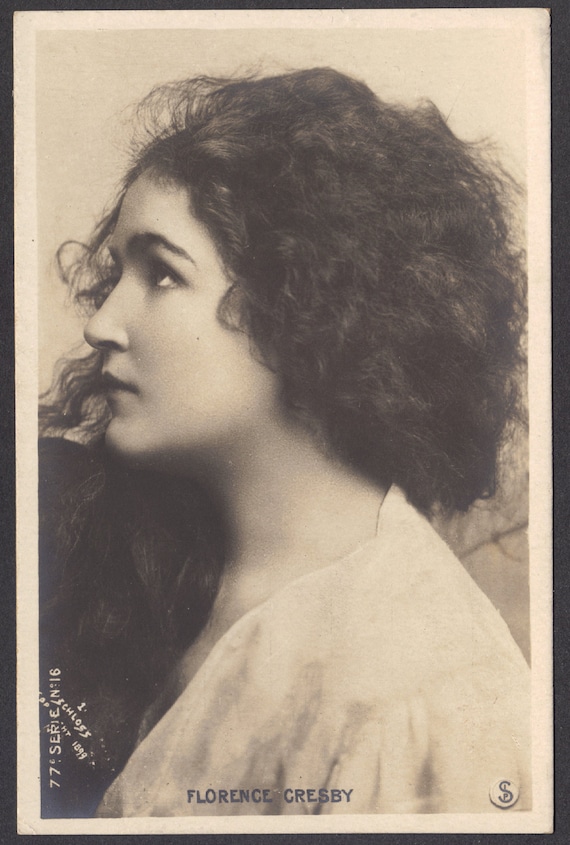
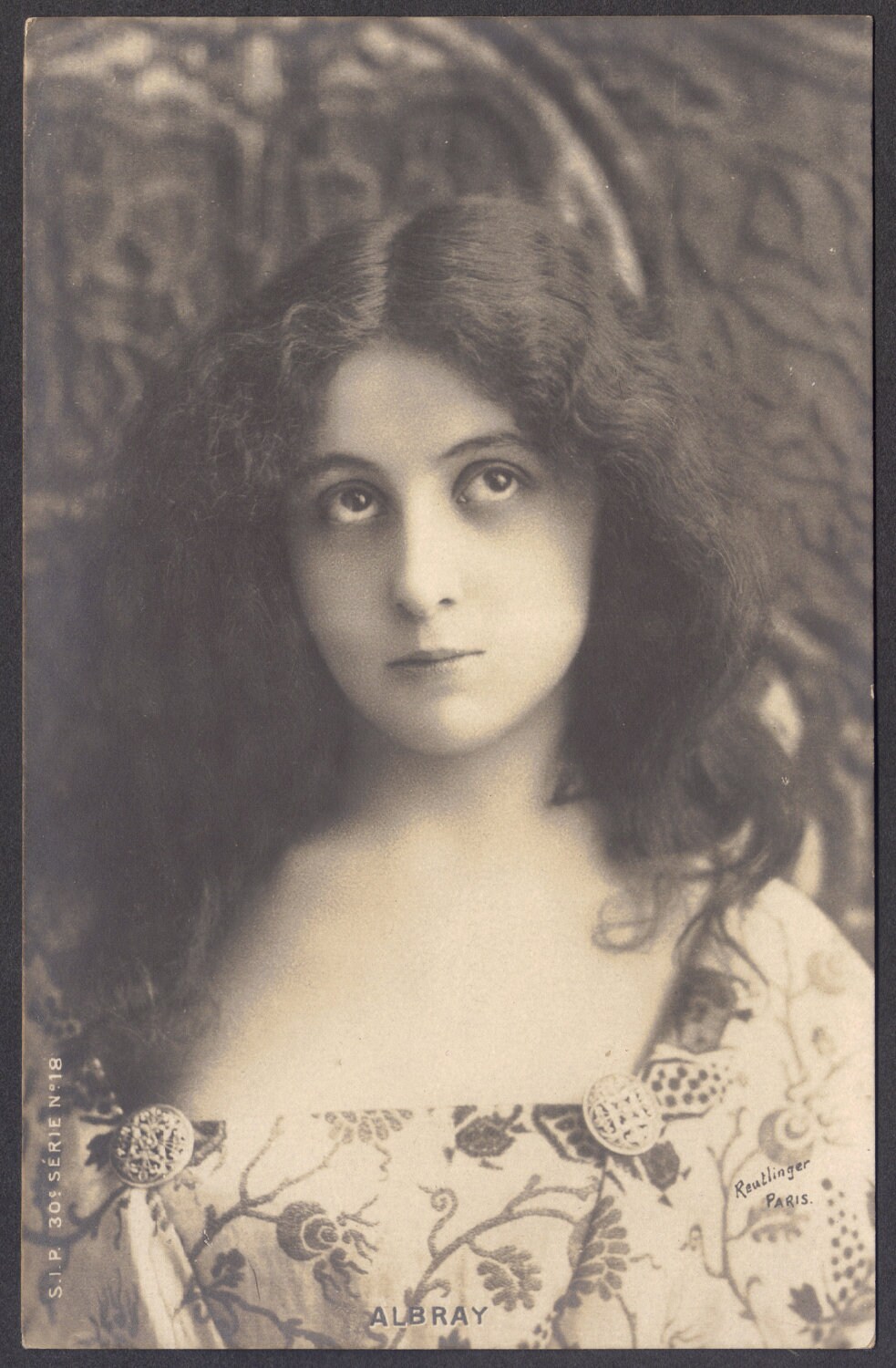
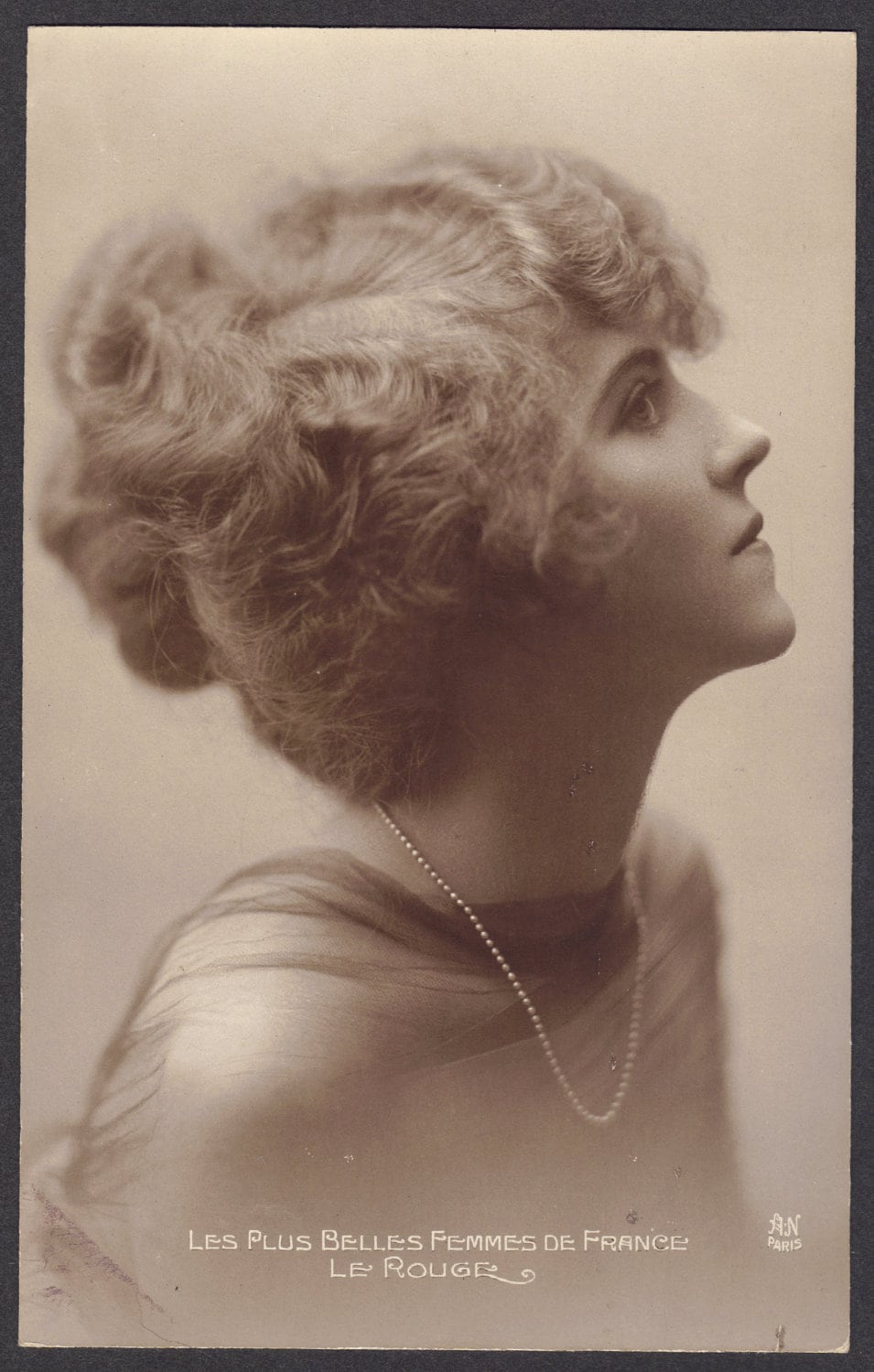
The currently featured items in Red Poulaine are postcards with portrait images of young women, all dazzling beauties.

This wonderful portrait in profile of young artiste Florence Cresby was taken at the truly fine, Scloss Studio of New York, (we don't believe we've ever seen an image of theirs which wasn't really grand), which is why we're guessing Flo was an American girl, but the card was published by SIP, or Societe Industrielle de Photographie, a wonderful French Publishing house which handled a lot of Reutlinger's work, among others. Which is why we're guessing she was performing in Paris :) What a beautiful young woman! What a marvelously concieved photograph! Card is in almost perfect, unposted condition with a tiny crease in bottom left corner. We so love it when we get lucky like this. Schloss studio date of 1899 in lower left quadrant. Graceful age discoloration, but otherwise, wow!

AVAILABLE FOR PURCHASE Florence Cresby, American Girl in Paris, 1899
Our next image is a beautiful portrait of the artiste D'Albray, her upturned eyes lending her a soulful expression. Her gown is decorated with a floral motif that reminds one of a medieval tapestry, and the large basketwork buttons at the corners of the squared neckline contribute to the effect. Perhaps she is portraying a princess awaiting her fairy godmother?

AVAILABLE FOR PURCHASE Mlle D'Albray Belle Epoque Artiste by Reutlinger, circa 1905
From Alfred Noyer's collectible and truly fine series, "Les Plus Belles Femmes de France," comes Le Rouge. Lovely profile portrait of a French woman of the 1910s, or 20s, beautifully coiffed and wearing thin gauze across her shoulders, and a necklace of tiny pearls.

AVAILABLE FOR PURCHASE Le Rouge, or, The Redhead, from Noyer's Les Plus Belles Series circa 1910s/20s
Probably published circa 1905, this French card, posted 1910, presents a lovely portrait of a young girl with flowers, a spirit of Spring. We don't know the girl's name, but we do know she is, you guessed it, a dazzling beauty.

AVAILABLE FOR PURCHASE Sweet Child of Spring posted 1910


Monday, October 1, 2012

One Million Roses

SOLD Marguerite de Sevre
The story is told this way:

Once, there was a poor and humble Georgian named Niko Pirosmani. He was a house painter, a painter of signs, and of simple pictures of people and animals that had in them a spark of magic to touch the hearts of his fellow Georgians.

Niko Pirosmani, painter, Tbilisi, Georgia, 1916. Portrait by Eduard Klar.
Eduard Klar [Public domain], via Wikimedia Commons
One day a famous French actress on tour stopped for a bit in Tblisi, the town where Niko lived, and Niko fell in love. It was said that of all things this actress loved flowers, especially red roses, so Niko, being only a simple man, and feeling a desperate kind of passion, took all the money he had in this world, he sold all of his canvases, his brushes, everything he owned he sold, and with this money he bought red roses; thousands, perhaps a million of them, and he filled the public square beneath her hotel window with these brilliant flowers. A few old grandmothers say that they can still remember how, throughout Tblisi, on that day, the air was heavy with the perfume of those roses.

Die Schauspielerin Margarita "The actress Margarita," 1909
Niko Pirosmanashvili (1862–1918) [Public domain], via Wikimedia Commons
In the morning when the actress, whose name was Marguerite de Sevre, awakened, she looked out her window to find the morning sun shining down upon the thousands, perhaps a million, scarlet roses in the square below. Watching from a discreet distance, Niko saw her surprised smile, and wept for joy. Marguerite saw the flowers, but she did not see Niko.

Well, Marguerite de Sevre returned to Paris, back to the bright gaiety of her life there. But Niko, poor Niko, financially ruined by this one impulsive act, lived out the rest of his life alone and slowly died of liver failure and malnutrition.

Ah well, perhaps it is only a story.


The story became a folktale in the Soviet Union, and a popular song, "One Million Roses," was based upon it. This song remains a favorite with audiences today throughout Russia and other nations that were once part of the USSR.


We were fortunate enough to locate another De Sevre, as well as an image of Suzanne Derval posing in the same chair. These images will be available for purchase in our shop on Etsy in the very near future.

Suzanne Derval
Marguerite de Sevre


Thursday, September 13, 2012

Saharet, the India Rubber Lady

SOLD Saharet
The Australian dancer Saharet was born Clarissa (or Clarise) Rose Campbell in either Melbourne or Ballarat, in 1879.[1, 2] A talented and limber dancer known for her ability to do high kicks, "a reviewer described Saharet as an India rubber lady in her rendition of a dislocation dance."[1]

Beautiful and vivacious, she led a full and interesting life. We hope to share a more complete biographical post with our readers at some time in the future. Today, we are sharing this video of a 1905 silent film clip, showing Saharet dancing the Bolero.[3]


Note A shorter video of the same film clip, but with an added musical sound track, is available at http://www.youtube.com/watch?v=1crlXwGhXcM.

An interesting side note to the silent film clip shown in these videos is that it was directed by the Frenchwoman Alice Guy (married name Blanché), who was, according to IMDB, the first woman to become a film director.[4, 5]

[1] Saharet. (2012, August 2). In Wikipedia, The Free Encyclopedia. Retrieved September 13, 2012, from http://en.wikipedia.org/w/index.php?title=Saharet&oldid=505444955
[2] Saharet. n.d. In HAT-History of Australian Theatre. Retrieved September 13, 2012, from 
http://www.hat-archive.com/Saharet.htm
[3] Change Before Going Productions. (2012, April 28). Saharet performs the bolero (1905) - Alice Guy Blanche - Madame Saharet boléro. In YouTube. Retrieved September 13, 2012, from http://www.youtube.com/watch?v=uD0nJYf4Cg4
[4] Saharet, boléro. n.d. In IMDB. Retrieved September 13, 2012, from http://www.imdb.com/title/tt1649402/
[5] Alice Guy. n.d. In IMDB. Retrieved September 13, 2012, from http://www.imdb.com/name/nm0349785/


Hot Pink Hand-Tinted Vintage Photograph of a Romantic Couple on a Beach


Wednesday, September 12, 2012

(Almost) Wordless Wednesday: Miss Ivy Lillian Close circa 1910s

AVAILABLE FOR PURCHASE Miss Ivy Lilian Close

Gorgeous soulful image of Miss Ivy Lillian Close. She was first Miss Britain of 1908, then a stage actress, then a silent film star in those very early days.

Tuesday, September 11, 2012

Monsieur G. Piprot, Postcard Producer and Photographer of the Misses Amy and Remple

If you are a vintage photograph and postcard enthusiast, who shares our interest in Parisian music hall performers and their postcard images, you may have noticed a star in the bottom corner of some of your favorite postcards. This is the production mark of Monsieur G. Piprot, who operated a postcard production company out of number 2 Rue de l'Amsterdam in Paris. He made use of a process called emaillographie, which like the process oranotypie (used by the prodigious Mr. Steglitz of Germany), was intended to add depth and clarity to the postcard print. The great Walery, Nadar, and many other famous Parisian photographers of the time were often published by M. Piprot under his star label. Not so common, were images actually photographed by G. Piprot, but we are lucky enough to have two such images, a pair of lovely stage performers, Miss Amy, and Miss Remple.

AVAILABLE FOR PURCHASEMiss Amy, photograph by G. Pirot
AVAILABLE FOR PURCHASE
Miss Remple, photograph by G. Pirot
These two young women are dressed in charmingly matched off-the-shoulder costumes and each sports a long, gorgeously thick braid. The cards have been hand-tinted, and the close observer will note that the colored panels on Miss Amy's dress correspond to the uncolored panels on Miss Remple's, and vice versa, so that each image presents a clever counterpart of the other.

One fun fact about these two cards is that they were posted by the same individual, Mateo, to two different women living in the same household. Mateo inscribed each card in a lovely hand, using violet ink.

Reverse of Miss Amy's postcard
Reverse of Miss Remple's postcard
We can't help but speculate whether Mateo, unable to make up his mind, was courting two sisters, and to wonder what reaction the women had on receiving the cards.


Two charming Oranotypes, (a process used in postcard production to maintain the depth and clarity of the photographic image), of a loving mother and her child. So sweet! The flowers in the hair are so expressive of the period. published by A.G. Steglitz in 1904. 

Mother and Daughter Oranotype, Image 1
Mother and Daughter Oranotype, Image 2
Posted in Brussels, Belgium in 1906 by someone with a fine and carefully practiced hand. 

Reverse of  Mother and Daughter Oranotype, Image 1
Reverse of Mother and Daughter Oranotype, Image 2
We look forward to listing these in our shop.

Sunday, September 9, 2012

Fatmé Sjemile, Escapee from the Sultan's Harem

On 26 Sep 1913, a young woman stepped off the ship France and onto US soil. She was just one of 1,826 passengers on the ship. According to the ship’s manifest and the Ellis Island paperwork, she was born in Turkey. But, we can speculate that the accuracy of her birthplace might only have been as accurate as her reporting of it, since many people arrived at Ellis Island without birth certificates or other proofs of identity.

Steamship France, Photo source: The Statue of Liberty-Ellis Island Foundation, Inc.
Although she was only 22, this lovely young woman had already achieved notoriety in the music halls of Paris. Now, possibly sensing the oncoming storm in Europe, or perhaps escaping more personal troubles, she was once more giving up the comforts and familiarity of her home in pursuit of a place where she could be free. Her name was Fatmé Sjemile, and she claimed she had been the favorite odalisque, or concubine, to the Sultan Abdul Hamid. Whether she was coming to America, as so many immigrants were, to avoid war or simply in search of a better life, or even fleeing agents of the Ottoman Empire, intent on capturing her and taking her back to the sultan’s palace, her spirit and determination were very much evident in the choices she made.


AVAILABLE FOR PURCHASE Fatmé Sjemile, Supreme Dancer of the Sultan of Turkey
At the turn of the twentieth century, Orientalism was at its height. French Colonial interests in the Mid-East, Asia, and North Africa offered inspiration to designers of Art Nouveau dress and jewelry. Mata Hari, a school teacher of Dutch origin, enthralled all of Europe with the fanciful Oriental image she had created for herself. In this postcard photograph, Fatmé wears a costume evocative of a 19th century Turkish dancing girl, precisely the image she wished to conjure for her audience. Even the texture of Fatmé’s hair is reminiscent of that of the Moss-Haired girls, the Circassian beauties, of P.T. Barnum’s invention fifty years before, who also were claimed to be harem girls escaped from Turkish sultans. 

We cannot know whether this flamboyant beauty’s claims were true, but we can appreciate the romance of her story: the harem girl who escaped from the sultan’s palace, made her way down the steep and treacherous mountains of Turkey and across Europe, and upon her arrival in Paris fascinated audiences with her Oriental dancing.


Madge Lessing, photographed by C.J. Horner of Boston. Dressed fancifully as a page, or perhaps as Cupid, Madge appears to be leaning against a friendly tiger in a scene reminiscent of John R. Neill's illustrations to some of the later OZ books, in particular, those featuring the Hungry Tiger.

Madge Lessing & friend, photo by C.J. Horner of Boston

Friday, September 7, 2012

Mlle. Joly Violetta, Famous European Dancer

At the turn of the twentieth century, the beautiful French star Joly Violetta graced the stages of theaters around the world . A dancer and pantomimist, her career began in Europe, but her popularity carried her to South Africa and Brazil, as well as the United States.

AVAILABLE FOR PURCHASE Joly Violetta  plays a gypsy in 1905
Joly Violetta often partnered with the Brazilian dancer Arnaud, who "assisted [her] in parodies and Brazilian dances." Alone, and with M. Arnaud, she trod the Vaudeville stage, headlining with Will Rogers and other famous acts of the time.


SOLD Mlle. Joly Violetta
Joly Violetta introduced a popular pantomime in Berlin, which she brought with her to the United States and performed in her first US appearance at the St. Paul Minnesota Orpheum Theater. Her performance was positively reviewed in the January 23, 1909 issue of the New York Star:


Despite her many successes on the stage, we have been able to learn very little about Joly Violetta's personal life, making her something of a mystery. We do not know where she was born, nor the date of her birth, and her later life is also obscure. Should anyone have any information which could shed some light on her biography, we would be delighted to learn of it.

We are lucky enough to have found another image of Joly Violetta, which will soon be available in the Red Poulaine Etsy shop:

As you can see by the embroidery on her blouse, Joly Violetta is wearing a costume that is either the same, or very similar to, the one she is wearing in the first postcard in this post. We find the details of this costume particularly wonderful, from the embroidery on the blouse and vest, to the simulated tatters, or flower petal designs, of the skirt, and we hope that you will agree that this is a wonderful find.