6.00 USD, by redpoulaine via Etsy http://ift.tt/1f0BZfQ
Welcome to Red Poulaine's Musings. Here we hope to entertain and delight you with stories about the people and times from bygone eras and the vintage images that act as our windows into their times. Red Poulaine is a husband and wife joint enterprise on Etsy. We take pride in offering fine, interesting vintage items to our customers, while providing the best customer service possible. Please come visit us at http://www.etsy.com/shop/redpoulaine today.
Showing posts with label Pierrette. Show all posts
Thursday, February 20, 2014
Stylish Pierrette, circa 1920s French Postcard
6.00 USD, by redpoulaine via Etsy http://ift.tt/1f0BZfQ
Monday, February 3, 2014
Sunday, November 25, 2012
This Week's Featured Items: Pierrot & Colombinette
This week's featured items in the Red Poulaine shop are four hand-tinted postcards featuring Pierrot and, in three cases, his beloved Colombinette.
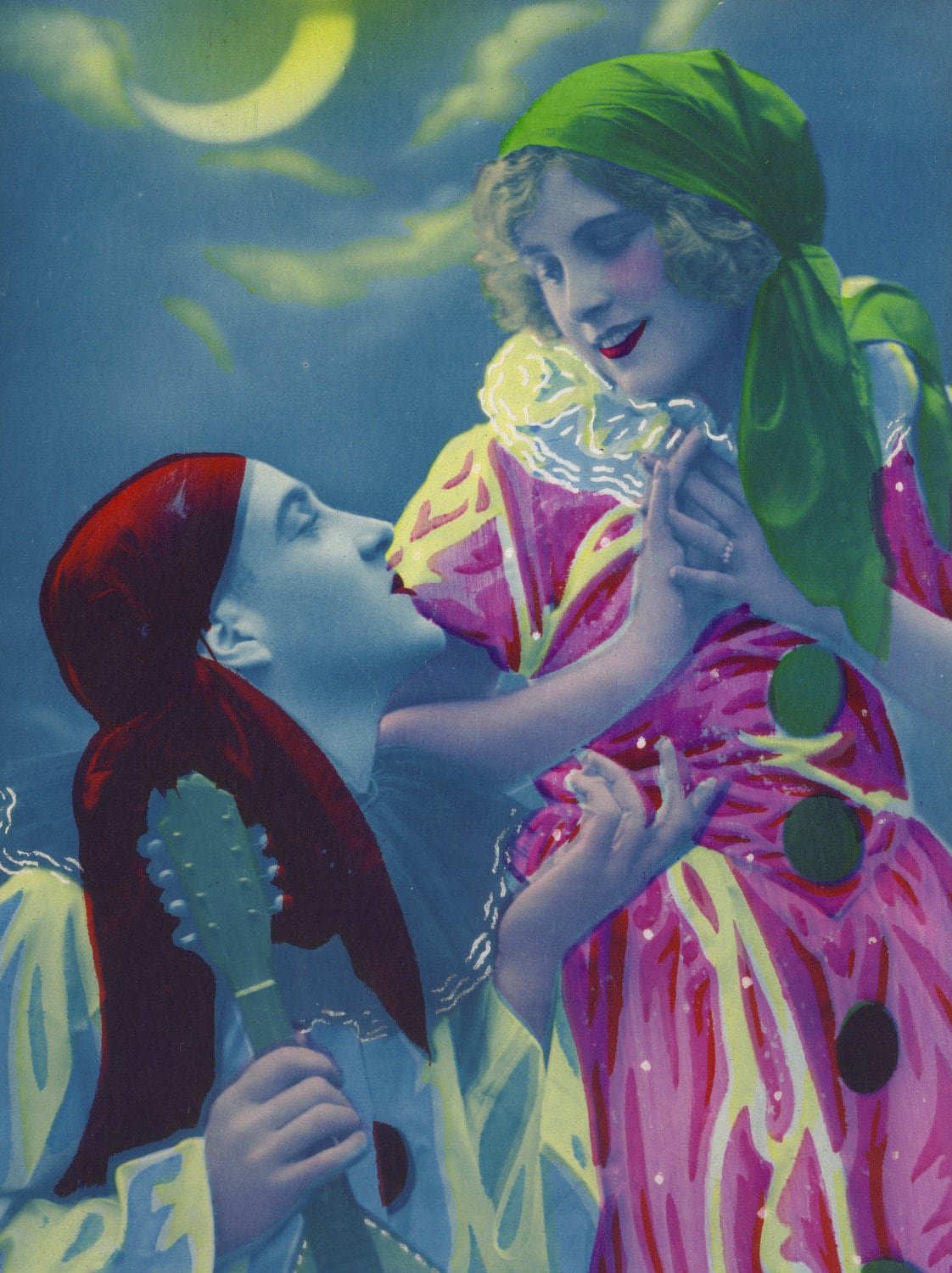
The first of our featured cards is a beautifully and brightly-colored hand-tinted card published by Bleuet, probably in the 1920s, showing Pierrot wooing Colombinette under the moon, while holding a mandolin in one hand. We love the wonderful scarves that grace each of the lovers' heads.
Although not one of our featured cards, we also have in our shop a third from the same series. In this card, Pierrot is angry with Colombinette, possibly having just learned of her association with Harlequin, and is rolling up his sleeve while threatening her with a large stick.
The first of our featured cards is a beautifully and brightly-colored hand-tinted card published by Bleuet, probably in the 1920s, showing Pierrot wooing Colombinette under the moon, while holding a mandolin in one hand. We love the wonderful scarves that grace each of the lovers' heads.
![]() |
| AVAILABLE FOR PURCHASE Pierrot and Colombinette by Bleuet circa 1920s Hand-Tinted |
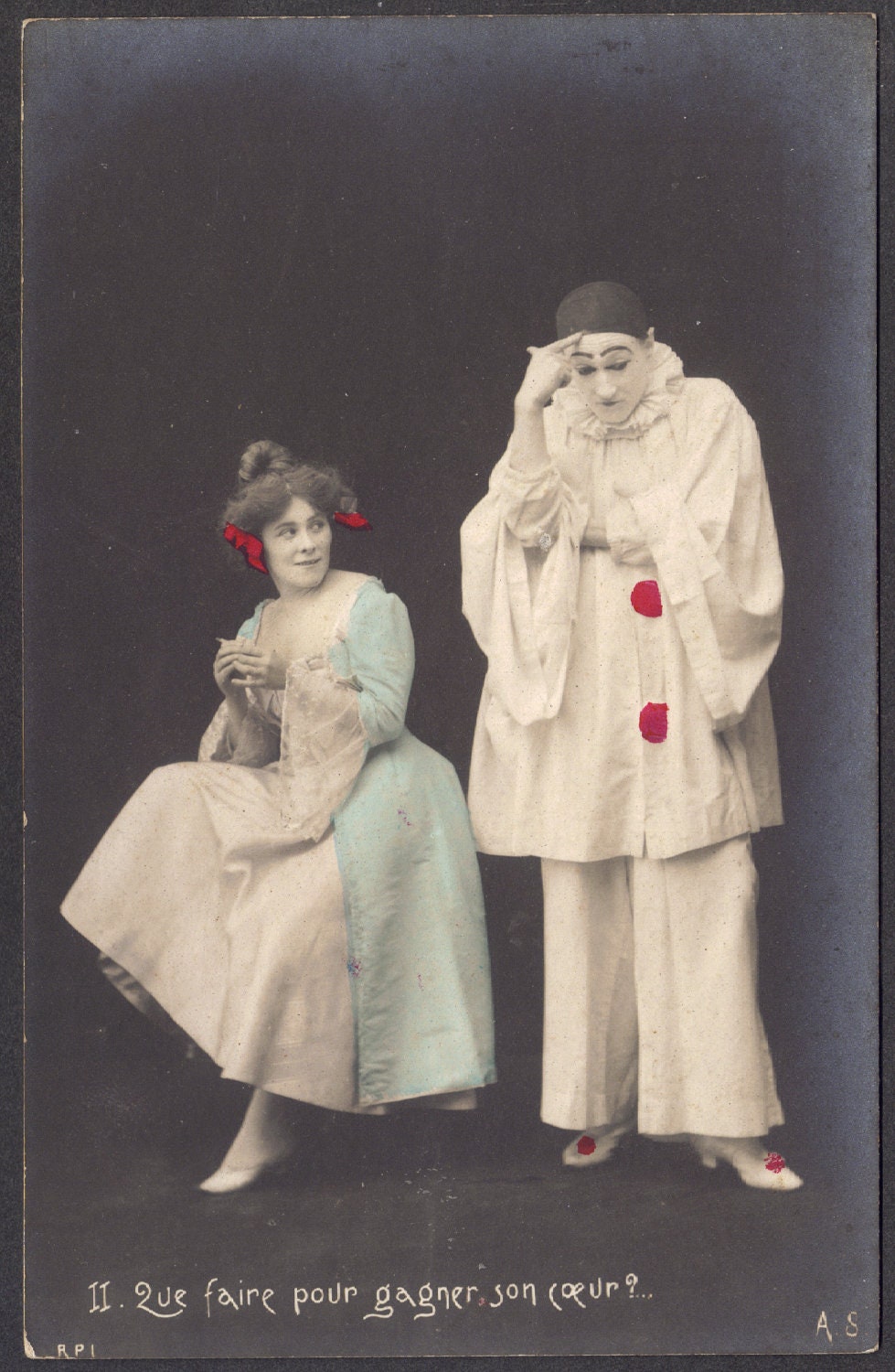
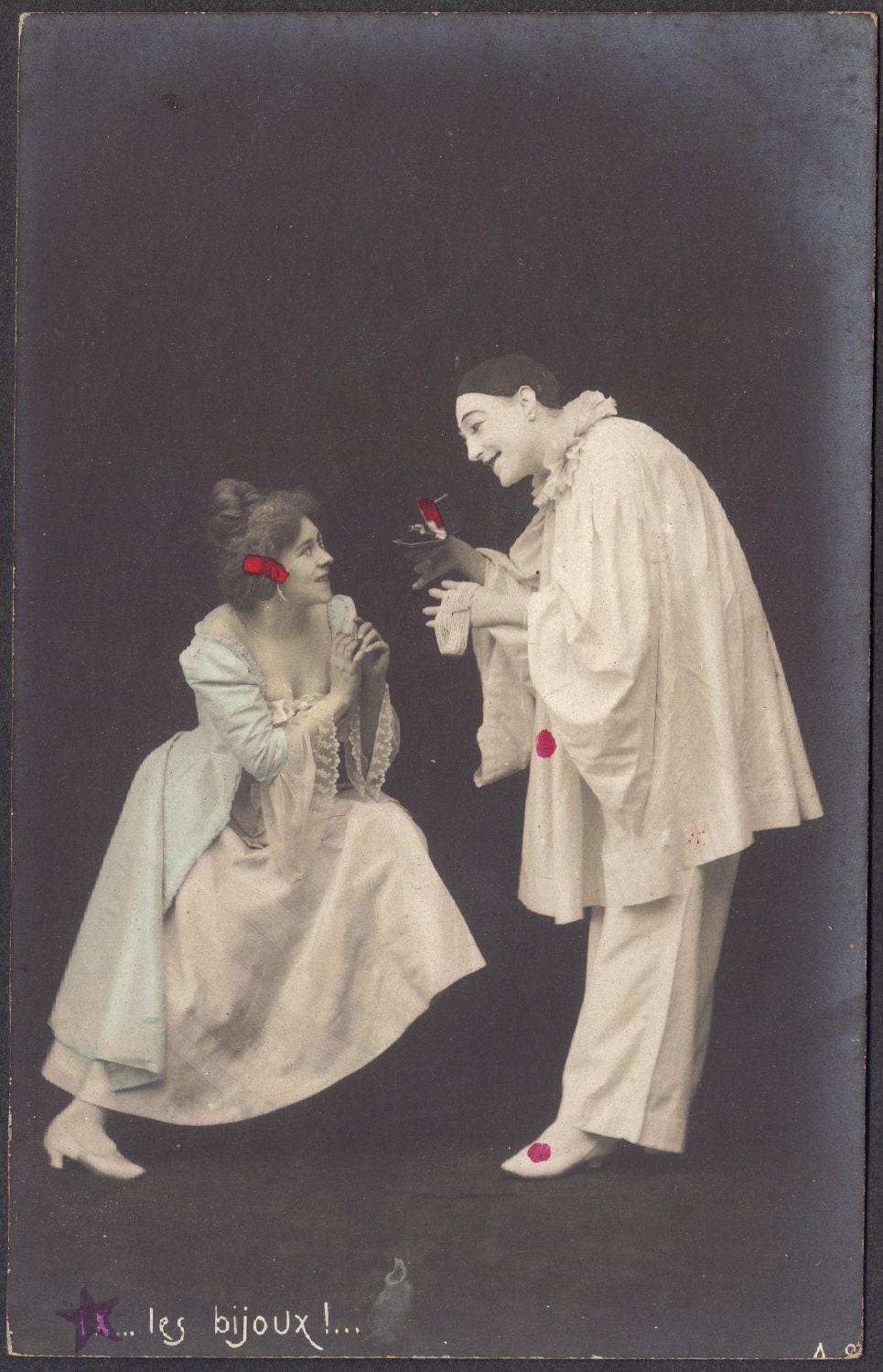
Two of our featured cards were issued as part of a series published between 1895 and1905. In these, the coloration is subtle, with the exception of the bright red used to highlight pompoms and ribbons, and we watch the relationship between the two develop, as Pierrot is first perplexed, then discovers that he can woo his love with tickets to "les bijoux!...."
|
|
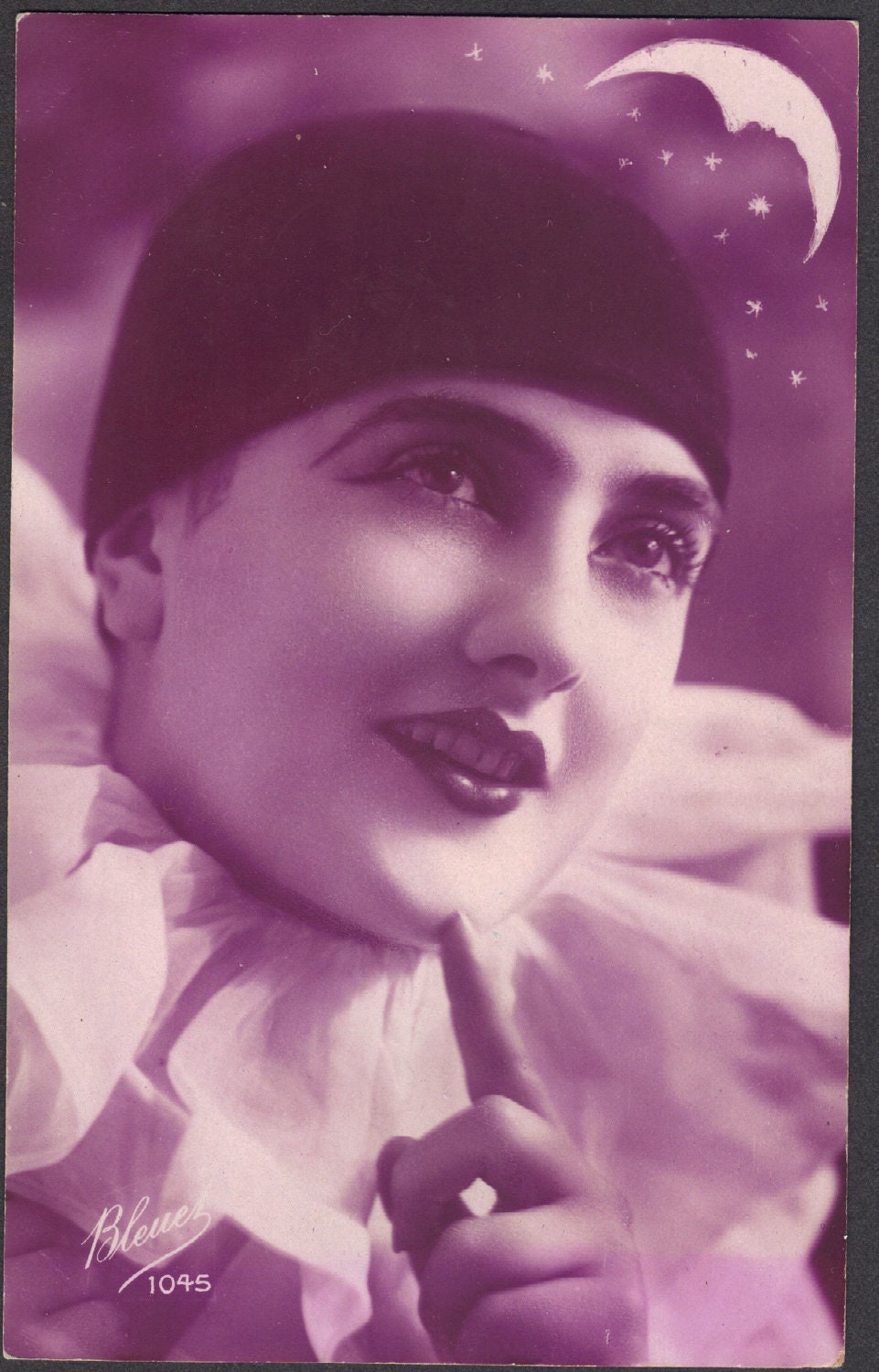
The final card featured is a violet-toned portrait shot by Bluet, of a woman dressed as Pierrot (or, possibly, Pierrette). The woman's expression is quite wonderful, a beautiful, magical expression!
![]() |
| AVAILABLE FOR PURCHASE Woman in Pierrot Costume circa 1920s |
This is a lovely card, with a charming note on the back in violet ink, which, when translated, reads roughly, "Souvenir of Carnival 1928, for my dear little Cherise. Hugs from your cousin, Angela."
What wonderful fun! We have seen photographs of hundreds of people parading through village streets on the occasion of some festival or other, all of them dressed up as Pierrot! Time machine please! Doctor, where are you? Bring the Tardis immediately, please!
P.S. Keep an eye on this blog for our Cyber Monday coupon code, scheduled for this afternoon. Thanks!
Monday, September 17, 2012
Pierrot's Origins Can Be Found in the Commedia dell'Arte
Pierrot's origins can be found in the Commedia dell'Arte, a 16th century theatrical movement of traveling players who performed (often with favorite "stock" characters) on temporary open air stages. The tragic opera Pagliacci (trans. players or clowns), by Ruggero Leoncavallo, premiered at the Teatro Dal Verme in Milan on May 21, 1892. It is a tale of travelling players and features a romantic triangle with a Pierrot-like clown, who betrayed by his wife and a Harlequin-like fellow performer resorts to murder.
For a real treat, check out this performance of what is probably the most well known aria in Pagliacci, "Vesti la giubba," sung by Luciano Pavarotti, one of the great tenors of our time.
It was probably in the late 17th century that an Italian troupe known as Comedie-Italienne, while performing in Paris, first introduced Pierrot to the French public.
Pierrot is often depicted as the sad clown, the ever trusting innocent, the sweet-natured soul, whose lover Colombine (sometimes called Colombinette or Colombina) betrays him with the wily Harlequin. But, with the popularity of pantomime, he often stood alone on the stage trying oh, so very hard to express his experience of life, without the words to do so.
By the late 1880s, with the dawning of la Belle Époque, Pierrot was to meet a new friend, Pierrette, who would vie with Colombine for his affections.
Pierrot's image was a favorite of Jules Chéret, possibly the most successful commercial artist of the period. In the Fine Arts, the Impressionists, and Post-Impressionists were inspired by Pierrot.
It is not at all unusual to find wonderful photos and RPPCs (Real Photo Post Cards) of couples at Carnival, or fêtes, dressed as Pierrot and his ensemble. Sometimes, even whole families get into the act.
Publishers of French postcards made successful use of Pierrot to create romantic, silly, and sometimes mysterious images to please the picture postcard buying public.
We are so very fond of Pierrot, here at Red Poulaine, that he shares a section in our shop with another favorite of ours, Mignon. But, fair warning, when you find him in stock, if you are a collector, better grab him quickly, because he is a very popular character and, like the traveling players from whom he is descended, seldom stays long in one place.
| Enrico Caruso, 1873-1921, in "Pagliacci,"c. 1908. Copyright by A. Dupont, N.Y. [Public domain], via Wikimedia Commons |
It was probably in the late 17th century that an Italian troupe known as Comedie-Italienne, while performing in Paris, first introduced Pierrot to the French public.
Pierrot is often depicted as the sad clown, the ever trusting innocent, the sweet-natured soul, whose lover Colombine (sometimes called Colombinette or Colombina) betrays him with the wily Harlequin. But, with the popularity of pantomime, he often stood alone on the stage trying oh, so very hard to express his experience of life, without the words to do so.
![]() |
| SOLD Pierrot and Colombinette asleep on a crescent moon |
![]() |
| SOLD Pierrot wooing Colombine |
![]() |
| Paul Cézanne: Pierrot and Harlequin (1888, Oil on canvas) [Public domain], via Wikimedia Commons |
![]() |
| SOLD Pierrot, La Colère |
By the late 1880s, with the dawning of la Belle Époque, Pierrot was to meet a new friend, Pierrette, who would vie with Colombine for his affections.
![]() |
| SOLD Lily Damita, in a Pierrette-like costume |
![]() |
| Jules Chéret, 3rd panel of la Pantomime [Public domain], via Wikimedia Commons |
| Pablo Picasso, Arlequin a cheval, 1905, [Fair Use] via WikiPaintings |
![]() |
| SOLD Pierrot plays the mandolin for his Colombine |
![]() |
| SOLD Pierrot and family at a fête |
![]() |
| SOLD "Croissants de Lune" |
![]() |
| SOLD Pierrot hugging Colombine |
Subscribe to:
Posts (Atom)


.jpg)