Showing posts with label Belle Époque. Show all posts

Tuesday, December 10, 2013

Unidentified Artiste Inspires Photographers and Painters for Over 100 Years

Like too many of our favorite images, this card has come and gone in a matter of a few hours, but she and her fabulous costume can have a place on our blog forever. We don't know the model's name, but we love this image!

SOLD Unidentified Artiste in Costume Orientale, c. 1910

The same model appears on another postcard below, image by Jean Agelou.

Grace La Rock, who, with Helmut Schmidt, operates Boudoir Cards, a beautiful site and a valuable source of information on postcards of La Belle Époque, as well as French and ethnic erotic postcards, has done a watercolor painting inspired by Agélou's image of our unidentified model. Helmut and Grace are customers of ours and, on hearing about this painting, we asked if we might share it on our blog. So many of our customers are involved in art of one sort or another and draw inspiration from these fine old images, and we are so very pleased when we can share examples of this with our readers. Below, is the original postcard image and the painting Grace created from it. Just wonderful.

Photograph by Jean Agélou of Unidentified Artiste Lounging in Lingerie and Wonderful Hat
Original Painting by Grace La Rock

Here is what Grace had to say about this painting:
Capturing me with her hypnotic eyes, and voluptuous curves, I find this vintage doll rather intriguing. She was my first water color rendering after almost 20 years. I prefer pale vintage rose for color, but chose to make her into more of a cupcake like she is. I plan to paint other poses of her in the future with more muted tones. This photograph was originally made by Jean Agélou, and shows that nudity is not necessary to become erotic. If only I had her hat and vintage lingerie.

Monday, June 24, 2013

Woodland Nymph Teasing Butterfly, circa 1910s


The "Naturist" movement was pervasive during the late 19th and early 20th centuries and, like the common appearance of classical/fantasy romantic imagery on the picture postcard of the time, suggests to us, a turning away of the public imagination from the onslaught of the industrial age, to say nothing of the dark clouds of war, which were gathering over Europe at just about the time we believe this card was published. 

If the term photo-realism is commonly used to describe a particular quality of some paintings, how about we coin the term painterly-fantasticallism for application to this photographic image?

AVAILABLE FOR PURCHASE Woodland Nymph Teasing Butterfly, Circa 1910s

This wonderful German nude was published by die Neue Photographische Gesellschaft, or NPG. Based in Berlin, NPG was one of the largest international producers of the picture postcard during that period. 

Reverse of Card

Clear Example of NBC Logo
Point of interest: In the "stamp box" on the back side of this card is the somewhat faded logo of the "NBC," Neue Bromsilber Convention, or the "New Silver-bromide Convention." Whenever this logo is found on a card, we can date its production to sometime after August of 1909, when the NBC was initially convened.

The NBC was, for lack of a better term, a cartel (one of many, actually), established by a large number of German publishers of silver-bromide print photo postcards, whose intent was to control prices and maintain a competitive edge. This might be called "price fixing" today, and perhaps a blatant violation of today's trade laws, but was quite common during this period. An indication of the strength of this cartel within the industry is the great frequency with which we run into cards bearing this imprint.
 

Also, just for fun, it's worth noting the design of the logo itself, a blazing sun within an equilateral triangle, which was printed in a variety of colors. Like the classic eye in the triangle, this symbol is often closely associated with occult, or "secret" societies. Ah, nothing like a little conspiracy with our morning coffee. :)

In dating this card, our guess is sometime in the early 1910s. The NBC, as we wrote above, dates from 1909, and apparently was still in operation by the early 1930s, so we can only rely on our own personal experience to fix an approximate date of issue. As always, any corrections we receive from readers are not just appreciated, but sincerely requested! We often draw our information from a huge swirling mass of sources called by our sons, "teh interwebs." These sources often offer us contradictory information so any help in the navigation of these storm-tossed depths is always most welcome. 


The absolutely wonderful site from which we drew all of our information on the NBC cartel, The Postcard Album, also lists an NPG logo for the publisher. The NPG logo they display is 
from the 1920s and very similar to the one on this card, but the NPG logo on the front of our card differs in certain respects, and without specific evidence to the contrary we have to trust our eyes. This image looks pre-1920s to us.

Friday, June 21, 2013

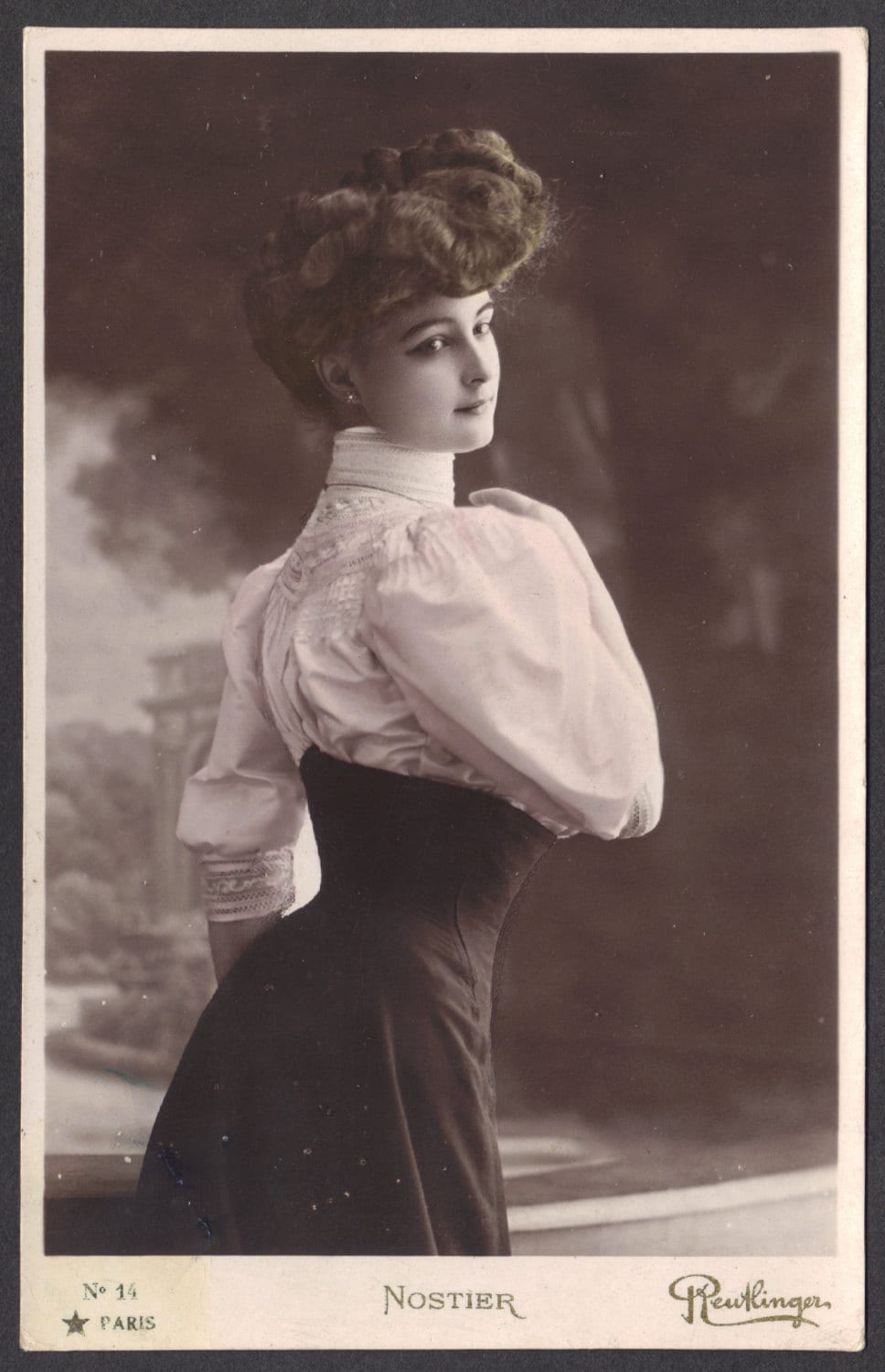
Mlle. Nostier in Swan-Bill Corset by Leopold Reutlinger, circa 1905

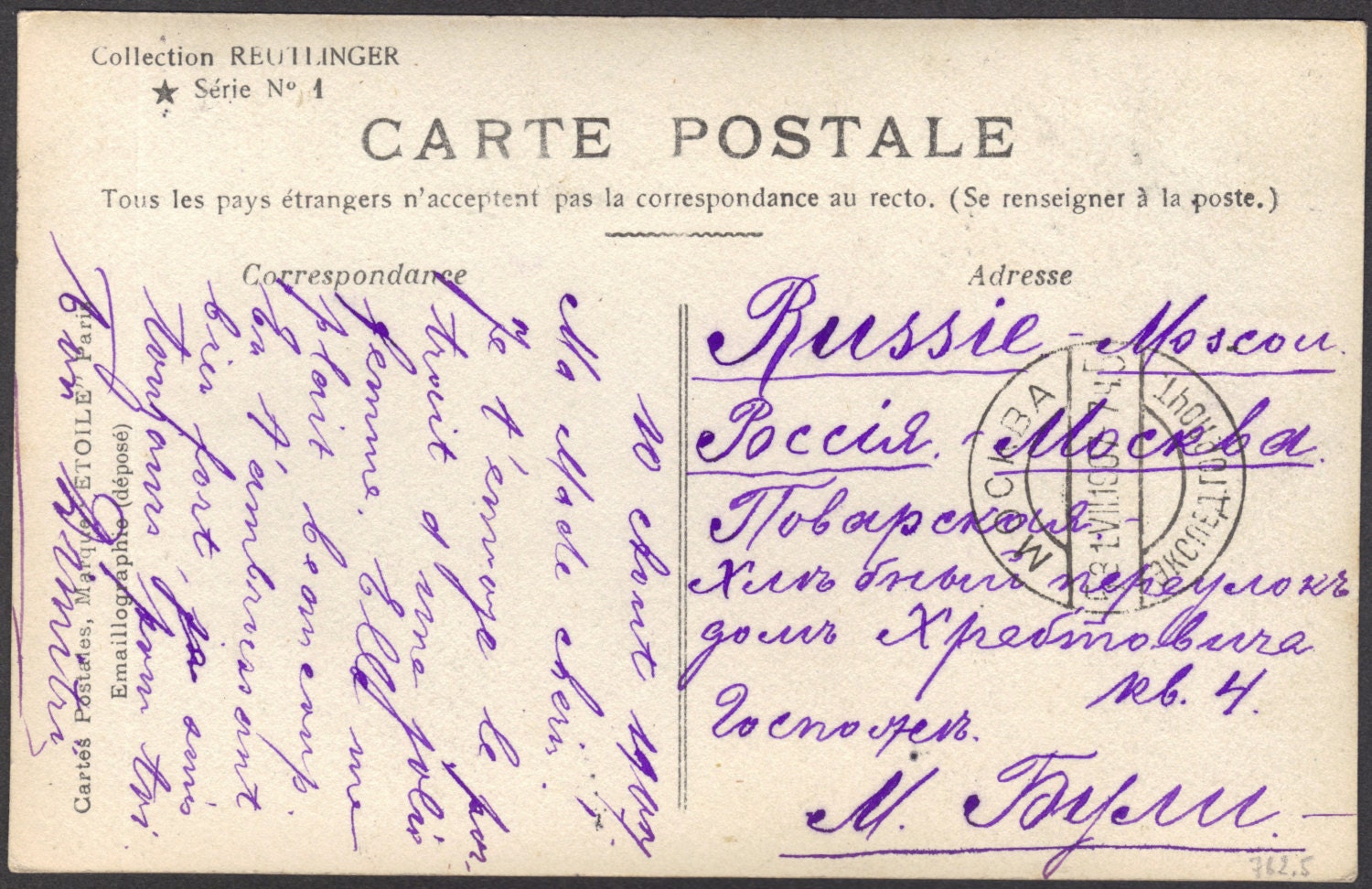
This lovely postcard, with a message in the ubiquitous violet ink of the period, and presumably posted to Moscow in 1907 (stamp missing), offers an image of a Mlle. Nostier (the only image of her we have ever seen), that was taken by Leopold Reutlinger and published by Monsieur G. Piprot of Paris. This image was also reproduced at about the same time on a Melia cigarette card.


AVAILABLE FOR PURCHASE French Actress Mlle. Nostier, in Swan-Bill Corset and Mutton Chop Sleeves, circa 1905


At the turn of 20th century, it was a common practice to use ink of that most romantic of colors, violet, when writing letters or postcard messages, especially when writing to a lover. This postcard has such a message, written in a particularly lovely hand. The message appears to have been inscribed by a Russian, Dimitri, in French, a language used commonly by the Russian aristocracy, but less commonly by Russian postal carriers, to his sweetheart back in Moscow.

Reverse of Mlle. Nostier in Swan-Bill Corset, circa 1905 postcard by Leopole Reutlinger


In the image on the front of the postcard, Mlle. Nostier is presenting a rather fine example of a "Gibson Girl," with her lovely upswept hair, mutton chop sleeves and the narrow waist and S-curve posture created by the "swan-bill" corset which was often worn to achieve the classic "Gibson" look.
 

The Gibson Girl image was so called after the extremely popular, and influential, illustrations produced during the late 19th/early 20th century by American artist Charles Dana Gibson, and used with great effect by other popular illustrators such as Howard Chandler Christy, and Harrison Fisher. The look remained popular into the WWI era, when it was gradually displaced by the new styles popularized by the "flapper." Quite a radical shift, we think, but of course ours is an over simplification of that transition.
 

Following, is a quote from Wikipedia's article History of Corsets, describing the swan bill or straight-front corset. Thanks Wikipedia!
The straight-front corset, also known as the swan-bill corset, the S-bend corset or the health corset, was worn from circa 1900 to the early 1910s. Its name is derived from the very rigid, straight busk inserted in the center front of the corset. This corset forced the torso forward and made the hips jut out in back.
The straight-front corset was popularized by Inez Gaches-Sarraute, a corsetiere with a degree in medicine. It was intended to be less injurious to wearers' health than other corsets in that it exerted less pressure on the stomach area. However, any benefits to the stomach were more than counterbalanced by injury caused to the back due to the unnatural posture that it forced upon its wearer. At this time, the bust lowered and corsets provided much less support for the breasts.

So, given that this card was posted in 1907, and the swan-bill corset went out of fashion only a few years later, we thought that we might "stretch" things just a bit and say that this was its...

Swan Song! :)